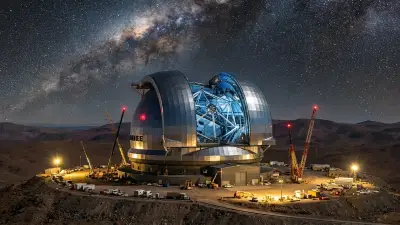
In the Atacama Desert of Chile, on the summit of Cerro Armazones at an altitude of 3,046 meters, the largest optical telescope the Earth has ever seen is taking shape. The Extremely Large Telescope (ELT) by the European Southern Observatory (ESO) promises to fundamentally change our understanding of the universe.
📖 Read more: Dark Energy: The Force That's Tearing the Universe Apart
🔭 What Is the ELT
The ELT is the flagship project of ESO (European Southern Observatory), an intergovernmental organization of 16 member states that operates some of the world's most advanced telescopes. With a primary mirror 39.3 meters in diameter, it will be by far the largest optical/near-infrared telescope on Earth. For comparison, today's largest telescopes have mirrors of 10 meters (Keck twins) and 10.4 meters (Gran Telescopio Canarias).
🪞 The Mirror
The ELT's primary mirror is not a single piece of glass — that would be impossible to manufacture and transport. Instead, it consists of 798 hexagonal segments, each 1.4 meters in diameter and just 50 millimeters thick. Each segment is polished to nanometer precision — if the mirror were the size of Europe, the largest bump would be just a few centimeters.
The key to its extraordinary performance is the adaptive optics system. Five lasers create artificial “guide stars” in the atmosphere, while deformable mirrors correct atmospheric turbulence in real time, thousands of times per second.
🎵 HARMONI
Integral field unit (IFU) spectrograph — the ELT's primary instrument for high-resolution spectroscopy in optical and near-infrared wavelengths.
📷 MICADO
High-resolution camera with adaptive optics — will capture the most detailed images ever taken by a ground-based telescope.
🌡️ METIS
Mid-infrared instrument for imaging and spectroscopy of exoplanets — will be able to photograph them directly.
✨ Adaptive Optics
5 laser guide stars, deformable mirrors, and real-time algorithms correct atmospheric blurring thousands of times per second.
📖 Read more: Dark Matter & Dark Energy: What Holds the Galaxy Together?
🌌 What It Will See
The ELT isn't just a bigger telescope — it's a tool that will answer fundamental questions:
- Exoplanet atmospheres: It will analyze the chemical composition of atmospheres of exoplanets in habitable zones, searching for biomarkers like oxygen and methane.
- The first stars: It will “see” back in time, to the first stars that formed after the Big Bang.
- Dark energy: It will measure the acceleration of the universe's expansion with unprecedented accuracy.
- Supermassive black holes: It will study the environment around supermassive black holes at the centers of galaxies.
🏗️ Construction
Construction began in 2017 with the leveling of the Cerro Armazones summit. The telescope dome will stand 80 meters tall with a diameter of 88 meters — the size of a football pitch. First light is expected in 2028, after delays from the original 2025 timeline.
The total cost is estimated at approximately €1.3 billion, making it the most expensive ground-based telescope ever built. Engineers and opticians in 12 countries are manufacturing components in parallel with the building's construction.
How much sharper than Hubble? The ELT will have 16 times higher resolution than the Hubble Space Telescope. It will collect 100 million times more light than the human eye. It could spot a coin from 100 kilometers away.
🔬 The Competition
The ELT is not the only “super telescope” under construction. Two other major projects are competing in the same arena:
- TMT (Thirty Meter Telescope): 30-meter mirror, originally planned for Hawaii (environmental and cultural protests led to an alternative site in La Palma). Collaboration between the USA, Canada, Japan, China, and India.
- GMT (Giant Magellan Telescope): Seven 8.4-meter mirrors forming an effective diameter of 24.5 meters. Also being built in Chile.
Of the three, the ELT is by far the largest and most advanced project — and the closest to completion. When it opens its dome in 2028, a new era in astronomy will begin — one that may finally reveal whether we are alone in the universe.