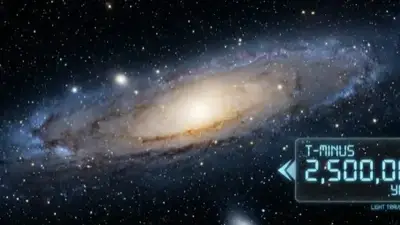
In 1950, during a lunch at Los Alamos National Laboratory, physicist Enrico Fermi made a deceptively simple observation that has haunted scientists ever since: "Where is everybody?" If the universe contains billions of stars with planets, and life arose here on Earth within a few hundred million years of conditions becoming favorable, shouldn't life — and intelligent, communicating civilizations — be abundant? And yet we have received no confirmed signal, seen no megastructure, detected no unambiguous sign of extraterrestrial intelligence. This contradiction is the Fermi Paradox.
The Fermi Paradox: Given the vast age and scale of the universe, the probability of other civilizations existing is extremely high. Yet we have received no signals, seen no detectable technology, observed no trace. This contradiction — between the expected ubiquity of life and the observed silence — is the Fermi Paradox.
The Drake Equation: Quantifying the Unknown
In 1961, astronomer Frank Drake proposed an equation to estimate the number N of communicating civilizations in our galaxy:
N = R* × fₚ × nₑ × fₗ × fᵢ × f × L
Where: R* = rate of star formation, fₚ = fraction with planets, nₑ = habitable planets per star, fₗ = fraction where life emerges, fᵢ = fraction where intelligence emerges, f = fraction that broadcasts signals, L = lifespan of communicating civilization.
The optimistic inputs: The Milky Way contains around 100 billion stars, and Kepler mission data suggests nearly every star hosts at least one planet, with many in the habitable zone. If even a tiny fraction develops intelligence, thousands or millions of civilizations should exist. Yet N = 0 observed signals. This is the paradox in numbers.
Galactic Timescales: The Age Problem
One of the most striking aspects of the Fermi Paradox involves the age of the galaxy. The Milky Way is approximately 13.5 billion years old. If a civilization arose just 1 billion years before ours, what technology could it have developed? Even at a conservative 1% the speed of light, a civilization with spacefaring capability could colonize every star system in the entire Milky Way in under 10 million years — a cosmic blink of an eye compared to the galaxy's age.
Galactic Civilization Timeline
Proposed Solutions: From Hopeful to Terrifying
1. The Rare Earth Hypothesis
Astronomers Peter Ward and Joe Brownlee proposed in 2000 that Earth is extraordinarily rare. The right distance from the right type of star, the presence of the Moon (stabilizing Earth's axial tilt), Jupiter acting as a comet shield, the position in the galactic habitable zone — all these coincidences together may be vanishingly rare. We may be alone not because life is rare, but because complex multicellular life requires an exceptional set of conditions.
2. The Great Filter
Economist Robin Hanson proposed in 1998 that there exists a “Great Filter” — an extremely difficult evolutionary or technological step that almost no civilization passes. The critical question: Is the Filter behind us or ahead of us?
- Optimistic scenario: The Filter is behind us (e.g., the emergence of the first eukaryotic cell was extraordinarily improbable). We've already passed the hardest step.
- Terrifying scenario: The Filter lies ahead — every sufficiently advanced civilization destroys itself (through AI, bioweapons, climate collapse). If we find microbial life on Mars, that would be bad news — it means the Filter is still ahead of us.
"If we discovered that life had arisen independently on Mars... it would be by far the most terrifying discovery in human history, suggesting that the Great Filter lies ahead of us."
— Nick Bostrom, philosopher, University of Oxford3. The Dark Forest Hypothesis
Perhaps civilizations exist but deliberately hide. The “Dark Forest” hypothesis (from Liu Cixin's novel of the same name) proposes that every civilization conceals itself because discovery means annihilation: in a universe of finite resources, any civilization that reveals itself becomes a target. Under this scenario, broadcasting our existence via the 1974 Arecibo message was recklessly dangerous.
SETI and the Search for Signals
The SETI Institute has been searching for electromagnetic signals from extraterrestrial sources since 1984. The most famous candidate remains the "Wow!" signal — detected by Jerry Ehman on August 15, 1977, at Ohio State University's Big Ear telescope. It lasted 72 seconds, matched all predicted characteristics of an alien transmission, and was never detected again.
Breakthrough Listen (2015–present), funded by $100 million from Yuri Milner, uses the world's largest radio telescopes to scan millions of star systems. As of 2024: zero confirmed extraterrestrial signals.
Tabby's Star (KIC 8462852): Discovered in 2015 by Tabetha Boyajian — a star showing bizarre dimming of up to 22% over days and weeks. No purely natural explanation has been perfectly satisfying. A “Dyson Sphere” was briefly considered seriously. Current best explanation: circumstellar dust. But the case remains a reminder that our search tools are still primitive.
The Fermi Paradox isn't just a scientific puzzle. It's a philosophical question about the nature of life, intelligence, and survival. Its answer — positive or negative — will permanently alter how we understand our place in the cosmos.
Sources: SETI Institute (seti.org), NASA Exoplanet Archive, Breakthrough Listen Initiative (breakthroughinitiatives.org), Nick Bostrom “Where Are They?” (MIT Technology Review, 2008), Robin Hanson “The Great Filter — Are We Almost Past It?” (gwu.edu, 1998), Peter Ward & Joe Brownlee “Rare Earth” (Copernicus Books, 2000)
Related Articles
Exoplanets with Conditions for Life
Which worlds beyond our solar system could harbor life?
Dark Matter and Dark Energy
95% of the universe is invisible. What do we know?
Milky Way & Andromeda Collision
In 4.5 billion years, two galaxies will collide on a cosmic scale.
Hawking Radiation
Do black holes actually emit energy and slowly evaporate?
Betelgeuse: When Will It Explode?
One of the brightest stars in the sky is preparing for a supernova.
Is Gravity a Force or Spacetime Curvature?
From Newton to Einstein — gravity bends space and time themselves.