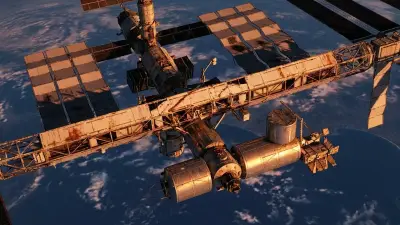
The International Space Station (ISS) — the largest structure humanity has ever built in space — is approaching the end of its operational life. After more than 25 years of continuous habitation, 3,000+ experiments, and 270+ astronauts from 21 countries, the ISS is scheduled for a controlled deorbit around 2030. What does this mean for the future of space exploration?
📖 Read more: Hubble Space Telescope: 35 Years of Cosmic Discovery
🏗️ 25+ Years in Orbit
Construction of the ISS began in 1998 with the launch of the Zarya module and was essentially completed in 2011. Since November 2000, the station has continuously hosted humans — a record of uninterrupted human presence in space exceeding 25 years. The size of a football field (109 meters) and weighing 420+ tons, the ISS travels at 28,000 km/h, completing one full orbit of Earth every 90 minutes.
Originally designed to operate until 2015, its lifespan was extended to 2020, then 2024, and finally to 2030. The total program cost exceeds $150 billion, making it the most expensive structure ever built.
📖 Read more: voyager-golden-record-earth-music-space
🔬 Scientific Legacy
The ISS has been a unique microgravity laboratory. Over 3,000 scientific experiments have been conducted in fields such as:
- Medicine: Studies on bone loss, muscle atrophy, and the effects of radiation on the human body.
- Pharmacology: Growing protein crystals in microgravity for better drug design.
- Materials: Testing new alloys and materials that cannot be created on Earth.
- Agriculture: Growing plants in space, including the first consumption of fresh lettuce.
🏆 Key ISS Achievements: First continuous human presence in space (25+ years), 270+ astronauts from 21 countries, 3,000+ experiments, platform for private space missions, inspiration for generations of scientists and engineers.
⚙️ Aging and Problems
After 25+ years in the hostile environment of space, the ISS faces serious aging issues. Cracks have been detected in the Russian Zvezda module, with small air leaks requiring constant monitoring. Ammonia leaks in cooling systems, worn solar panels, and outdated electronics are daily challenges.
📖 Read more: Cosmic Radiation: The Invisible Threat to Astronauts
Station maintenance requires an ever-increasing amount of crew time, reducing time available for scientific research. Nevertheless, NASA considers the ISS safe to operate until 2030.
🔥 The Fall: Deorbit in 2030
NASA has contracted SpaceX to build a specialized deorbit vehicle — based on the Dragon spacecraft — under a contract worth $843 million. The vehicle will dock with the ISS and push it into a controlled reentry trajectory.
The target: a controlled descent over Point Nemo — the most remote point in the ocean, in the South Pacific, far from any inhabited area. This location has been used as a “spacecraft cemetery” for decades, housing the remains of hundreds of satellites and stations, including Russia's Mir.
📖 Read more: Europa Clipper: NASA's Mission to Jupiter's Ocean Moon
🚀 What Comes Next
NASA doesn't plan to be without a station in low Earth orbit. Three commercial stations are being developed as successors:
- Axiom Station: Modules that will initially attach to the ISS before separating as an independent station.
- Orbital Reef (Blue Origin): A commercial station developed in partnership with Sierra Space.
- Haven-1 (Vast): The first commercial station planned for launch, smaller in size but with modern design.
The transition from government to commercial stations marks a new era where NASA will purchase services rather than build and operate infrastructure alone.
🌟 The Legacy
The ISS was more than just a station — it was a symbol. A symbol that former Cold War rivals can cooperate, that humanity can live and work in space, and that the knowledge we gain there can improve life on Earth. Its legacy will live on through the commercial stations that succeed it, in the technologies that will take us to the Moon and Mars, and in the millions of children who looked up at the sky and dreamed of space.