⭐ The Largest Known Stars
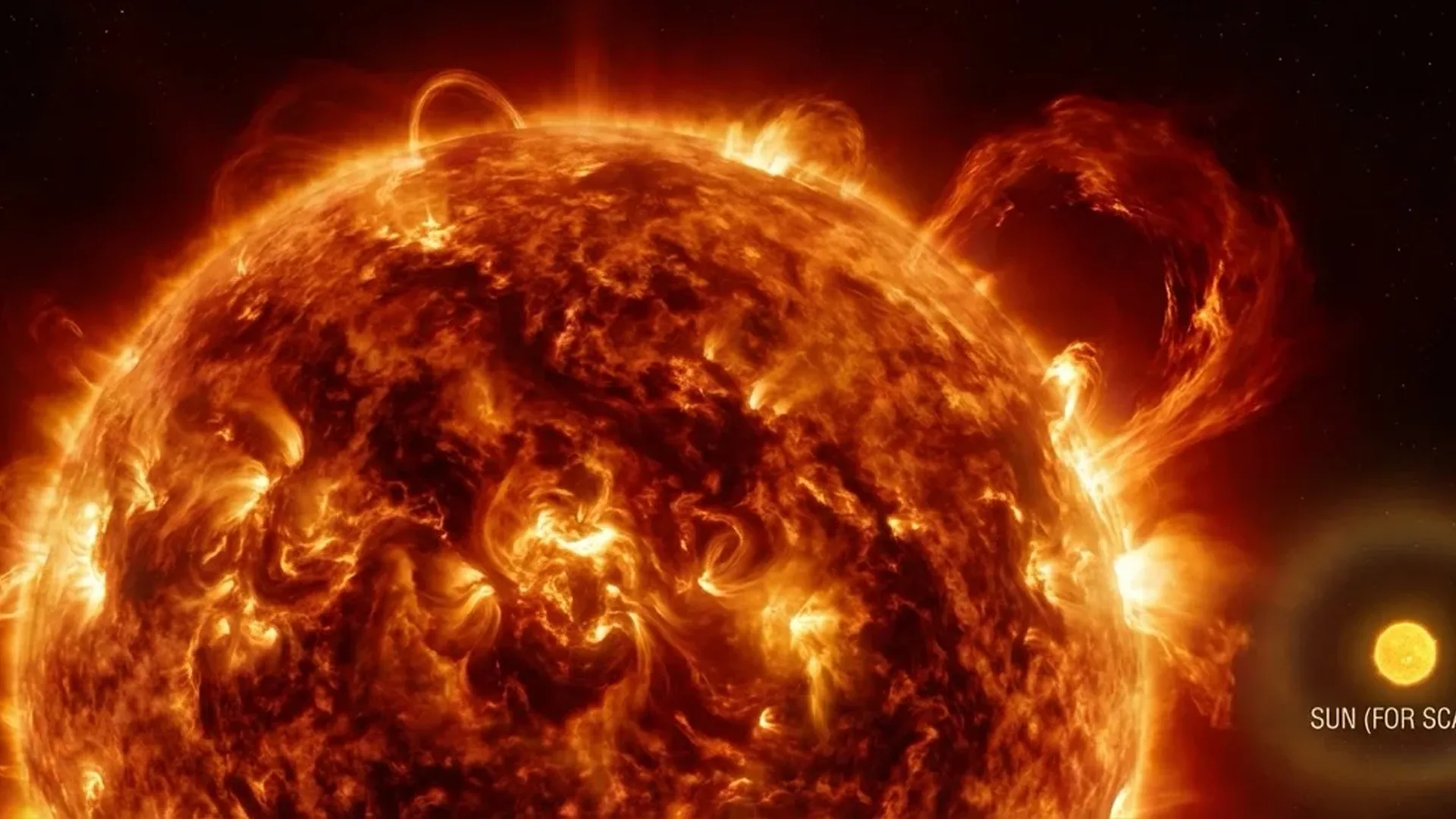
Among the countless stars in our galaxy, a few stand out as true cosmic behemoths. VY Canis Majoris, a red hypergiant located approximately 3,900 light-years from Earth in the constellation Canis Major, is one of the largest known stars in the universe. With a radius estimated at 1,420 times that of our Sun, if placed at the center of our solar system, its surface would extend past the orbit of Jupiter. But VY Canis Majoris is not alone — other hypergiants like UY Scuti, Stephenson 2-18, and Betelgeuse also rank among the most massive stellar objects ever observed.
📖 Read more: Neutron Stars: Why Are They Called Zombie Stars?
These stars are in the final stages of their lives, burning through their nuclear fuel at an extraordinary rate. Unlike our Sun, which will burn steadily for billions more years, hypergiants may have only hundreds of thousands of years left before they meet a spectacular end. Astronomers monitor these stars closely for signs of imminent collapse.
🔭 What Makes a Star “About to Explode”
When astronomers say a star is “about to explode,” they mean on cosmic timescales — this could mean anywhere from tomorrow to 100,000 years from now. The signs include dramatic brightness fluctuations, massive ejections of stellar material, and changes in the star's spectral signature. VY Canis Majoris has been observed ejecting huge knots and arcs of gas, losing mass at a rate thousands of times greater than the Sun's solar wind.
The Hubble Space Telescope has captured detailed images of the material surrounding VY Canis Majoris, revealing a complex nebula of ejected gas extending billions of kilometers into space. These ejections are believed to be precursors to a supernova or hypernova event. When the star's iron core finally collapses, the resulting explosion will briefly outshine entire galaxies.
🌟 Betelgeuse: The Most Famous Candidate
While VY Canis Majoris is larger, Betelgeuse in the constellation Orion is the most watched potential supernova candidate because of its relative proximity — only about 700 light-years from Earth. In late 2019 and early 2020, Betelgeuse experienced a dramatic dimming event known as the "Great Dimming," which triggered widespread speculation that the star was about to explode. Scientists later determined that a massive cloud of dust, ejected by the star itself, had temporarily blocked its light.
Betelgeuse has a radius roughly 900 times that of the Sun and varies in brightness on cycles of about 400 days. When it finally goes supernova, it will be visible in daylight for weeks and could appear as bright as the full moon at night. At 700 light-years distance, it poses no danger to Earth — we would need to be within about 50 light-years for a supernova to cause significant harm.
💥 What Happens During a Supernova
A core-collapse supernova occurs when a massive star (at least <8 solar masses) runs out of fuel to fuse in its core. Without the outward pressure from nuclear fusion, gravity wins, and the core collapses in milliseconds. The outer layers rebound off the incredibly dense core, creating a shockwave that tears the star apart. The explosion releases more energy in seconds than our Sun will produce in its entire 10-billion-year lifetime.
For the very largest stars like VY Canis Majoris, the death may be even more dramatic. Instead of a standard supernova, some hypergiants may undergo a hypernova — producing gamma-ray bursts and leaving behind a black hole rather than a neutron star. The elements forged and scattered by these explosions — iron, gold, uranium — become the building blocks for new stars, planets, and eventually life. As astronomer Carl Sagan famously said, “We are made of star stuff.”
🛠️ How Scientists Monitor These Stars
Modern observatories track potential supernova candidates using multiple wavelengths of light. The James Webb Space Telescope (JWST) can observe these stars in infrared, piercing through dust clouds to study their surfaces and ejected material. Ground-based telescopes like the Very Large Telescope (VLT) in Chile provide high-resolution spectroscopy, while radio telescopes detect the molecular gas being expelled.
NASA's planned Habitable Worlds Observatory and ESO's Extremely Large Telescope (ELT), expected to see first light in 2028, will provide unprecedented detail on stellar evolution. The International Astronomical Union maintains a watchlist of stars showing signs of late-stage evolution. When a nearby supernova finally occurs, a network of neutrino detectors worldwide — including Super-Kamiokande in Japan and IceCube at the South Pole — will detect the burst of neutrinos hours before the visible light reaches us.
Final Verdict
The largest stars in our galaxy are ticking cosmic time bombs — spectacular, terrifying, and essential to the cycle of creation. VY Canis Majoris and Betelgeuse represent the extreme end of stellar evolution, and their eventual supernovae will be among the greatest astronomical events in human history. With JWST, ELT, and neutrino detectors watching, we are better prepared than ever to witness and study these explosions. The next nearby supernova could happen in our lifetime — and when it does, it will rewrite astronomy textbooks.