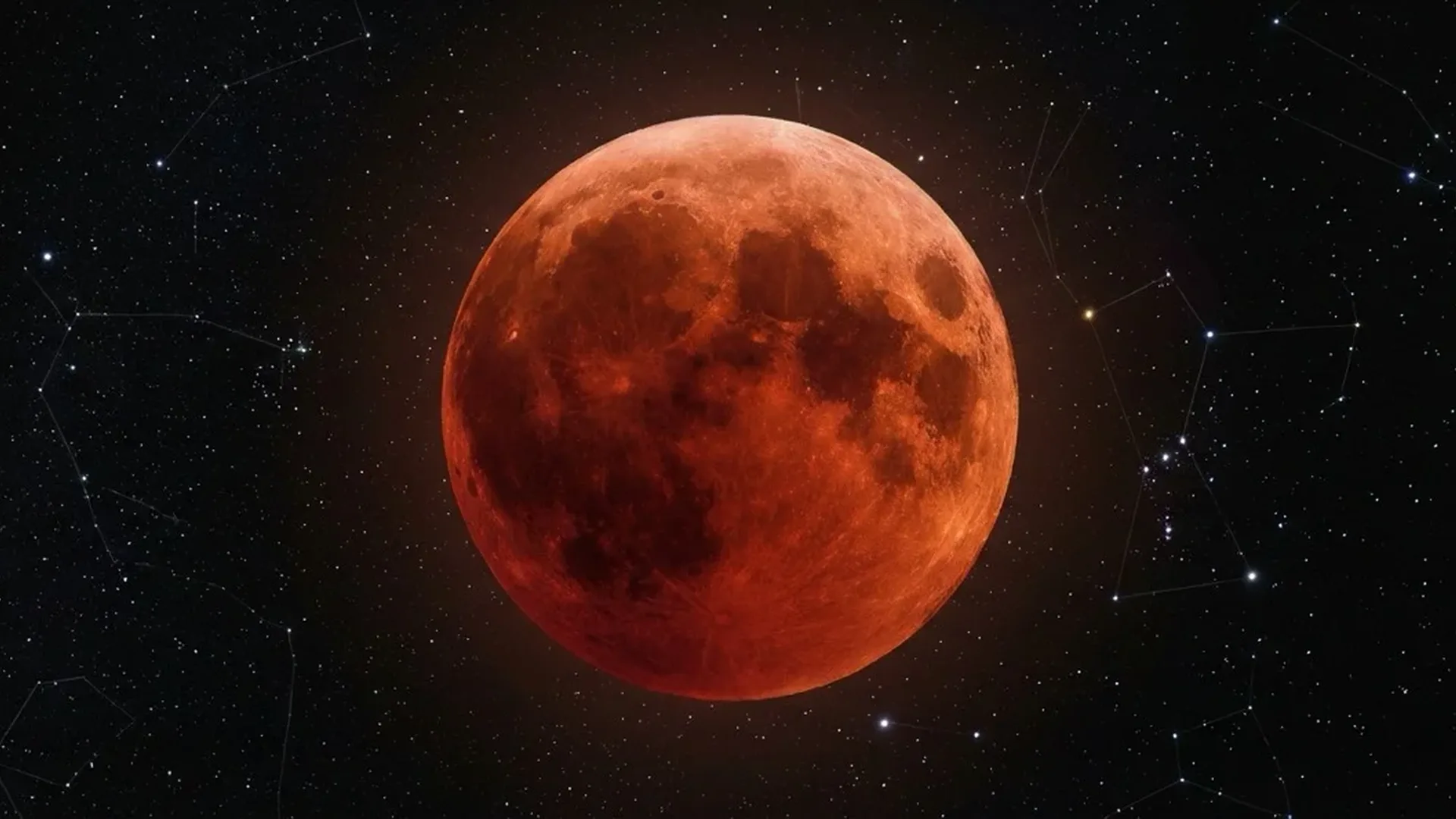
On March 3, 2026, the night sky will host one of the most spectacular astronomical events this decade: a total lunar eclipse. The full “Worm Moon” will slowly drift into Earth's shadow, turning a deep coppery red — the famous "blood moon." This will be the only total lunar eclipse of 2026, and the last until New Year's Eve 2028-2029.
📖 Read more: Meteor Showers 2026: Your Complete Guide
🔭 What Is a Total Lunar Eclipse?
A total lunar eclipse occurs when Earth sits directly between the Sun and a full Moon. Earth's shadow has two parts: the outer penumbra, which only slightly dims the Moon, and the darker inner umbra. During totality, the Moon passes entirely into the umbra, producing the dramatic reddish glow.
Unlike solar eclipses, a lunar eclipse requires no special protective equipment — you can safely watch with the naked eye, binoculars, or a telescope. All you need is clear skies and the Moon above the horizon.
🔭 When Will It Happen — Exact Times
The total lunar eclipse of March 3, 2026 will span 5 hours and 38 minutes from the first penumbral contact to the last. The eclipse unfolds at the same universal time worldwide — your local clock time and Moon position depend on your location.
Full eclipse: 08:44 – 14:22 UTC
Totality (blood moon): 11:04 – 12:02 UTC (58 minutes)
📖 Read more: Comet ATLAS and the Most Spectacular Comets of Our Era
Key totality times by timezone:
- Eastern (EST): 6:04 – 7:02 a.m. (Moon sets during totality!)
- Central (CST): 5:04 – 6:02 a.m.
- Pacific (PST): 3:04 – 4:02 a.m.
- Hawaii (HST): 1:04 – 2:02 a.m.
- Tokyo (JST): 8:04 – 9:02 p.m.
- Sydney (AEDT): 10:04 – 11:02 p.m.
It's worth looking at the Moon about 75 minutes before totality starts to see Earth's shadow gradually creep across the lunar surface during the partial phases — a slow, beautiful transformation.
🔭 Where Will It Be Visible?
The best views will be from western North America, the Pacific, Australia, New Zealand, and East Asia. According to Time and Date, just 2% of the global population (176 million) will catch every phase, but 2.5 billion people (31%) will see all of totality.
For the U.S., the rule is simple: the farther west, the better. On the East Coast, the Moon will set during totality — a frustrating sight. The southwestern states — Arizona, Southern California — offer the best combination of Moon altitude and statistically clear skies.
"Total lunar eclipses are like buses — you don't see any for years, then three come along at once. March 3, 2026 is the last chance before a triple run begins in late 2028."
📖 Read more: Universe: New Expansion Rate Measurement Deepens the Mystery
🔭 Why the Moon Turns Red — The “Blood Moon”
During totality, the Moon doesn't vanish — instead, it turns a deep copper-red. This “blood moon” effect occurs because sunlight is refracted through Earth's atmosphere.
The atmosphere acts like a prism: it scatters blue and green wavelengths, allowing only red light to bend around Earth and reach the Moon inside the umbra. The exact color depends on atmospheric conditions at the time — volcanic ash or heavy pollution can create a darker eclipse, while a “clean” atmosphere produces a bright orange-red.
💡 The Danjon Scale
Astronomers classify lunar eclipse brightness on the Danjon Scale (L0 to L4). L0 means a nearly invisible Moon, while L4 is a bright copper-orange. The exact value can't be predicted in advance — only measured during the event. This makes every total lunar eclipse unique in color.
📖 Read more: What Is a Nebula? Types, Colors, and Stunning Images
🔭 How to Photograph the Eclipse
Photographing a lunar eclipse doesn't require professional gear, but it does require preparation. Lighting conditions change dramatically as the Moon enters the umbra. Astrophotographer Fred Espenak recommends starting at ISO 400, f/8-f/11 with 1/250s shutter speed during partial phases. During totality, switch to ISO 800-1600, f/2.8 with 1-2 second exposures.
A tripod and remote shutter release are essential. Practice focusing on the Moon the nights before — magnify in live view and adjust until it's tack sharp. For North America, the Moon will drift from upper-left to lower-right: position it in the upper-left corner of your frame.
📷 DSLR/Mirrorless Camera
Use a 200-600mm telephoto on a tripod. Bracket 3 exposures (0.5s, 1s, 2s) during totality at the same ISO and aperture for maximum detail.
📱 Smartphone
Go wide-angle without zoom — landscape shots with the Moon above buildings or water. Use a small tripod, timer shutter, and RAW mode if available.
🌤️ Weather & Location
Check cloud cover forecasts 3 days out via NASA Worldview or Clear Outside. Pick an elevated spot with an unobstructed view to the west.
🔭 After March 2026 — What Comes Next
After the March total lunar eclipse, the next opportunity won't come quickly. On August 27-28, 2026, a deep partial lunar eclipse (93%) will be visible from Europe, Africa, and the Americas — impressive but not total. The next total lunar eclipse won't occur until December 31, 2028.
After the long wait, a triple run follows: total lunar eclipses in June 2029, December 2029, and June 2030. Until then, March 3, 2026 is your only shot at a blood moon — worth every effort, even if it means setting an alarm for 3 a.m.
📚 Sources
- Space.com — “Total lunar eclipse March 2026: A complete guide to the next blood moon” (February 2026)
- Space.com — “Total lunar eclipse March 2026: Live updates” (February 2026)
- Space.com — “7 easy tips for photographing the blood moon total lunar eclipse” (February 2026)
- Time and Date — “2-3 March 2026 Total Lunar Eclipse (Blood Moon)”