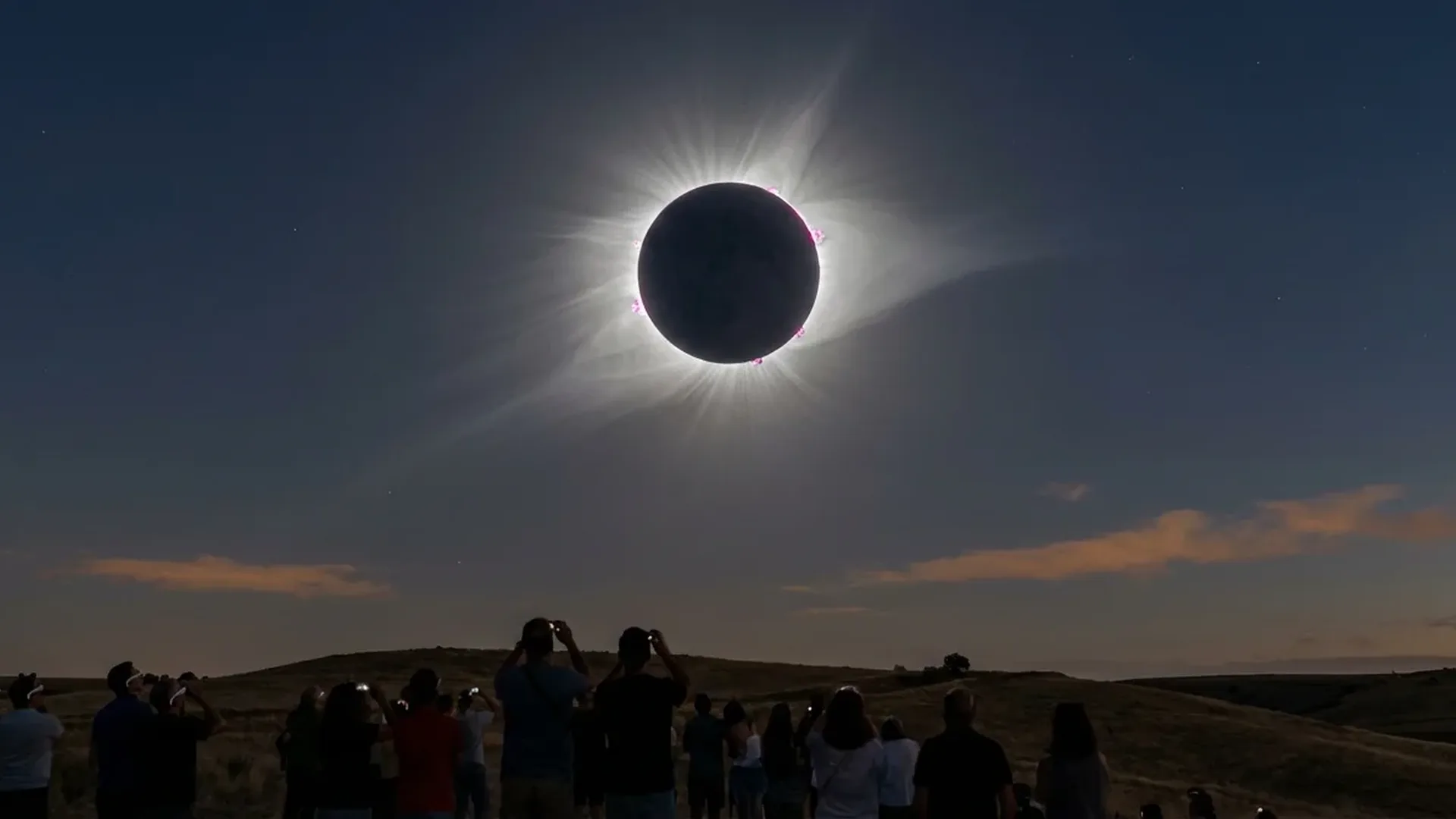
On August 12, 2026, the sky will darken over southern Europe in one of the most spectacular astronomical phenomena — a total solar eclipse. It will be the first total eclipse visible from mainland Europe since 1999, with Spain at its center. Let's look at what will happen, where it will be visible, and how to observe it safely.
📖 Read more: When a Star Vanishes: Tidal Disruption by a Black Hole
🌑 August 12, 2026: The Big Day
The total solar eclipse of August 12, 2026 will follow a path starting from Arctic Russia, passing through Greenland, Iceland, crossing the Atlantic Ocean, and ending in northern Spain. The maximum duration of totality will reach 2 minutes and 18 seconds — enough time to enjoy the Sun's corona, prominences, and the “diamond ring” effect.
While two minutes may sound brief, the experience of a total eclipse is unanimously described as one of the most awe-inspiring experiences of a lifetime. The sky darkens to twilight, the temperature drops, animals become confused, and the Sun's corona appears like an ethereal wreath of white light.
🇪🇸 Spain in Darkness
The path of totality will cross northern Spain, passing through areas including Asturias, Burgos, and the Valencia region. Palma de Mallorca will be very close to the center of the path, making it an ideal observation destination. Hotels in these areas are already receiving bookings from eclipse chasers worldwide.
Spain offers excellent conditions: clear August skies, easy access, and developed tourist infrastructure. For European astronomy enthusiasts, Spain is the most accessible destination to experience this rare phenomenon.
📖 Read more: When Galaxies Collide: The Milky Way's Date with Andromeda
🌍 Who Will See the Eclipse
The total eclipse will only be visible within the narrow path of totality — a strip approximately 300 kilometers wide. However, a partial eclipse will be visible across almost all of Europe, North Africa, and the Middle East. In countries like the UK, France, and Germany, the partial eclipse will cover 40-60% of the solar disk — noteworthy, but an entirely different experience from totality.
The most critical difference: during a partial eclipse, the Sun remains blindingly bright and the corona is not visible. Only during a total eclipse, when the Moon completely covers the Sun, is this extraordinary spectacle revealed.
👓 Safe Observation
Observing an eclipse requires specialized protective equipment. Solar filters must meet the ISO 12312-2 standard. Eclipse glasses are the simplest solution — they cost very little and allow safe direct viewing. Never use regular sunglasses, camera film, or improvised filters.
⚠️ WARNING: Never look directly at the Sun without certified solar filters — not even during a partial eclipse. Just a few seconds without protection can cause permanent eye damage (solar retinopathy). Only during the seconds of totality — and only then — can you look without a filter.
Alternative methods include: a telescope with a solar filter, pinhole projection (a small hole in cardboard that projects the Sun's image onto a surface), or a solar telescope with an H-alpha filter that shows prominences and eruptions.
📖 Read more: Comet 3I/ATLAS: The New Interstellar Visitor Has Arrived
☀️ What You'll See
During a total eclipse, phenomena unfold one after another: first, the solar disk begins to be “eaten” by the Moon (first contact). Gradually, the light weakens, creating penumbral shadows with peculiar patterns. Just before totality, the “diamond ring” appears — a final flash of light. Then, the corona is revealed in all its majesty, solar prominences become visible, and “Baily's beads” appear — bright points of light passing between the mountains and craters of the Moon.
📅 After: 2027 and 2028
The good news for European astronomers is that this decade will bring more eclipses: On August 2, 2027, another total eclipse will cross Spain and North Africa (Morocco, Algeria, Tunisia, Libya, Egypt). The 2027 path will be more southerly, with a longer duration of totality — up to 6 minutes and 23 seconds at maximum.
This means that if you miss the 2026 eclipse, you'll have a second chance just one year later. However, every total eclipse is unique — the corona changes shape according to the solar cycle, and each location's atmosphere adds different magic to the spectacle. The 2026 total eclipse is worth a trip to Spain — and will likely change the way you see the sky forever.