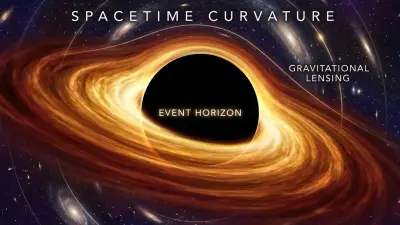
If there's one object in the universe that defies all human intuition, it's the black hole. A region of spacetime where gravity is so extreme that nothing — not even light — can escape. Black holes aren't science fiction; they're real, we've photographed them, and they exist everywhere in the universe.
🕳️ Definition
A black hole is an object whose gravity is so strong that the escape velocity exceeds the speed of light. In practice, this means nothing can leave once it crosses the event horizon — the invisible boundary beyond which there is no return.
The radius of the event horizon is called the Schwarzschild radius, named after Karl Schwarzschild who first calculated this solution to Einstein's equations. At the center (theoretically) lies the singularity — a point of infinite density where known physics breaks down.
📊 Types of Black Holes
Stellar (3–100 solar masses): Formed from the core collapse of massive stars after a supernova. They are the most common type.
Intermediate (100–100,000 solar masses): The most mysterious type. We don't know exactly how they form — possibly through mergers of smaller black holes or the collapse of enormous stars in the early universe.
Supermassive (millions to billions of solar masses): Found at the center of nearly every galaxy. Our own — Sgr A* — has a mass of approximately 4 million solar masses.
Primordial (theoretical): Hypothetical black holes that may have formed in the first moments after the Big Bang due to local density fluctuations.
📸 The First Photograph
On April 10, 2019, the Event Horizon Telescope (EHT) collaboration presented something unprecedented: the first photograph of a black hole. The image shows the shadow of the supermassive black hole M87* at the center of galaxy Messier 87, 55 million light-years away, with a mass of 6.5 billion solar masses.
In May 2022, the EHT presented a second image — this time of Sgr A*, the black hole at the center of our own Milky Way, at a distance of just 26,000 light-years.
⚛️ Hawking Radiation
In 1974, Stephen Hawking proposed that black holes aren't entirely “black” — they emit faint thermal radiation due to quantum effects near the event horizon. This “Hawking radiation” means black holes slowly evaporate — though for a stellar black hole, this would take far longer than the current age of the universe.
This creates the "information paradox": if a black hole evaporates completely, what happens to the information of the matter it swallowed? This remains one of the greatest open problems in theoretical physics.
📸 The M87* image is perhaps the most important astronomical photograph of the 21st century. To capture it, 8 radio telescopes across 4 continents had to function as a single Earth-sized telescope — the Event Horizon Telescope. The data was so enormous it was physically transported on hard drives rather than streamed over the internet.
⏰ Time Dilation
According to Einstein's General Relativity, gravity bends not only space but also time. Near a black hole, time flows more slowly. An observer approaching the event horizon would experience time normally, but a distant observer would see them moving in slow motion — and never actually crossing the horizon.
This phenomenon was impressively depicted in the film Interstellar (2014), where one hour near the black hole Gargantua corresponded to 7 years on Earth.
💿 Accretion Disk
Matter approaching a black hole doesn't fall straight in — it spirals, forming an accretion disk. Friction heats this disk to millions of degrees, making it a powerful source of X-ray radiation. Some black holes also produce relativistic jets — beams of plasma launched perpendicular to the disk at near-light speeds, extending thousands of light-years.
🍝 Spaghettification
If an astronaut approached a stellar black hole, tidal forces — the difference in gravity between the near and far points of the body — would stretch the body into a thin “noodle.” This phenomenon is fittingly called “spaghettification.” For supermassive black holes, the tidal forces at the event horizon are gentler — theoretically, someone could cross the horizon without immediately noticing.