Beyond Time
The geologist who buried himself alive in a cave to prove that time doesn't exist
📖 Read more: The Lykov Family: Hidden in Siberia for 40 Years
The young geologist with the mad idea
In 1961, a 22-year-old French geologist named Michel Siffre discovered something remarkable: an underground glacier inside the Scarasson cave, deep in the French Alps, about 70 kilometers from Nice. Initially, he planned a fifteen-day geological expedition to study the glacier. But fifteen days weren't enough. He decided to stay two months.
And then came the idea. The idea that, as he later said, “became the idea of my life.” He decided to live like an animal — without a watch, in the dark, with no knowledge of time. The goal: to discover what happens to the human body when all external time cues are removed — light, clocks, calendars, routine.
It was 1962 — the year of the Cuban Missile Crisis, the year Yuri Gagarin had just entered space. The world was interested in nuclear shelters and submarines. Nobody knew how the human organism reacts to permanent darkness. Siffre decided to become his own lab rat.
63 days in Scarasson
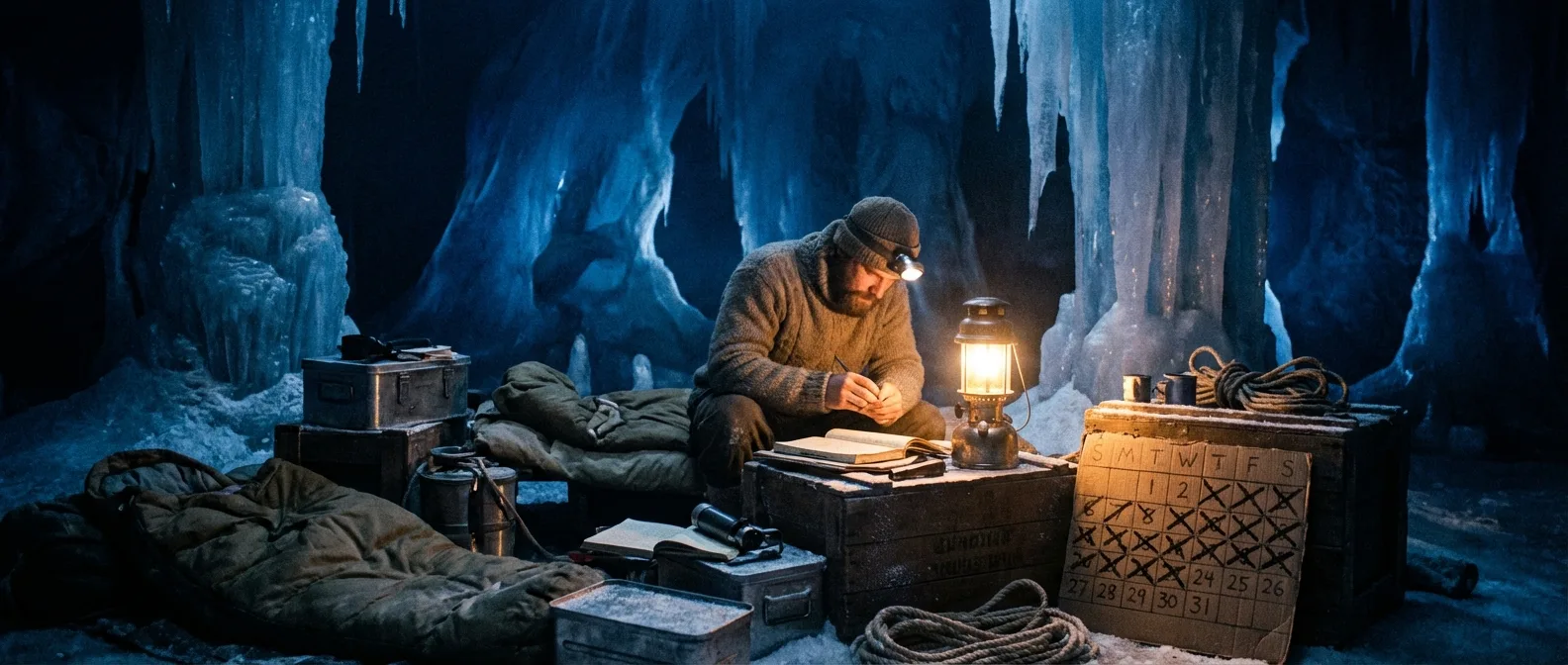
On July 16, 1962, the 23-year-old Siffre descended into the Scarasson cave. He had a tent, food supplies, books — including Plato — and a telephone connected to a team on the surface. He had no watch. No calendar. No natural light — just a single bulb.
The protocol was simple but ingenious: he would call his team every time he woke up, every time he ate, and every time he was about to sleep. The team had no right to call him — so he couldn't guess the time. With each call, he measured his pulse and performed a psychological test: counting from 1 to 120 at the rate of one number per second.
Conditions were brutal. Temperature was below freezing. Humidity reached 98%. His feet were permanently wet and his body temperature dropped to 34°C (93°F). But Siffre didn't stop. He read, wrote, explored, thought.
Then came the grand discovery. In the counting test to 120, Siffre needed five minutes to count what he believed was two minutes. His psychological time had compressed by half. He thought he was living on August 20 — when in reality it was September 14, the day the experiment ended. He thought he still had another month left in the cave.
"I decided to live like an animal, without a watch, in the dark, without knowing the time. Without realizing it, I had created the field of human chronobiology." — Michel Siffre
The discovery of the internal clock
What the experiment revealed was astonishing: the human organism has an internal biological clock, independent of the Earth's day-night cycle. In 1922, it had already been proven that rats have an internal clock. But for humans, there was no evidence — until Siffre.
His sleep-wake cycle wasn't 24 hours, but approximately 24 hours and 30 minutes. This means that without external stimuli, the human organism “drifts” slightly each day. After a few weeks, day and night no longer correspond to reality.
NASA was impressed. They funded the mathematical analysis of the first experiment. The French military — interested in sleep cycles aboard nuclear submarines — provided massive funding. Siffre had opened an entirely new field of scientific research: human chronobiology.
The decade between: experiments with others
After 1962, Siffre didn't stop. Over the next decade, he organized more than a dozen underground isolation experiments with other volunteers — mostly spelunkers, because only they had the psychological endurance. One man stayed four months, one woman three months, another man six months.
The results were remarkable — and alarming. All volunteers developed 48-hour cycles: 36 hours of continuous wakefulness followed by 12–14 hours of sleep. The only exception was Siffre himself, during his first experiment. This bothered him.
During these experiments, something else was discovered: the relationship between wakefulness and REM (dreaming) sleep. For every ten extra minutes of wakefulness, the volunteer gained one extra minute of dream sleep. And the more they dreamed, the faster their reaction times during the next waking phase. The French military immediately asked: "Can we produce drugs that artificially increase dreaming time, so soldiers can stay awake for 30+ hours?"
One of the most terrifying incidents occurred in 1964. The second volunteer after Siffre had a microphone attached to his head. One day, he slept for 33 hours. The surface team didn't know if he was alive or dead. At 34 hours, he snored — and everyone breathed. A few minutes later, he woke up and called to report his pulse, as if nothing had happened.
Midnight Cave: 205 days in the dark
Ten years after the first experiment, on February 14, 1972, Siffre descended into Midnight Cave — a cavern near Del Rio, Texas. This time, the ambition was greater: he would stay six months. 205 days. He wanted to catch the 48-hour cycle that all other volunteers had caught except him.
This time, the equipment was far more sophisticated. Electrodes on his head, heart, muscles — monitoring all vital functions. A tent illuminated by incandescent bulbs. Food. Books. And again — no clock.
The first weeks were relatively normal. But as months passed, Siffre sank into profound loneliness. His memory began to deteriorate — he couldn't remember what he had done one or two days earlier. Every day was like one continuous, indivisible night.
"When you are surrounded by night — the cave was completely dark, with just a light bulb — your memory does not capture the time. You forget. After one or two days, you don't remember what you have done a day or two before. The only things that change are when you wake up and when you go to bed. Besides that, it's entirely black. It's like one long day." — Michel Siffre
One day, a mouse appeared in his tent. Siffre tried to befriend it — it was the only living creature besides himself. He shared jam with it. But the mouse left, and he was alone again.
Toward the end, things deteriorated dramatically. Siffre later admitted to hallucinations and severe bouts of depression. Some “days” lasted 18 hours, others 36, some reached 52. He couldn't tell the long ones from the short ones. Time had become an amorphous mass.
Return to the light
On September 5, 1972, after 205 days, the team informed him the experiment was over. Siffre believed it was mid-August. He had lost nearly three weeks from his memory. Psychological and actual time no longer had any relationship.
He emerged from the cave 100,000 dollars in debt — he had vastly underestimated the cost of transporting his equipment from France to Texas. He was forced to leave the field of chronobiology for years. Much of the data from that experiment was never mathematically analyzed.
What the caveman taught us
Siffre's experiments changed the way we understand time, sleep, and human biology. Before him, the idea of an “internal clock” in humans was theoretical. After him, it was proven.
His findings were applied everywhere: at NASA for astronaut sleep cycles, on nuclear submarines for shift schedules, in occupational medicine for night-shift workers, in psychiatry for treating sleep disorders. Practically every time you adjust a nightlight or hear about “sleep hygiene,” the root of that knowledge traces back to a dark cave in the Alps and a 23-year-old with a telephone.
But beyond the science, Siffre's story is about the limits of the human mind. What happens when a person is left entirely alone, without any temporal marker — without changing light, without social contact, without sound? The mind begins to unravel. Memory weakens. The perception of time compresses or stretches without logic. Sleep becomes chaotic. Depression invades.
Siffre was once asked: “What is time?” He answered: "We don't know. All we know is that we experience it — and that the way we experience it doesn't match reality." That simple truth — that the time we live is not the time that exists — is perhaps the most unsettling discovery ever to emerge from a cave.
"What is time? We don't know. That is an experience I think we all can appreciate. It's the problem of psychological time. It's the problem of humans." — Michel Siffre
— The End —