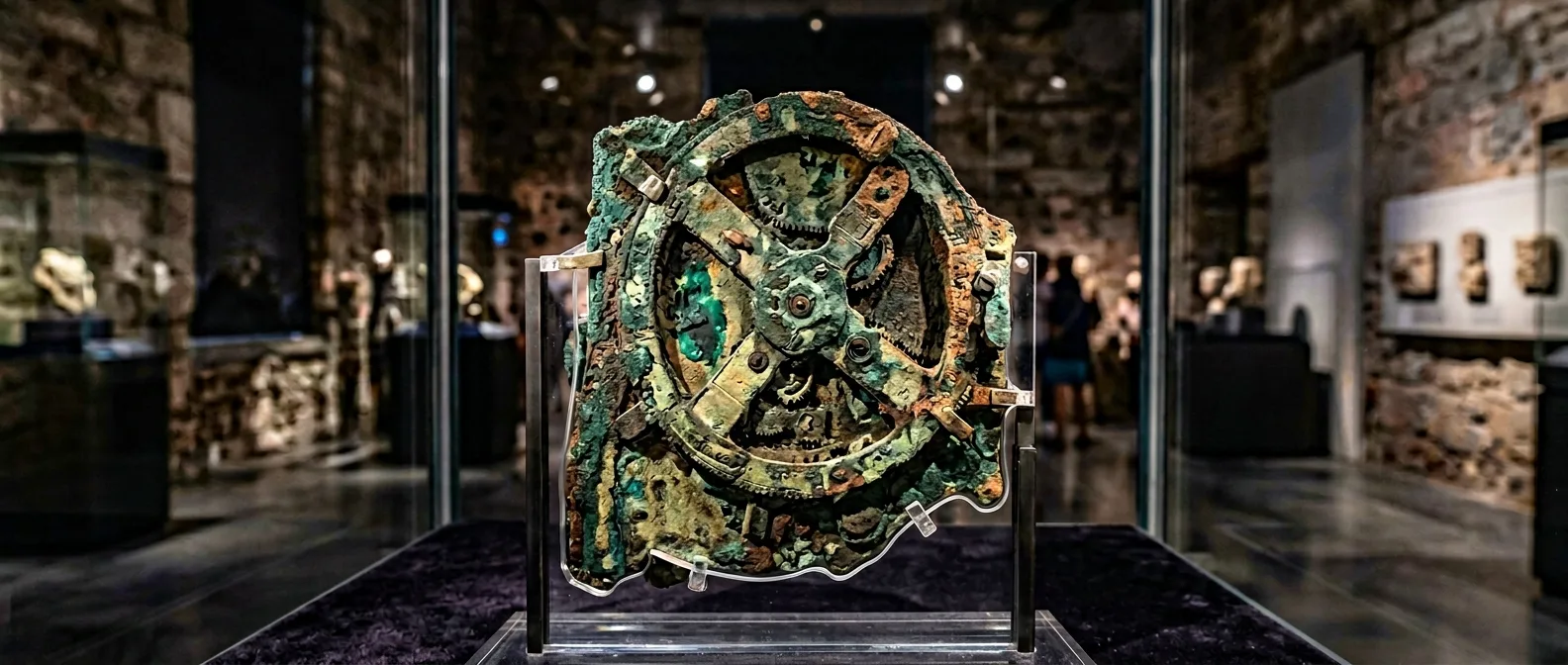
Antikythera Mechanism: A 2,000-Year-Old Computer
In the spring of 1901, a group of Greek sponge divers sheltering from a storm near the tiny island of Antikythera hauled up something from the seabed that would rewrite the history of technology.
📖 Read more: The Book That Predicted the Titanic 14 Years Before
Sponge divers and a sunken world
The story begins not with scientists or archaeologists, but with working men earning a living from the sea. Captain Dimitrios Kontos and his crew of sponge divers from the island of Symi were returning from the North African coast when rough weather forced them to anchor near Antikythera, a small, rocky island between Crete and the Peloponnese. While waiting for the storm to pass, diver Elias Stadiatis descended to check the seabed for sponges.
What he found instead was a nightmare — or so he thought. At a depth of roughly sixty meters, Stadiatis encountered what appeared to be a field of dead bodies: human arms, legs, and faces staring up from the murky darkness. Panicked, he signaled to be pulled up and told his captain about the corpses below. Kontos dove down himself and quickly realized the truth. These were not bodies — they were ancient bronze and marble statues, scattered across the seafloor from a shipwreck dating back more than two millennia.
The Greek government, alerted to the discovery, organized one of the world's first major underwater archaeological expeditions. Over nine months in 1900–1901, the divers — risking their lives at dangerous depths with only primitive diving suits — brought up an astonishing haul: the bronze statue of a youth now known as the “Antikythera Ephebe,” marble sculptures, glassware, jewelry, coins, and amphoras. Two divers were paralyzed from decompression sickness. One died.
Among all these treasures, a small, heavily corroded lump of bronze was barely noticed. It was catalogued and placed in storage at the National Archaeological Museum of Athens, where it sat largely ignored. Nobody imagined that this unassuming object was the most important find of the entire shipwreck — and one of the most significant archaeological discoveries in history.
A mystery in a museum drawer
On May 17, 1902, archaeologist Valerios Stais was examining the recovered artifacts when he noticed something the others had missed. The corroded lump had cracked open, and inside Stais could see what appeared to be gear wheels — tiny, precisely cut bronze cogwheels with triangular teeth. He announced that the object was some kind of astronomical calculating device.
His colleagues were skeptical, to put it mildly. The prevailing view in the early twentieth century was that the ancient Greeks, for all their philosophical brilliance, simply did not possess the mechanical sophistication to build geared machinery. Gears this precise, the experts insisted, could not have been made before the medieval period at the earliest. Many dismissed the mechanism as an anachronism — perhaps a medieval astrolabe that had fallen onto the wreck site at a later date, or simply a misidentified object.
For the next fifty years, the Antikythera Mechanism sat in the museum, studied occasionally but never truly understood. The fragments — eventually 82 separate pieces were identified — were too corroded, too fragile, and too complex for the technology of the time to penetrate. The mechanism kept its secrets behind a wall of green-black corrosion, waiting for someone stubborn enough to crack it open.
That person was Derek de Solla Price, a British-born physicist and historian of science working at Yale University. Price first encountered the mechanism in 1951 and became obsessed. He recognized immediately that the device was genuine — and that its implications were enormous. If the ancient Greeks could build a geared calculating machine of this complexity, then the entire narrative of the history of technology needed to be rewritten.
Price spent the next two decades studying the fragments. In 1959, he published a landmark article in Scientific American titled “An Ancient Greek Computer,” which brought the mechanism to worldwide attention for the first time. But his greatest breakthrough came in 1971, when he partnered with Greek nuclear physicist Charalambos Karakalos to take X-ray and gamma-ray images of the fragments.
The X-rays were revelatory. For the first time, researchers could see through the layers of corrosion and examine the internal gear trains. Price counted at least thirty individual gears, some no larger than a coin, with teeth cut to a precision of roughly one millimeter. He could trace the gear trains and begin to understand how they connected. In 1974, he published his masterwork, “Gears from the Greeks,” in which he proposed that the mechanism was an astronomical calculator capable of predicting the positions of the Sun and Moon.
Price died in 1983, before the full complexity of the mechanism was understood. But he had achieved something irreversible: he had proven beyond doubt that the ancient world was far more technologically advanced than anyone had believed. The Antikythera Mechanism was real, it was ancient, and it was extraordinary.
Seeing through two thousand years
The next great leap came in 2005 when an international team led by astronomer Mike Edmunds and mathematician Tony Freeth brought cutting-edge imaging technology to bear on the fragments. Using a custom-built X-ray computed tomography (CT) scanner — the same kind of technology used in medical imaging, but orders of magnitude more powerful — they were able to create detailed three-dimensional maps of the mechanism's interior.
The results were staggering. The CT scans revealed gear wheels that had never been seen before, hidden deep inside corroded fragments. The total count of gears rose to at least thirty-seven, some researchers say more. But the most electrifying discovery was text — thousands of tiny Greek characters, each barely a millimeter tall, inscribed on the surfaces and interior of the device. These inscriptions turned out to be an instruction manual, explaining what the mechanism did and how to use it.
The inscriptions, combined with the mechanical analysis, finally revealed the mechanism's full capabilities. It was not merely a simple astronomical calculator. It was a breathtakingly complex device that modeled the cosmos as the ancient Greeks understood it.
What the machine could do
The Antikythera Mechanism was essentially a hand-cranked, gear-driven model of the heavens, housed in a wooden case roughly the size of a large book. On the front was a single large dial showing the Greek zodiac and the Egyptian calendar. On the back were two spiral dials — one tracking the Metonic cycle (a 19-year cycle that relates the lunar month to the solar year) and the other tracking the Saros cycle (an 18-year eclipse prediction cycle).
📖 Read more: The Woman Who Survived 3 Shipwrecks on 3 Sister Ships
By turning a handle on the side, the user could set the device to any date — past, present, or future — and read off the positions of the Sun and Moon against the zodiac, the phase of the Moon, the timing of solar and lunar eclipses, and even which eclipses would be total and which partial. A subsidiary dial tracked the four-year cycle of the Panhellenic games, including the Olympics, the Pythian Games at Delphi, the Nemean Games, and the Isthmian Games at Corinth.
One of the mechanism's most remarkable features is its modeling of the Moon's motion. The Moon does not orbit the Earth in a perfect circle — its orbit is elliptical, meaning it moves faster when closer to Earth and slower when farther away. The ancient Greeks knew this but explaining how to model it mechanically is another matter entirely. The mechanism solved this problem with an ingenious pin-and-slot gear arrangement: a small pin on one gear engaged with a slot on another, converting uniform circular motion into the variable speed needed to replicate the Moon's actual movement across the sky. This is a level of mechanical sophistication that simply was not supposed to exist in the ancient world.
Recent research suggests the front dial may also have displayed the positions of the five planets known to the ancients — Mercury, Venus, Mars, Jupiter, and Saturn — though these gear trains have not survived intact. If confirmed, this would make the mechanism a complete planetarium, modeling the entire known solar system in miniature.
The ghost of Archimedes
Who built the Antikythera Mechanism? This is perhaps the most tantalizing question of all, and the answer remains uncertain. But the clues point in fascinating directions.
The ship carrying the mechanism was a Roman cargo vessel, likely traveling from the eastern Mediterranean toward Rome, possibly around 70–60 BC. The cargo — Greek statues, luxury goods, fine pottery — suggests it was carrying plundered or purchased art from the Greek world to wealthy Roman buyers. But the mechanism itself is clearly Greek, not Roman. The inscriptions are in Koine Greek, and the astronomical knowledge it embodies is firmly rooted in the Greek scientific tradition.
The ancient Roman orator Cicero, writing in the first century BC, described two devices brought to Rome after the sack of Syracuse in 212 BC — the same siege in which Archimedes was killed. One device, Cicero wrote, was a bronze sphere that could show the motions of the Sun, Moon, and planets. He attributed its construction to Archimedes himself.
Could the Antikythera Mechanism be a descendant — or even a copy — of Archimedes' legendary device? The timing fits: Archimedes died in 212 BC, and the mechanism is dated to roughly 150–100 BC. The astronomical tradition of Syracuse, where Archimedes worked, could easily have continued for generations after his death. Some scholars have pointed to the island of Rhodes as a likely place of manufacture, noting that the great astronomer Hipparchus worked there and that the eclipse data encoded in the Saros dial corresponds to observations that would have been visible from a latitude consistent with Rhodes or Syracuse.
Others have suggested a connection to the school of Posidonius, a philosopher and polymath who established an influential academy on Rhodes in the first century BC. Cicero himself visited Posidonius and reported seeing a mechanical device that modeled the motions of the heavens. Whether this was the very mechanism that ended up at the bottom of the sea off Antikythera, we may never know. But the connections are striking.
Perhaps the most disturbing aspect of the Antikythera Mechanism is the void that follows it. After the fall of the Hellenistic world and the collapse of the Roman Empire, nothing remotely comparable in mechanical complexity appears in the historical record for roughly 1,500 years. The next geared astronomical devices we know of are Islamic astrolabes from the medieval period, and even these are far simpler than the Antikythera Mechanism.
How is this possible? How could such sophisticated technology simply vanish?
The answer lies in the nature of ancient knowledge transmission. Devices like the mechanism were not mass-produced — they were individual creations, built by master craftsmen for wealthy patrons or scientific institutions. The knowledge required to construct them was likely held by a very small number of specialists, passed from teacher to student in closed workshops. When those workshops were destroyed, when those craftsmen died without successors, the knowledge died with them.
The Roman conquest of the Greek world was catastrophic for Greek science. The Romans admired Greek art and philosophy but had little interest in Greek engineering for its own sake. Libraries were burned, academies were closed, and the intellectual infrastructure that had produced minds like Archimedes and Hipparchus was gradually dismantled. The knowledge was not so much lost as it was allowed to wither — underfunded, undervalued, and eventually forgotten.
It is sobering to consider how many other mechanisms like this may have existed and simply did not survive. Bronze is a valuable material — ancient bronze objects were routinely melted down and recast into coins, weapons, or new tools. The Antikythera Mechanism survived only because it sank to the bottom of the sea, beyond the reach of scavengers and metal recyclers, preserved in the cold, dark water for two millennia. It could be the sole survivor of an entire class of devices that once populated the workshops and observatories of the ancient Greek world.
Rebuilding the impossible
In recent decades, several teams have attempted to reconstruct the Antikythera Mechanism. The most famous reconstruction is by Michael Wright, a former curator at the Science Museum in London, who spent years building a working replica based on his own detailed study of the fragments. Wright's model, completed in 2006, demonstrated that the mechanism could indeed have displayed planetary positions — supporting the theory that the original device was a complete planetarium.
In 2021, the team led by Tony Freeth at University College London published a revolutionary new model of the mechanism's front panel, using sophisticated computer modeling and the latest CT scan data. Their reconstruction proposed an elegant gear arrangement that could display the motions of all five known planets, the Sun, the Moon, and the Moon's phases on a single compact dial — a feat of miniaturization and mechanical ingenuity that astonished even modern engineers.
Swiss watchmaker Hublot produced a wristwatch inspired by the mechanism's design, incorporating some of its gear principles into a luxury timepiece. The project, while commercial, underscored a remarkable irony: the mechanical principles invented by anonymous Greek craftsmen more than two thousand years ago remain relevant — and impressive — even in the age of silicon chips and quantum computers.
The Antikythera Mechanism sits today in a quiet room at the National Archaeological Museum of Athens — a cluster of corroded bronze fragments behind glass, looking for all the world like something you might find in a junkyard. Most visitors walk past it without a second glance, drawn instead to the golden masks of Mycenae or the towering marble kouroi. But those who stop, who lean in and read the small explanatory plaques, find themselves staring at something that defies easy comprehension.
This was a machine that could predict the future — not through magic or prophecy, but through mathematics and engineering. It encoded the rhythms of the cosmos into bronze gears and inscribed instructions so that any educated person could read the heavens like a book. It was built by people who had no electricity, no steel, no lathes powered by anything other than human hands. And then it was lost — swallowed by the sea, forgotten for two thousand years, dismissed as impossible even after it was found.
The Antikythera Mechanism is not just an artifact. It is a message from the ancient world, reminding us that human ingenuity has no fixed starting point. The capacity to observe, to calculate, to build — these are not modern inventions. They are as old as curiosity itself. And every time we assume that the past was simpler than the present, there is a corroded lump of bronze in a museum in Athens, quietly proving us wrong.