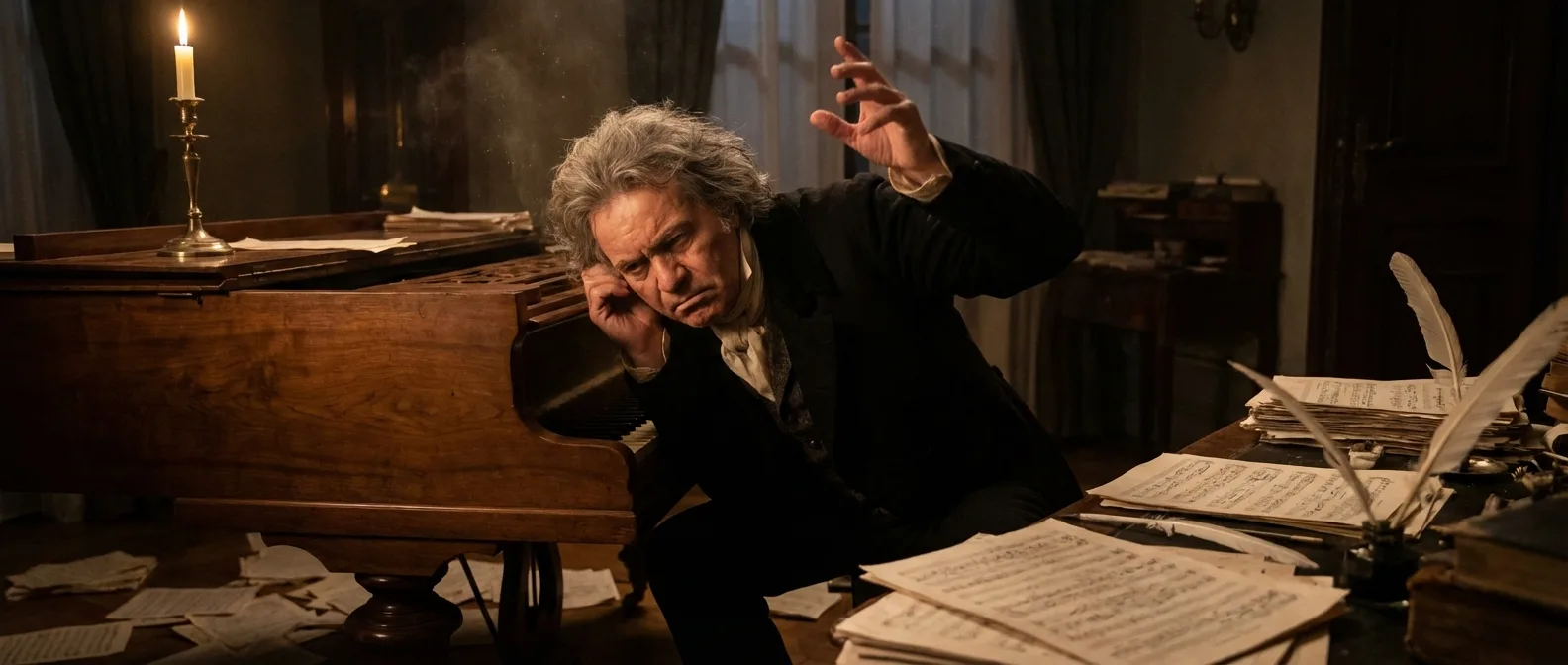
Deaf Beethoven: Masterpieces Without Sound
A True Story
📖 Read more: The History of Music Listening: From Vinyl to Streaming
The sound before the silence
On December 16, 1770, in a narrow, damp house on Bonngasse in the city of Bonn, Ludwig van Beethoven was born. His father, Johann, a tenor in the court of the Elector of Cologne, recognized his son's talent early — and decided to exploit it ruthlessly. He would drag young Ludwig out of bed in the middle of the night, hauling him to the piano while drunk, demanding hours of practice. He struck the boy when he made mistakes. Desperate to mold a new “child prodigy” in the image of Mozart, Johann even falsified his son's age on the programs of public concerts.
Yet from this cruelty, something extraordinary grew. By the age of twelve, Beethoven was already publishing his first compositions. At sixteen, he traveled to Vienna, where Mozart himself reportedly heard him play — and, if we trust the accounts of the era, remarked: "Keep your eyes on this young man. One day he will give the world much to talk about."
In 1792, the young Beethoven settled permanently in Vienna. The city of Haydn and Mozart would remain his home until the day he died. He studied under Haydn, though their relationship was tense — Beethoven was stubborn, impatient, convinced that music must shatter the constraints of classical form. He quickly became the most sought-after pianist in the city, famous for his thunderous crescendos and improvised scores that left audiences literally speechless.
The silence descends
The first signs appeared around 1798, when Beethoven was just twenty-seven years old. A tinnitus — an unrelenting buzz inside his ears that never ceased. At first, he ignored it. Then, he panicked. He sought help from every doctor in Vienna — almond oil, warm baths, hydrotherapy at Heiligenstadt. Nothing worked.
📖 Read more: Bhopal Tragedy: The Worst Industrial Disaster
1798–1801His hearing deteriorated steadily. Beethoven struggled to catch high-pitched notes and to follow conversations in noisy rooms. He hid his condition from friends and patrons, terrified that its revelation would destroy his career. In a letter to his friend Karl Amenda he confessed: "I must tell you that I live a wretched existence. For nearly two years I have avoided almost every social gathering, because I cannot bring myself to say to people: I am deaf."
How he composed without hearing
This is the question that has captivated musicologists, neurologists, and philosophers for two centuries: how can someone write music without hearing? The answer lies in the nature of musical genius.
Beethoven no longer needed his ears, because he “heard” inside his mind. After decades of intensive training, he had developed an inner auditory memory so rich, so detailed, that he could “hear” every note, every timbre, every orchestration inside his head. He knew precisely how a bassoon sounds in a low register, how a violin resonates in pizzicato, how brass and percussion combine in fortissimo.
There were other methods too. Beethoven would clench a wooden rod between his teeth and press the other end against the piano — the vibration traveled through bone conduction, giving him a faint sense of the sound. He hammered the keys with such force that he broke strings — searching for vibrations powerful enough to feel through his body. The pianos he used were in a permanent state of destruction.
But his true power was not technical. It was philosophical. Beethoven confronted deafness not as an obstacle, but as a liberation. Without the noise of the outside world, he sank into an inner universe of sounds that were no longer constrained by physical laws. His late compositions do not sound like music made for human ears — they sound like music made for the soul.
📖 Read more: Chernobyl: The Night of the Worst Nuclear Disaster
Masterpieces of silence
Beethoven's final creative period — roughly from 1818 until his death — produced some of the most profound, daring, and enigmatic musical works ever written. Works before which his contemporaries stood bewildered — some in awe, others questioning whether the deaf composer had lost touch with reality entirely.
Missa Solemnis (1819–1823)Beethoven devoted four full years to this Mass — an unusually long span even by his own standards. The Missa Solemnis is not merely sacred music; it is an existential cry. Beethoven, who was not especially devout, transformed the liturgy into something unprecedented: a spiritual drama between man and the cosmos, a plea for peace so deep it transcends all creed. He considered it his greatest work.
The premiere of the Ninth
On May 7, 1824, at the Theater am Kärntnertor in Vienna, the Ninth Symphony was performed for the first time. Beethoven stood beside the conductor Michael Umlauf, turning the pages of the score and making conducting gestures — but Umlauf had instructed the orchestra to ignore him entirely. Beethoven could hear nothing; he was conducting a phantom orchestra inside his head.
When the performance ended, Beethoven continued staring at the score. He had not realized the music was over. The contralto Caroline Unger approached him gently and turned him toward the audience. What he saw overwhelmed him: two thousand people were on their feet, tears streaming down their faces, clapping, waving handkerchiefs, crying out in rapture. The ovation lasted a full five minutes — so prolonged that the police requested silence, fearing the crowd's enthusiasm might be mistaken for political protest. In imperial Vienna, only the Emperor was entitled to three cheers. That evening, Beethoven received five.
📖 Read more: Dashrath Manjhi: Carved a Mountain Alone for 22 Years
The final days
Beethoven's last years were steeped in suffering. Beyond his deafness, he endured chronic digestive ailments, probable liver cirrhosis — undoubtedly aggravated by excessive wine consumption — and relentless legal battles over the guardianship of his nephew Karl. He was a solitary, irascible, disheveled giant who moved constantly from one lodging to the next, quarreled with landladies, and walked for hours through the countryside, muttering melodies that no one but him could hear.
On March 26, 1827, Beethoven died in Vienna at the age of fifty-six. According to accounts, a thunderstorm was raging outside that afternoon. Moments before drawing his last breath, he raised his fist toward the sky — a final act of defiance. His funeral drew twenty thousand mourners, an enormous crowd for the Vienna of that era. Franz Schubert, one of the torchbearers, died himself just eighteen months later.
The legacy
Modern neuroscience considers Beethoven one of the most remarkable examples of neuroplasticity — the brain's ability to reorganize itself after trauma. Studies of musicians with hearing impairment show that the auditory cortex can retain rich musical representations even without external stimuli. In Beethoven's case, this capacity appears to have been so highly developed that it fully compensated for his hearing loss.
But beyond neuroscience, Beethoven's story is something more profoundly human. It is the story of a man who refused to let fate define him. Who, at the darkest moment of his life — at Heiligenstadt in 1802 — made a choice: instead of surrendering to despair, he resolved to transform pain into art. And that art proved greater than any adversity.
The Ninth Symphony was adopted as the anthem of the European Union. The “Ode to Joy” rings out at ceremonies, stadiums, and revolutions. The late quartets are considered the invisible foundation upon which the entire musical language of the twentieth century was built — from Schoenberg to Shostakovich. The “Moonlight” Sonata remains one of the most recognized pieces of music on the planet.
EpilogueLudwig van Beethoven spent the last ten years of his life in absolute silence. He never heard the Ninth Symphony performed. He never heard his late quartets played. He never heard the applause, the tears, the cries of admiration. And yet, this man — trapped in a body without sound — created music that speaks to every human soul, in every age, in every corner of the world. Because true music is not born in the ears. It is born far deeper — where silence and sound become one.