Donner Party: The Settlers Who Resorted to Cannibalism
A True Story
📖 Read more: The Climber Who Cut Off His Own Arm to Survive
The departure
George Donner's party departed from Independence, Missouri, on May 12, 1846. It consisted mainly of farming families — some were prosperous, some had little more than the clothes on their backs. Donner, a 62-year-old farmer from Illinois, led a caravan of 23 wagons and oxen.
The plan was simple: they would follow the Oregon Trail to the Rocky Mountains and then head south toward California. The timeline was tight — they needed to cross the Sierra Nevada before the first snows fell in November. They had roughly five months.
The fatal shortcut — Hastings Cutoff
At Fort Bridger, in present-day Wyoming, the party found a pamphlet by Lansford Hastings. Hastings promised a “new route” farther south that would cut hundreds of miles and weeks off the journey. The reality was that Hastings had never personally crossed this trail with wagons.
Donner was persuaded. Despite warnings from experienced guides, the party turned south. That decision cost them three critical weeks. Instead of open plains, they encountered savage canyons, dense forests that had to be cleared tree by tree, and the Great Salt Lake Desert — 80 miles without water.
Crossing the Salt Desert took five days instead of two. Oxen died of thirst. Families abandoned wagons full of their possessions in the middle of the desert.
The descent into chaos
By October, the party had lost precious time, many animals, and several members. There had already been the first death — and the first violent confrontation. John Snyder, a teamster, was killed in a quarrel with James Reed. Reed was banished from the party and forced to continue alone, without provisions.
Lewis Keseberg, a German immigrant, was abandoned after his first injury. An elderly man was left behind to die in the desert. The group slowly disintegrated. They were no longer a party — they were separate families struggling to save themselves.
Trapped at Truckee Lake
On October 28, the party reached Truckee Lake (today's Donner Lake), at the foot of the Sierra Nevada. They needed only one pass — Donner Pass, at 7,200 feet elevation. It was the last obstacle before California's green hills.
But the snow came early. A storm blanketed the pass in ten feet of snow overnight. They tried three times to ascend. Each time they failed. The wagons couldn't make it through; the oxen slipped on the ice. On November 4, the party accepted the inevitable: they would winter there.
The snow fell so thick we couldn't see the oxen. The children were crying. The women were praying. No one spoke about what everyone knew — that we would die there.
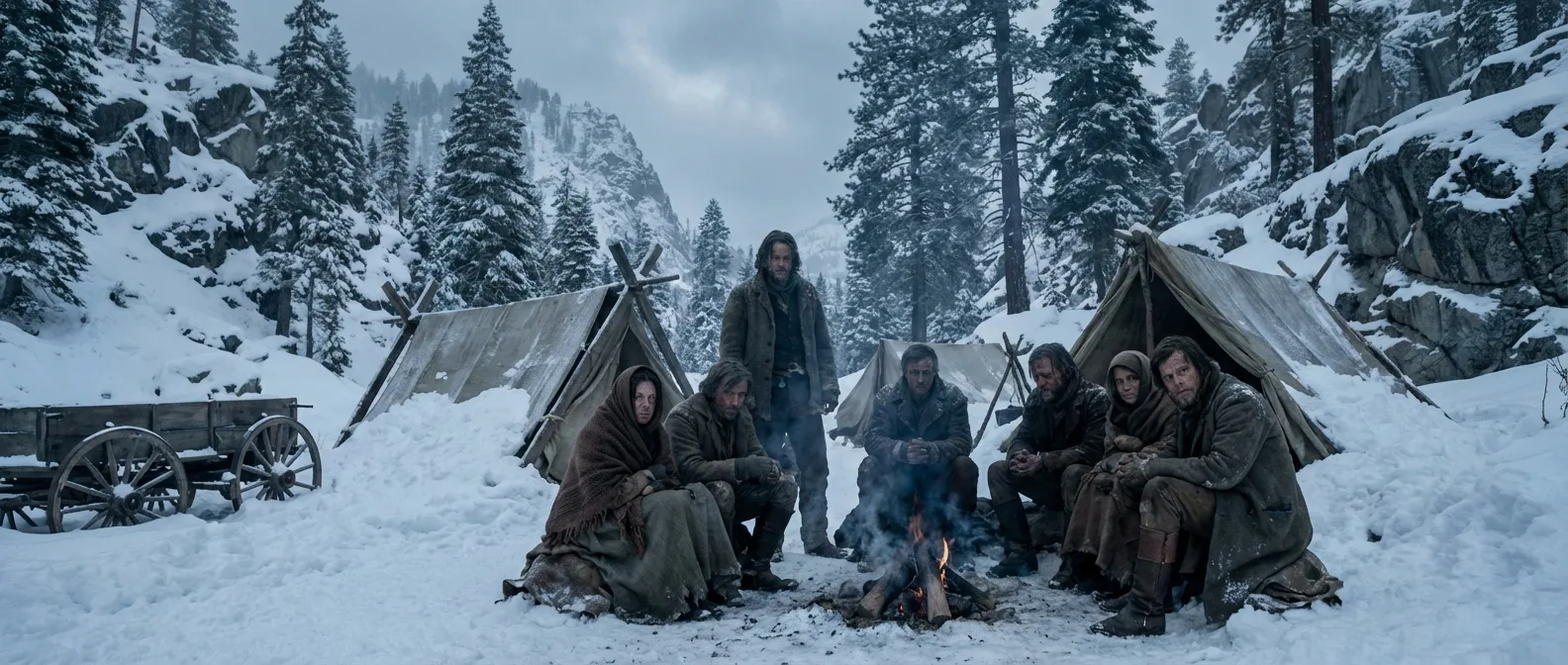
The party split into two camps: one by the lake and one farther back, where the Donner families were. They built makeshift shelters from pine branches, ox hides, and stones. Temperatures dropped to -4°F.
Food ran out within weeks. First they slaughtered the remaining animals. Then they boiled ox hides — softening them in water and chewing them for hours. They ate tree bark, roots, pine branches. Children cried ceaselessly from hunger.
The winter of 1846-47 was exceptionally severe. Snow reached 22 feet. The shelters were buried entirely — settlers literally lived beneath the snow, in caves they dug around their crude cabins.
The desperate expedition
On December 16, fifteen of the strongest members — 10 men and 5 women — decided to attempt the impossible: to cross the Sierra Nevada on improvised snowshoes. They became known as “The Forlorn Hope.”
Things went terribly wrong. After one week, food was gone. Around Christmas, one by one, members of the group died. The survivors, on the brink of death from starvation, made an unthinkable decision: they ate the flesh of their dead companions.
Of the 15 members of the “Forlorn Hope,” only 7 reached California alive — after 33 days of trekking through the snow. All 5 women survived, but only 2 of the 10 men.
Cannibalism at the camps
Back at the camps, the situation was equally horrifying. The first to die was Baylis Williams, on December 15. Many others followed. By early January, some settlers decided to eat the dead. It was not a decision made easily — it was the last resort before death.
Tamsen Donner, George's wife, refused to eat human flesh even at the brink of death. Patrick Breen, who kept a diary, recorded the deaths with chilling composure: “Mrs. Murphy said she would commence on Milt. I did not stop her.”
The children were the most vulnerable. Many were too weak to stand. Maternal love was the last force keeping them alive — mothers gave their own portions to the children, putting themselves at even greater risk.
The rescue missions
The first rescue party arrived on February 18, 1847. Seven men from Sutter's Fort in California had ascended the Sierra Nevada through deep snow. What they found was a scene of horror: skeletal human remains hanging near makeshift hearths, children with bloated stomachs, women who could not stand on their feet.
A total of four rescue missions were needed from February through April. Each mission battled the same terrifying conditions — deep snow, avalanches, bitter cold. Some of the rescuers themselves nearly perished.
📖 Read more: The Fisherman Who Survived 438 Days Alone in the Pacific
The bodies were so emaciated I was done. The children didn't look like children — they looked like shadows.
Lewis Keseberg — the last one
The final rescue party arrived in April and found only one person alive: Lewis Keseberg. Around him were human bones and a pot containing human flesh. Keseberg admitted he had eaten dead companions but denied killing anyone.
The fate of Tamsen Donner remains a mystery. She was alive during the third rescue but refused to leave, choosing to stay beside her dying husband. When the fourth rescue arrived, Keseberg was the only one alive. He claimed Tamsen died alone in the cold.
Keseberg was haunted by the stigma of cannibalism for the rest of his life. He was publicly called a “cannibal.” He died in 1895, poor and alone, his name never fully cleared.
48 survivors, an eternal story
Of the original 87 settlers, 48 survived. Most of the children were saved — largely thanks to their mothers, who sacrificed everything. Women survived at a far greater rate than men — a phenomenon still studied today by biologists.
Truckee Lake was renamed Donner Lake. A memorial and museum stand at the site today. The story of the Donner Party became a symbol of both human endurance and the dark limits that accompany it.
Modern archaeology has returned to the site multiple times. Excavations at Alder Creek (the Donner camp) in 2003-2004 found cooked bone fragments — but it was impossible to determine whether they were human or animal. The truth, in some places, remains buried in the snow.
The line between humanity and survival
The story of the Donner Party is not simply a horror story. It is a story about the limits of the human being — how much one can endure, what one will do to live, and how one lives afterward. Most survivors never spoke publicly about what happened that winter. Some rebuilt their lives in California. Some never recovered.
Virginia Reed, who was 12 years old during the ordeal, later wrote in a letter to her cousin the phrase that became legendary: “Never take no cutoffs and hurry along as fast as you can.” Her advice became an unofficial motto for subsequent wagon trains crossing the West. The Donner Party story became the subject of dozens of books, films, and documentaries, and is taught in American schools as a cautionary tale about the perils of Western Expansion and the dangers of unverified shortcuts through uncharted territory.
Donner Lake remains there, quiet. In winter, it still snows deeply. Beneath the snow, the earth remembers. And the story reminds us that sometimes, the most terrifying truth is not what people do — but why they are forced to do it.