The Great Escape
1,500 meters underground, a motorcycle on rails, and the most wanted man in the world
📖 Read more: The Great Escape from Alcatraz
El Chapo
Joaquín Archivaldo Guzmán Loera — known across the globe as “El Chapo” (The Shorty) — wasn't merely a drug lord. He was the head of the Sinaloa Cartel, the most powerful criminal organization in the Western Hemisphere. With an estimated fortune of $12–14 billion, Guzmán appeared on the Forbes list as one of the wealthiest people in the world. U.S. authorities believe he was responsible for the deaths of over 34,000 people.
He was born in La Tuna, a mountain village in the municipality of Badiraguato, Sinaloa, into grinding poverty. His father, Emilio Guzmán Bustillos, grew opium poppies in the hills — the only “industry” in the region. By 30, Joaquín had seized control of the largest flow of cocaine, heroin, and methamphetamine from Mexico to the United States. His legend was built on two things: ruthless violence and tunnels.
Because El Chapo wasn't just an expert in narcotics. He was a pioneer in underground passages. He had constructed dozens of tunnels beneath the US-Mexico border, complete with lighting, ventilation, and transport systems. In his early operations, he packed cocaine into chili pepper cans under the brand name “La Comadre” and shipped them to the U.S. by train. The money came back in enormous suitcases stuffed with cash, waved through Mexican customs by corrupt airport officials. That expertise would serve him well when he decided to execute the greatest prison escape from a maximum-security facility.
The first escape: Puente Grande, 2001
The first time El Chapo escaped was almost comical in its simplicity. In January 2001, imprisoned at the Puente Grande facility in Jalisco, Guzmán walked out hidden inside a laundry cart. Guard Francisco “El Chito” Camberos Rivera opened his electronically operated cell door, and maintenance worker Javier Camberos rolled him through several doors and eventually out the front entrance. From there, he was driven away in the trunk of a car. At a gas station down the road, Camberos went inside to pay — and when he came back, Guzmán had vanished on foot into the night.
The truth was that he had bribed nearly the entire staff. Guards, directors, even officials from the Justice Ministry were on the payroll. The story told to the bribed guards was that Guzmán was smuggling gold — supposedly extracted from rock at the inmate workshop — out of the prison, a cover story designed to prevent anyone from raising the alarm. The escape cost $2.5 million in bribes. In total, 78 people were implicated in the plot. The prison director was later jailed. One guard who came forward to report the situation disappeared seven years later — almost certainly murdered on Guzmán's orders.
📖 Read more: Frank Abagnale: Pilot, Doctor, None of the Above
For 13 years, he roamed free. The most wanted man in the Western Hemisphere lived in the mountains of Sinaloa, constantly moving, protected by roughly 300 armed informants and bodyguards — a security apparatus rivaling that of a head of state. He employed armored cars, aircraft, all-terrain vehicles, and sophisticated counter-surveillance equipment.
In February 2014, following a joint operation by Mexican and American forces, he was captured at the Miramar condominiums in Mazatlán — Room 401, fourth floor. Sixty-five marines in ten pickup trucks moved in at 3:45 a.m. He had planned to visit his newborn twin daughters before retreating to the mountains. He was transferred to Altiplano prison — Mexico's maximum-security facility.
“He will never escape again. This prison is impenetrable.” — Mexican official (February 2014)
The construction
Immediately after his capture, a massive construction project began. On a plot of land in the Santa Juanita neighborhood, 1.5 kilometers from Altiplano prison, a team of builders started digging. They worked for months on end, day and night. Nobody noticed. Or rather, nobody wanted to notice. Guzmán's wife, Emma Coronel Aispuro, a former beauty queen, is believed to have helped coordinate parts of the operation from the outside.
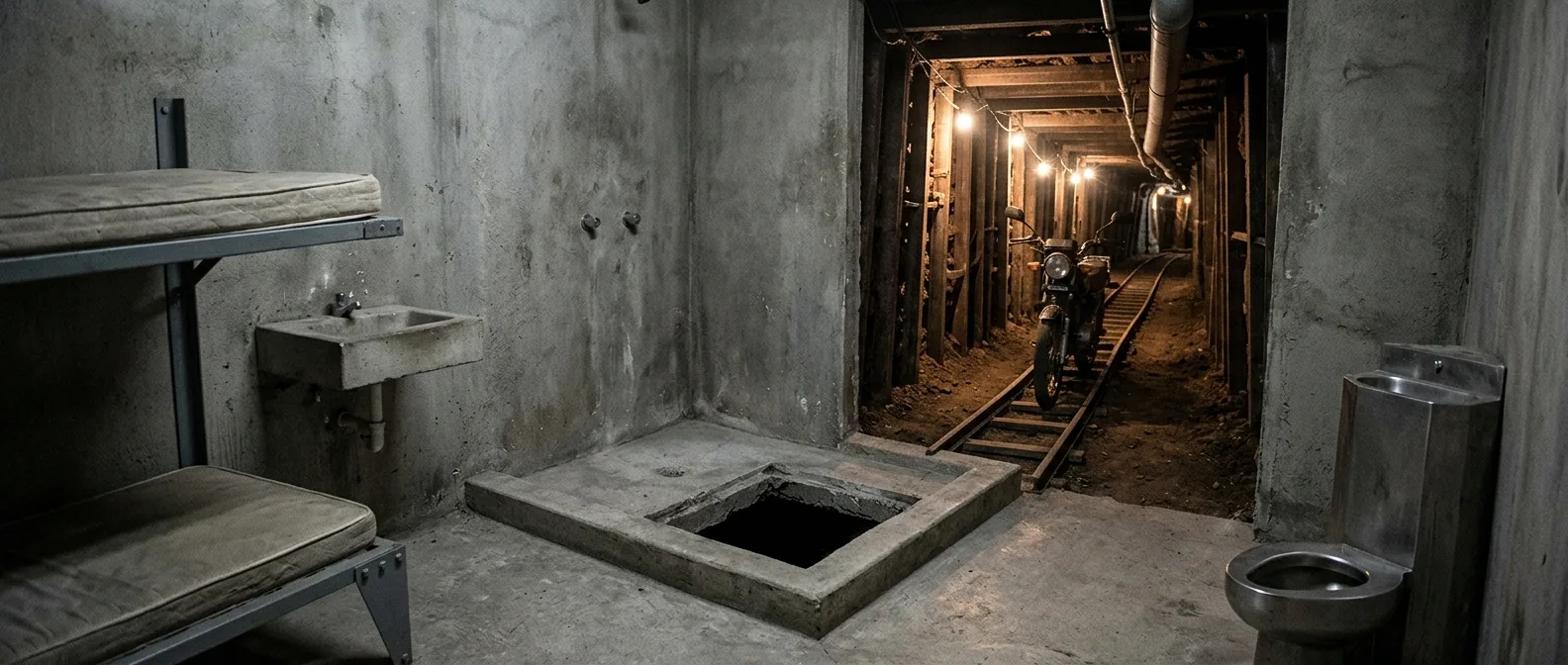
The tunnel was an engineering marvel: 1,500 meters long, 1.7 meters high, 75 centimeters wide, 10 meters below ground. It had electric lighting with LED tubes, a ventilation system with air ducts, high-quality construction materials, and — the crowning touch — a modified motorcycle mounted on rails, like a small train, for rapid transport of people and supplies. The construction bore all the hallmarks of the dozens of cross-border smuggling tunnels that Guzmán's organization had built over the years.
The entrance on the prison side was a 50-by-50-centimeter square opening — directly beneath the shower in Guzmán's cell. The spot had been chosen with surgical precision: it was the sole blind spot of the security cameras in his cell. At the other end, an unfinished house served as the exit — a building under construction that attracted no attention in the neighborhood.
Security footage shows exactly what happened. At 8:52 PM, Guzmán is sitting on his bed. He stands up. Walks toward the bathroom. Crouches behind the shower wall — and vanishes. Literally. The camera shows an empty cell. The shower area was the only part of his cell not covered by surveillance cameras — something that was certainly not a coincidence.
Beneath the shower, a ladder descended 10 meters into a human-height tunnel. Guzmán climbed down, mounted the motorcycle, and “rode” 1,500 meters in a matter of minutes. At the other end, a house was ready: clean clothes, a new identity, a car. An entire escape plan, executed with military precision.
Guards realized he was missing after 25 minutes. A hundred and twenty employees were working at the prison that night. Eighteen who worked in Guzmán's wing were immediately detained, and by the following afternoon 31 had been called in for questioning. The prison director, Valentín Cárdenas Lerma, was among those arrested. The Mexican government issued an international alert, flights were canceled at Toluca airport, and soldiers occupied positions at Mexico City's international airport. By the time anyone could react, El Chapo was already in the mountains.
President Peña Nieto was en route to an official state visit in France when the news broke. Interior Minister Miguel Ángel Osorio Chong, already in Paris, flew back to Mexico immediately. The president called the escape an “affront” to the Mexican state and placed a bounty of 60 million pesos (roughly $3.8 million) for information leading to his recapture.
Sean Penn, Kate del Castillo, and the third capture
His freedom lasted just six months — and he lost it in part because of vanity. Mexican actress Kate del Castillo had written an open letter to Guzmán in 2012, expressing her sympathy. His lawyers put them in contact. After his 2015 escape, they began planning a film about his life together. American actor Sean Penn heard about the connection through a mutual acquaintance and asked to come along for an interview for Rolling Stone magazine.
The meeting was traced by intelligence services through cell phone intercepts. In early October 2015, Mexican marines raided a ranch near Tamazula, in the Sierra Madre mountains of Durango. Guzmán came under fire but managed to escape — this time by hiding behind two women (his personal cooks) and a young girl, holding the child in his arms as a human shield. The Attorney General stated that “the helicopter located him, but it was decided not to fire.”
📖 Read more: Hinterkaifeck Farm: 6 Dead and the Killer Lived There
In January 2016, authorities tracked “armed people” to a house in the coastal city of Los Mochis, Sinaloa. They monitored communications for a month — code names “Grandma” or “Aunt” referred to El Chapo. The final act came when the gunmen in the house placed a massive order for tacos — a signal that the VIP had arrived.
During the raid, five gunmen were killed, six arrested, and one marine was wounded. Authorities recovered two armored cars, eight assault rifles — including two Barrett M82 sniper rifles — two M16 rifles with grenade launchers, and a loaded rocket-propelled grenade launcher. Once again, Guzmán had an escape tunnel — this time beneath a bathtub. He reached a sewer, but emerged onto a main road. He carjacked a vehicle. He was caught minutes later.
"He sleeps, eats, and breathes in a 7-by-12-foot cell. Twenty-three hours a day, alone. No tunnels this time." — Eastern District of New York Prosecutor
Trial, ADX Florence, and the legacy
In January 2017, he was extradited to the United States. His trial at the federal courthouse in Brooklyn lasted three months — opening arguments began on November 13, 2018, and closing arguments took place on January 31, 2019. On February 12, 2019, he was found guilty on all counts. On July 17, 2019, he was sentenced to life in prison plus 30 years and ordered to forfeit more than $12.6 billion.
He is held at ADX Florence in Colorado — known as the “Alcatraz of the Rockies,” America's most secure supermax prison. Its inmates include terrorists, spies, and the most dangerous criminals in the world. El Chapo spends 23 hours a day alone, in a windowless cell, with virtually no human contact.
His own wife, Emma Coronel Aispuro, was arrested in February 2021 at Dulles International Airport, charged with conspiracy to distribute cocaine, methamphetamine, and heroin in the U.S. — as well as aiding and abetting his 2015 prison escape. She was sentenced to three years and released in September 2023.
The escape wasn't just a story of audacity — it was a story of state failure. How does someone build a 1.5-kilometer tunnel next to a maximum-security prison without anyone noticing? The answer — and everyone knows it — is corruption. Dozens of officials, guards, and police officers were arrested following the escape. El Chapo doesn't dig tunnels — he pays people to dig. And in Mexico, many were willing. His story doesn't end with his capture. The Sinaloa Cartel continues to operate. Drugs continue to cross the border. And somewhere in Mexico, someone is probably digging a new tunnel.
— The End —