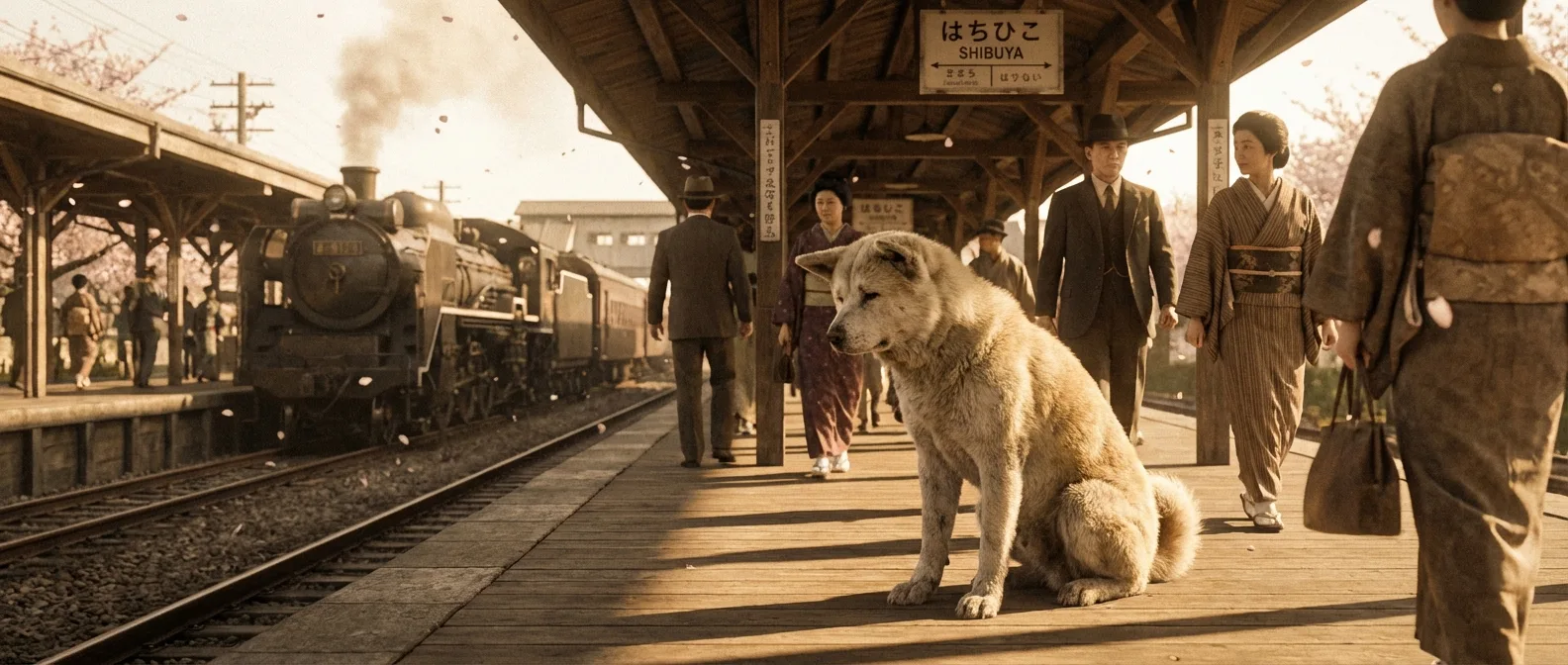
Hachiko: The Dog Who Waited 10 Years
A True Story
📖 Read more: The Soldier Who Hid in the Jungle 30 Years After the War
Born in Akita
Hachiko was born in mid-November 1923, on a farm near the city of Ōdate, in Akita Prefecture, northern Japan. He was one of four male puppies of purebred Akita stock — large dogs with thick creamy-white fur, known for their strength and unwavering devotion.
Professor Hidesaburō Ueno, a pioneer of agricultural engineering at Tokyo Imperial University, did not buy Hachiko. The puppy was a gift from Chiyomatsu Mase, a former student of Ueno's working in Akita Prefecture. On January 14, 1924, the puppy was placed in a straw bag with cookies — which he didn't eat — and shipped by train through snowy mountains to Tokyo.
When he arrived, they thought he was dead. The exhausting journey had left him nearly unconscious. Ueno and his partner, Yaeko Sakano, nursed the puppy for six months until he fully recovered.
Life with the Professor
Ueno adored Hachiko. He let him sleep indoors, under his Western-style bed — unusual for the era in Japan. Hachiko had chronic digestive problems, so Ueno and Yaeko followed a strict dietary regimen for him. They raised him with deep affection and constant care.
Every morning, Hachiko accompanied Ueno to Shibuya Station. Every afternoon, he appeared at the ticket gates — always at the same spot, always at the same time. When Ueno stepped off the train, Hachiko's entire body would shake with joy. They walked home together, step by step. Station staff and locals knew them well — the professor and the big white dog who waited for him every evening.
The Akita Inu breed is recognized in Japan as a symbol of devotion and honor. By 1928, according to research by Hirokichi Saitō, only 30 purebred Akitas remained in all of Japan — Hachiko among them.
The day he never came home
Professor Ueno went to work as he did every morning. That day, he suffered a cerebral aneurysm while in a colleague's office. He died instantly. He was 53 years old.
That afternoon, Hachiko walked to Shibuya Station, as he always did. He sat at the ticket gates. He waited. Ueno never appeared. Hachiko waited until dark. Then he walked home. Alone.
Yaeko wrapped Ueno's blood-stained shirt inside a futon and placed it in outdoor storage. Three days later, they found Hachiko there — lying next to the shirt, having eaten nothing. On May 25, during the wake, Hachiko lay under Ueno's coffin and didn't move. The next day, May 26, he went back to Shibuya Station to wait.
"Despite having been with Ueno only about 15 months, Hachiko waited for Ueno, 'commuting' almost daily for the next nine and a half years."
After Ueno's death, Hachiko's life became chaotic. Yaeko had to leave the house two months later and could only keep one dog — the aggressive Esu. Hachiko was passed to relatives. First to Watanabe, a kimono shop owner, who kept him tied up all day.
Next, he was sent to the Takahashi family in Asakusa, who manufactured barber chairs. There, he was chained to a barber chair in the backyard. One day he broke free, got into a fight with other dogs, and bystanders beat him with tools — wanting to kill him. He survived only because the family's son, Kōichirō, stepped in to stop them.
Eventually, Yaeko entrusted him to Kikusaburō Kobayashi — Ueno's gardener, who lived near Shibuya Station. Kobayashi had known Hachiko since he was a puppy. He was the person who had picked him up at the station on January 15, 1924, on Ueno's behalf. With the Kobayashis, Hachiko finally found a loving home. Kobayashi cared for him “as a living memento of Ueno” — and according to his son Sadao, treated the dog better than his own children.
The endless wait
Once settled with the Kobayashis, Hachiko resumed his routine. Every morning around 9, he walked to Shibuya Station. He sat at the ticket gates. He watched the faces of people coming out. He returned home between 5 and 6 in the evening. This happened every single day — rain, snow, blazing heat, typhoon. He always walked with his head down, as though in mourning.
But the waiting was far from peaceful. Most people treated him as a stray and a nuisance. Station employees kicked him, hit him, poured water on his face. Yakitori vendors chased him away. Some painted marks on his face with ink — black circles around his eyes like glasses, curved lines on his muzzle like a mustache. His collar and ID tag were repeatedly stolen, since people believed a dog's ID tag brought good luck in childbirth.
In the spring of 1929, Hachiko fell severely ill with mange. He lost all his fur. He nearly died. The Kobayashi family refused to give up on him, and after months of care he recovered — though his left ear, which already drooped from an earlier dog fight, drooped even more afterward.
Despite all the mistreatment, Hachiko was known as calm, gentle, and dignified. He never barked at people or other dogs. He loved snow — sliding downhill using his head and neck to steer. But he was terrified of thunder and gunfire from the nearby Yoyogi Military Field. When he heard them, he would bolt into the nearest house to hide.
"I saw Hachiko coming out of the station employees' room, with dark circles around his eyes, looking like he was wearing black-framed glasses. His snout had curved lines, like a black mustache. I felt sorry for him. He looked sad, as if he were in mourning."
All of Japan learns his name
Hirokichi Saitō, a descendant of samurai and founder of the Society for the Preservation of Japanese Dogs, had first encountered Hachiko in July 1928. He visited him regularly, fed him yakitori, and played “paw,” “sit,” and “turn around” with him. He studied the dog for years and wrote about his life.
On October 4, 1932, the Asahi Shimbun newspaper ran an article based on Saitō's research, headlined: “Tale of a Poor Old Dog: Patiently Waiting for Seven Years for the Dead Owner.” The journalist hadn't consulted Saitō, and the piece was full of errors — but none of that mattered. It ran across Japan. Hachiko became a celebrity overnight.
People began bringing him food at the station. Teachers and parents used his story as a moral lesson for children. With fame, the mistreatment decreased — but never fully stopped. In January 1934, fourth-grade girls wrote to the stationmaster, reporting that they'd seen a boy kick Hachiko and a station employee pour water on him in the dead of winter.
📖 Read more: The Man Who Lived in an Airport for 18 Years
His proper name was “Hachi” (八, eight). After the publicity, people called him “Hachikō” — with the suffix "-kō" (公) meaning “noble, prince,” used as a term of affection. His full Japanese title: Chūken Hachikō (忠犬ハチ公) — “the faithful dog Hachiko.”
The bronze statue
In January 1934, Saitō and sculptor Teru Andō launched a national fundraising campaign for a bronze statue. The response was overwhelming — donations poured in from academics, students, and professionals, as well as from Korea, China, Taiwan, and America. One fundraising event alone attracted 3,000 people.
On April 21, 1934, at 1pm, the bronze statue was unveiled at Shibuya Station. The crowd was so dense that Saitō and 10-year-old Hisako — Ueno's granddaughter — barely managed to reach the platform. Hisako cut the ribbon. Hachiko himself was there, sitting beside his own statue, as the crowd cheered.
Andō chose to make the statue realistic — with the left ear drooping, exactly as it truly was — rather than as an idealized Akita. The decision drew some criticism, but the result was authentic. Hachiko was already 10 years old, worn and tired, but every day he still went to the station.
The last evening
Hachiko was now 11 years old. He had struggled to walk for months. Years of health problems — heartworm, fluid in the abdominal cavity — had taken their toll. In early March 1935, he stopped eating. His abdomen swelled. He began vomiting.
Around 11pm on March 7, Hachiko visited every shop in front of Shibuya Station, one by one. Around midnight, he entered every room inside the station. According to witnesses, he may have been saying goodbye to the people and places he had known for a decade. At the Takizawa liquor store, which had fed him for years, he stopped in one last time.
He was found dead around 6am on March 8, 1935, in an alley near the Takizawa Liquor Store — just steps from the station. Haruno Takizawa, the owner's wife, found him at the gate of her house — still warm. She stroked him and called his name. His head was turned eastward, toward Aoyama Cemetery — where Ueno rests.
"It is the only time in Japanese history that nationwide mourning has occurred for an animal."
Newspapers around the world reported his death — Los Angeles, Paris, Budapest. Approximately 10,000 people visited his statue over the following five days. The funeral was held on March 12 at Aoyama Cemetery, with 16 Buddhist monks, Hachiko's four-year-old son Kuma-kō, and about 60 attendees. Two necropsies eventually confirmed his causes of death: carcinosarcoma (cancer) and heartworm. Four yakitori skewers were found in his stomach, but they had caused no damage.
The fate of the statue
During World War II, the Japanese government requisitioned metals for the war effort. Someone draped a white sash across Hachiko's statue with the words “Conscript it.” On October 12, 1944, it was taken down in an emotional farewell ceremony. Many considered this the “second death” of Hachiko.
It was melted down on August 14, 1945, in Hamamatsu — one day before Emperor Hirohito announced Japan's surrender. It became locomotive machinery parts — not bullets, as sometimes claimed. The sculptor Teru Andō and his daughter had already perished in the Tokyo bombing raid of May 25, 1945.
📖 Read more: The Climber Who Cut Off His Own Arm to Survive
After the war, Teru's son Takeshi Andō — who had survived frontline service — took on the task of building a second statue. The American occupation authorities initially resisted, viewing the dog's loyalty as promoting devotion to imperialism. Eventually they realized Hachiko had nothing to do with that. Ordinary citizens — Japanese and American — donated money. The new statue was unveiled on August 15, 1948, the third anniversary of the surrender. It still stands at the same spot today.
A legacy beyond borders
Hachiko's story crossed oceans. Helen Keller visited Japan in 1937, asked about him, and received an Akita puppy — Kamikaze-Go — who became the first Akita to travel to America. After the war, American soldiers brought dozens of Akitas home, and the breed spread across the world.
In 1987, the film “Hachikō Monogatari” became the highest-grossing Japanese film of the year. In 2009, the American remake “Hachi: A Dog's Tale” starring Richard Gere moved audiences worldwide. The Futurama episode “Jurassic Bark” (2002), inspired by Hachiko, is considered one of the most emotionally devastating half-hours in television comedy — Fry's dog Seymour waits 12 years for his owner who was frozen into the future.
On March 9, 2015, at the University of Tokyo — where Ueno had worked — a new pair of bronze statues was unveiled: Hachiko joyfully jumping up to greet Ueno returning from work, briefcase placed on the ground. After 80 years, they were reunited — at least in bronze.
On May 19, 2016, part of the remains of Yaeko Sakano was finally buried beside Ueno and Hachiko at Aoyama Cemetery — after 55 years of negotiations between the two families. “To Hachiko, the professor was his father, and Yaeko was his mother,” one of the organizers said. Hachiko's family was whole again.
In November 2023, Japan celebrated Hachiko's 100th birthday. A hologram of him greeted visitors at the Akita Dog Center in Ōdate. Every year on March 8, a memorial ceremony takes place at his statue. The front paws and muzzle of the bronze figure gleam — polished smooth by millions of hands, year after year.
Why we remember Hachiko
Hachiko's story isn't one of heroism. It's not a mystery or a crime. It's something simpler — and perhaps that's why it's more powerful: the story of a dog who couldn't understand why his person didn't come back.
Hachiko didn't know what death meant. He only knew that every day, Professor Ueno comes through the railway gate. And that's what he waited for. Nearly ten years. Abused, ill, old — but always there.
In an age when loyalty feels like a luxury, Hachiko reminds us that some bonds don't break — not with time, not with death. He may not have been a hero. He was just a dog. But nobody remembers the people who kicked him at the station. We remember him.