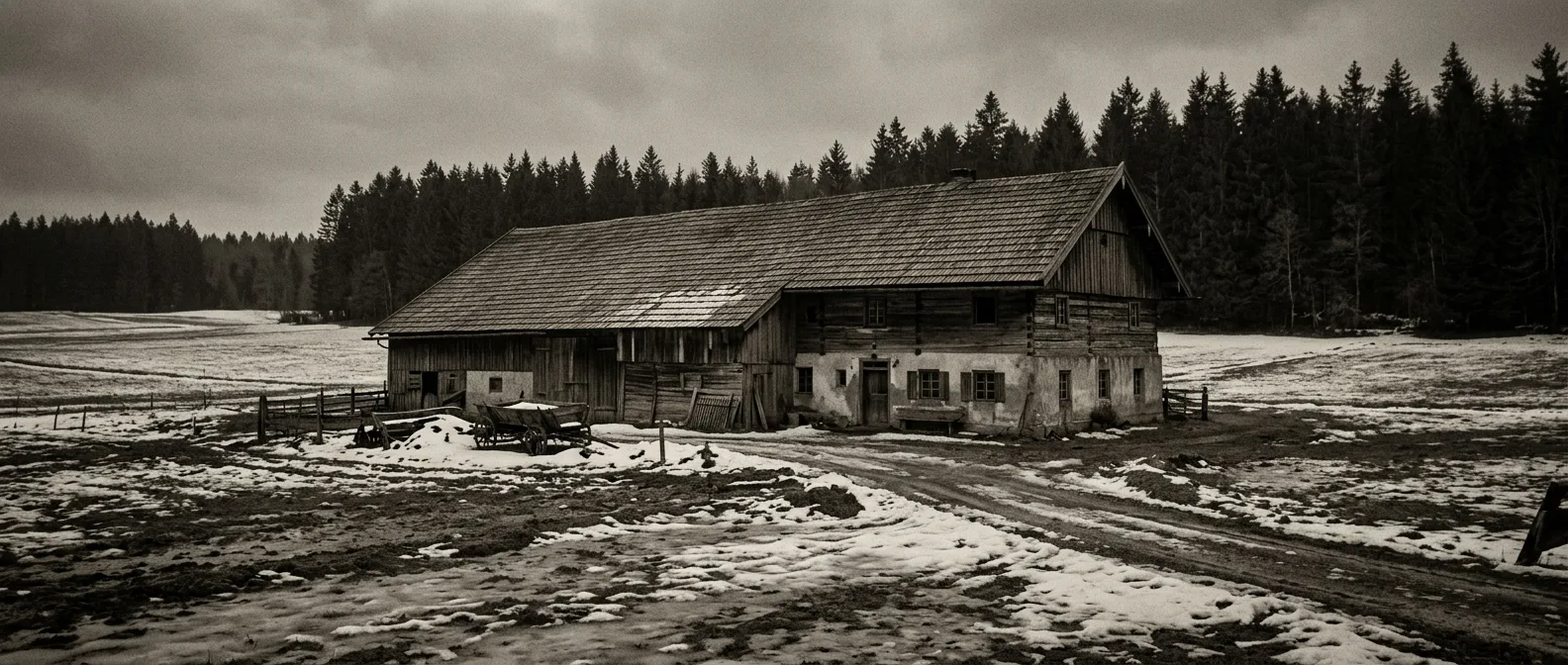
Hinterkaifeck Farm: 6 Dead and the Killer Lived There
On March 31, 1922, neighbors grew worried because no one had seen the Grubers in days.
📖 Read more: Zodiac Killer: The Murderer Who Sent Cryptic Ciphers
The farm in nowhere
The Hinterkaifeck farmstead was built around 1863 in an isolated spot between the villages of Waidhofen and Gröbern in Bavaria. Its name literally means “behind Kaifeck” — a tiny hamlet about a mile to the south. The farm was surrounded by dense forest, hidden from the outside world. Andreas Gruber, born on November 9, 1858 in Grainstetten, married Cäzilia Sanhüter in 1886. Cäzilia, already 37 at the time, had three children from her first marriage to Josef Asam.
Their daughter Viktoria was born in 1887. She married Karl Gabriel on March 11, 1914. A few months later, Karl was called up to serve in World War I. He was reported killed at the Battle of Arras on December 12, 1914 — at least according to official records. His body, however, was never recovered.
In 1915, Andreas and Viktoria were convicted of incest. Andreas received a one-year prison sentence; Viktoria served one month. The relationship did not stop. In 1919, Lorenz Schlittenbauer — a neighbor and Viktoria's lover — reported Andreas to authorities after Viktoria confessed that her newborn son Josef had been fathered by her own father. Schlittenbauer initially withdrew the complaint, then reasserted it at trial, but the court did not convict. Ultimately, Schlittenbauer agreed to adopt little Josef.
Six months before the murders, maid Kreszenz Rieger had quit. She claimed she kept hearing strange noises in the attic and believed the farm was haunted. Her replacement was Maria Baumgartner, 44 years old. Maria's sister escorted her to the farm and left shortly after — she was likely the last person to see the family alive. Maria worked at Hinterkaifeck for exactly one day before she was murdered.
The warning signs
In March 1922, Andreas discovered a strange newspaper from Munich on his property — a paper no one in the area was subscribed to. He initially assumed the postman had lost it, but that was not the case. Someone unknown had brought it there.
Just days before the murders, Andreas found footprints in the fresh snow. They led from the forest to a door with a broken lock that connected to the farm's machine room — but there were no tracks leading back. Someone had entered the property and never left. That same evening, the family heard footsteps coming from the attic. Andreas searched but found no one. Despite telling neighbors about what he had seen, he refused offers of help and never contacted police.
According to a school friend of young Cäzilia, Viktoria had fled the farm the night before the murders after a violent argument with her father — and was found hours later wandering in the forest. The prevailing theory: the killer had been hiding in the attic for days, watching the family's every move.
The night of March 31
Late on the evening of Friday, March 31, Viktoria, her seven-year-old daughter Cäzilia, and her parents were lured to the barn through the stable. The killer was waiting. Andreas was first. He was struck on the head with a Reuthaue — a heavy mattock used by Bavarian farmers. Then his wife Cäzilia. Then Viktoria. And finally, little Cäzilia.
The four bodies were stacked in the barn. But little Cäzilia did not die immediately. Forensic examiners later discovered she had torn her own hair out in tufts — evidence that she remained alive for hours after the assault, lying on the straw beside the corpses of her family.
The killer then moved into the living quarters. He killed Maria Baumgartner in her bed — she was most likely still asleep. Last was little Josef, just two years old, in his bassinet. The same weapon was used on both victims inside the house.
The Reuthaue was later found hidden in the barn's loft, covered in dried blood. A penknife was also discovered buried in the hay — it was never identified as belonging to anyone.
The killer who didn't leave
After the murders, the perpetrator did not abandon the farm. He remained there for at least three to four days. He fed the animals. He cut meat from the pantry. He consumed the entire bread supply from the kitchen. He lit a fire in the hearth.
At 3:00 a.m. on April 1 — the night of the murders — a farmer named Simon Reißländer, traveling home near Brunnen, spotted two mysterious figures standing at the edge of the forest near Hinterkaifeck. When the strangers noticed him, they turned away so their faces could not be seen.
The following night, an artisan named Michael Plöckl happened to pass by the farm. He observed smoke indicating the oven was being heated. An unidentified occupant approached Plöckl and blinded him with a lantern. He also noticed the smoke had a revolting odor. His report was never investigated — no one examined what had been burned inside the oven.
Money was untouched. Andreas had a significant sum of cash hidden in the house — it remained in place. The killer did not come for robbery.
The farm was discovered on April 4 — four days after the murders. Schlittenbauer first sent his 16-year-old son Johann and 9-year-old stepson Josef Dick. They found no one. He arrived later that afternoon with Pöll and Sigl. They found four bodies in the barn and two inside the house.
The investigation that failed
An investigative team from Munich, led by Inspector Georg Reingruber, was assigned to the case. But the crime scene had already been contaminated: onlookers had moved the bodies, touched potential evidence — some had even cooked meals in the kitchen. On April 5, court physician Johann Baptist Aumüller performed autopsies inside the barn. The victims' skulls were removed and sent to Munich for examination.
Lorenz Schlittenbauer was the first suspect. When the bodies were found in the barn, he immediately unlocked the front door of the house without difficulty — even though a key had gone missing from the household days before the murders. He entered the house alone. Why wasn't he afraid the killer might still be inside? In 1925, he was found visiting the demolished remains of Hinterkaifeck. He stated that the killer's attempt to bury the victims had been hindered by frozen ground — information seemingly only the perpetrator would know. He died in 1941 without ever being charged, having won several slander lawsuits against anyone who called him “the murderer of Hinterkaifeck.”
Karl Gabriel, Viktoria's “dead” husband, was never fully ruled out. His body was never found at the Battle of Arras. After World War II, prisoners of war from the Schrobenhausen region claimed that a German-speaking Soviet officer had identified himself as the Hinterkaifeck murderer. The theory that this officer was Gabriel, who had emigrated to the Soviet Union, was never substantiated.
The Gump brothers — Adolf and Anton — were members of Freikorps Oberland, a far-right paramilitary organization. Adolf was identified as a suspect as early as April 9, 1922, and was allegedly involved in the murder of nine farmers in Upper Silesia in 1921. Their sister, Kreszentia Mayer, declared on her deathbed that her brothers had committed the murders. Anton was taken into custody but later released, and the case against him was discontinued in 1954.
The case was officially closed in 1955. The last interrogations were conducted in 1986 by Detective Chief Superintendent Konrad Müller-Thumann before his retirement.
The macabre remains
The Hinterkaifeck farm was demolished in 1923, less than a year after the murders. During demolition, new evidence emerged — the blood-encrusted Reuthaue hidden in the loft and a penknife buried in the hay. A small concrete monument known as the Hinterkaifeck Andachtsstätte was erected near the site as a memorial to the victims.
The victims' skulls, removed for forensic examination, were lost during World War II. Without them, modern DNA analysis became impossible. In 2007, fifteen students from the Fürstenfeldbruck Police Academy re-examined the case using contemporary criminal investigation techniques. Their final report confirmed the meticulousness of the original investigation but criticized the failure to collect fingerprints — a practice already common at the time. All authors of the report independently agreed on who the main suspect was — but his name was not published, out of respect for his living descendants.
The case has inspired countless works. Andrea Maria Schenkel published the novel “Tannöd” in 2006 — a fictionalized account of the events. It sold over one million copies, was translated into twenty languages, and adapted into a film in 2009. Amazon's TV series “Lore” devoted an entire episode to the case in 2018.
The farm that never spoke
Hinterkaifeck haunts us because it combines everything: an isolated farm surrounded by forest, a family harboring dark secrets of incest, a killer who hid for days in the attic watching his victims, and a police investigation that never identified him.
More than a century later, the truth remains buried — like the bodies in the barn of that Bavarian farmstead. Perhaps somewhere there once existed a confession, a letter, a note tucked inside some drawer. But to this day, the Hinterkaifeck farm keeps its secrets.