How an Italian Stole the Mona Lisa
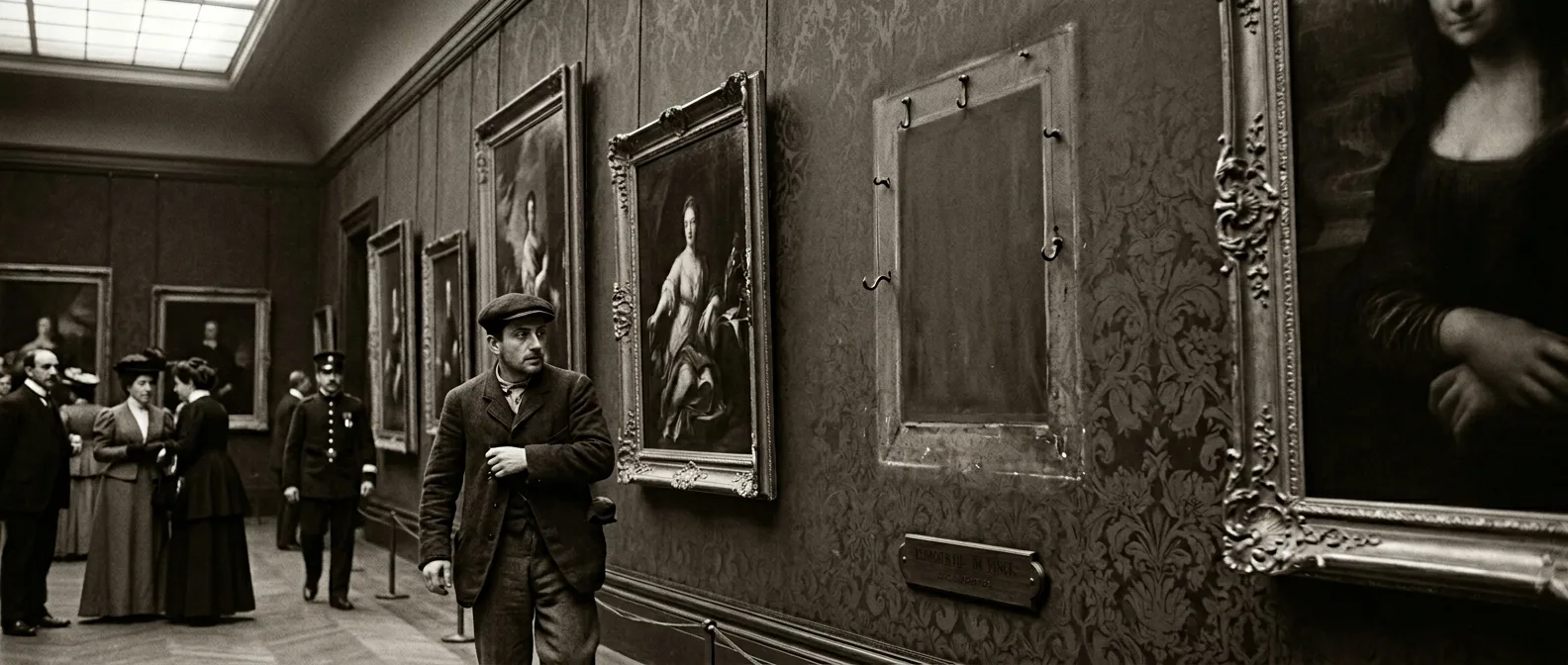
On August 21, 1911, a short Italian worker named Vincenzo Peruggia walked into the Louvre Museum in Paris, detached the ...
📖 Read more: The Conman Who Sold the Eiffel Tower Twice
The man behind the theft
Vincenzo Peruggia was born on October 8, 1881, in Dumenza — a small village in the Italian Alps, near the Swiss border. He was a working-class man, without notable education or ambition. In 1908, he moved to Paris looking for work.
He found employment at the Louvre Museum — cleaning paintings, installing frames, constructing protective cases. He was part of the very team that built the glass covering for the Mona Lisa. He knew exactly how the security worked — and how little of it there was. Entry to the museum was free. Guards were few. Peruggia stood just 5 feet 3 inches tall, thin, with a mustache — the last person you'd suspect.
A morning at the Louvre
Monday, August 21, 1911. Closing day — every Monday during summer, the museum was shut to the public. Peruggia entered around 7am through the workers' door, wearing a white smock — indistinguishable from the rest of the staff.
When the Salon Carré gallery was empty, he lifted the Mona Lisa off the four iron pegs securing it to the wall — between a Correggio and a Titian. He carried it to a nearby service stairway, removed the protective glass case and frame, and hid those behind student artworks stored on the staircase landing.
The painting — executed on wood, measuring just 30 by 21 inches — was too large to conceal under a smock worn by a man of his size. Instead, Peruggia took off his smock, wrapped it around the painting, tucked it under his arm, and descended the stairs. At the exit, the service door was locked. A plumber, thinking he was a fellow employee, unlocked it for him. Peruggia walked out into the Paris morning with the Mona Lisa under his arm.
The Louvre director, who was on holiday, had once boasted: "Steal the Mona Lisa? That would be like thinking someone could steal the towers of Notre Dame cathedral."
28 hours before anyone noticed
Tuesday morning, August 22. A normal day. A painter enters the Salon Carré to sketch the Mona Lisa — a common sight, as artists regularly copied works from the collection. He sees four empty pegs on the wall. He asks a guard. “They probably took it for photographing,” comes the reply.
Hours pass. Nobody worries. The arts minister had left instructions: “Don't call me unless the Louvre burns down or the Joconde is stolen.” Until someone finally checks — and discovers the Mona Lisa isn't in any workshop, any photography studio, anywhere. Panic. At least 60 policemen pour into the Louvre hunting for clues.
France in shock
The theft became global news overnight. Newspapers in Paris, London, New York — all ran the story on the front page. The Louvre shut down for a week. The chief investigating officer declared confidently: "The theft took place on closing day, we know who came in and out — this investigation will only take two to three days."
It didn't take three days. It took over two years. Police interrogated dozens of suspects — among them the poet Guillaume Apollinaire, who was arrested and imprisoned for several days, and Pablo Picasso, who was called in for questioning and released. Passengers aboard an ocean liner were searched before departure. In New York, police searched another ship. Newspapers offered reward money. Hundreds of false tips flooded the police and the press daily.
Meanwhile, thousands of people went to the Louvre — to stare at the empty wall. One visitor described being "among numerous curious visitors, staring at the empty space where the famous lady had hung." The Mona Lisa was becoming more famous now that she was gone.
"People go to the Louvre to see the empty wall. The Mona Lisa is more famous now that she is missing than when she hung there."
Two years under the bed
Peruggia took the painting to his small apartment in Paris. He placed it inside a wooden trunk, under his bed. There the Mona Lisa remained — hidden, wrapped in cloth, in a rented room that cost a few francs a week — for two full years.
Police visited Peruggia's apartment and questioned him twice about his possible involvement. The second time, a detective sat at the very table under which the painting was hidden in a cavity — and wrote his report there, leaning on it. He didn't find it. Though Peruggia's thumbprint was on the glass case, his fingerprints and photograph were already in police files (he'd been arrested and photographed in 1909), and it was known he'd helped build the protective glass and wasn't working at the time of the theft — the police forgot to add his name to the list of fingerprints to check against their records.
📖 Read more: The Postman Who Hoarded 40,000 Letters at Home
The detective wrote his report leaning on the table under which the painting was hidden. The greatest art theft of the 20th century was literally under his nose.
Motive — patriotism or profit?
Peruggia always insisted the theft was an act of patriotism. “I am an Italian and I do not want the picture given back to the Louvre,” he declared. He believed Napoleon had plundered the painting from Italy — which was untrue. Leonardo da Vinci brought it to France himself in 1516, as a gift for King Francis I, 250 years before Napoleon was born.
But letters he sent to his father reveal different motives. Four months after the theft he wrote: “Paris is where I will make my fortune — and it will arrive in one shot.” The next year: "I am making a vow for you to live long and enjoy the prize that your son is about to realize for you and all our family." His notebook before the theft contained names of billionaires: Rockefeller, Carnegie. He had even traveled to London to try selling the painting — where the dealer Duveen laughed at him.
There's a third theory: the Argentine con man Eduardo de Valfierno had commissioned the French forger Yves Chaudron to make copies of the Mona Lisa. He planned to sell them as “the real thing” — but only if the original vanished. Did he use Peruggia to carry out the theft? The theory rests on a single 1932 magazine article, with no external confirmation. But it fits the picture.
The arrest in Florence
After two years, Peruggia finally made his move. He saw advertisements by antique dealers in an Italian newspaper, took the painting by train to Italy, and settled in a cheap hotel room in Florence — unable even to pay his bill.
In December 1913, he contacted Alfredo Geri, an art gallery owner in Florence, signing himself as “Leonardo V.” He offered to sell the Mona Lisa for 500,000 lire. Geri brought in Giovanni Poggi, director of the Uffizi Gallery, to authenticate it. Peruggia opened a suitcase in his hotel room — and there, wrapped in red cloth amid socks and underwear, lay the Mona Lisa. Poggi confirmed it was genuine. After taking the painting “for safekeeping,” they informed the police. Arrest.
Hero or fool?
Italy's reaction was extraordinary: Peruggia became a national hero. Crowds cheered him. Newspapers hailed him as a “patriot.” The New York Times ran the headline: "FLORENTINES IN RIOT OVER 'MONA LISA'; Crowd of 30,000 Sweeps Police Aside in Mad Rush to See Stolen Painting."
Before its return to the Louvre, the painting toured Italian museums — Florence, Rome, Milan. Millions of Italians came to see it. The trial was nearly farcical. The court psychiatrist, Paolo Amaldi, posed a riddle: “Two birds in a tree. A hunter shoots one. How many are left?” Peruggia answered: “One!” The correct answer was zero — the other bird would have flown away. Amaldi declared him “an imbecile.” This, combined with popular pressure, led to a lenient sentence: one year and 15 days — reduced on appeal to just seven months.
"He was, quite clearly, a classic loser."
After prison
Peruggia was released and served in the Italian Army during World War I. He was captured by Austria-Hungary and held as a prisoner of war for two years until the war ended. After the war, he married Annunciata Rossi, had a daughter named Celestina, and returned to France.
He worked again as a house painter, using his birth name, Pietro Peruggia. He never made any money from the theft. He never became rich. He died on October 8, 1925 — on his 44th birthday — of a heart attack, in Saint-Maur-des-Fossés, a suburb of Paris. His death went largely unreported, because he was living under the name Pietro — and no one connected the quiet painter with the legendary thief.
The theft that made a masterpiece a legend
The Mona Lisa was returned to the Louvre on January 4, 1914. Today, roughly 10 million people see it every year — behind bulletproof glass, in a climate-controlled case, under constant guard. At the 2024 Paris Olympics opening ceremony, the theft was humorously referenced when the Minions characters “stole” the painting in an animated sequence.
The story reveals something deeply paradoxical: the man who stole the Mona Lisa didn't destroy its fame — he created it. Before the theft, the painting was important but not particularly popular. It was the theft, the headlines, the empty wall, and two years of police incompetence that turned a masterpiece into a global icon. And Peruggia? He died nearly forgotten, without having earned a single franc from the most famous theft in art history.