Milgram Experiment: Would You Kill If Asked?
A True Story
📖 Read more: The Experiment That Proved How Easily We Obey Orders
The man behind the machine
Stanley Milgram was born on August 15, 1933, in the Bronx, New York, the son of Jewish immigrants from Eastern Europe. His father was a baker, his mother a seamstress. He grew up in a neighborhood where news from Europe arrived late but struck deep — relatives who never answered letters, entire branches of the family tree that vanished into the camps. At sixteen, Stanley watched a documentary about the Nuremberg Trials. Seeing the defendants repeat “I was following orders,” he felt something he couldn't explain: it wasn't the cruelty that shocked him, but the ordinariness of their faces.
He studied political science at Queens College, then turned to social psychology at Harvard under Solomon Asch — the man who had shown how easily a group can make you say a line is longer than your own eyes tell you. Milgram took it a step further: he wasn't interested in social pressure. He was interested in authority. The bare, unambiguous command of a man in a suit.
The shadow of Eichmann
In April 1961, the trial of Adolf Eichmann began in Jerusalem — the bureaucrat who organized the transport of millions of Jews to the death camps. Eichmann was no monster. He was a middle-aged man with glasses, thin hands, and sterilized speech. He sat behind glass and explained, with bureaucratic precision, that he was simply “following orders.” Hannah Arendt, covering the trial for The New Yorker, introduced the phrase “the banality of evil” — the idea that horror doesn't require monsters, only obedient people.
Milgram watched the trial from America, glued to his television. He had just taken a position at Yale University in New Haven, Connecticut. He was twenty-eight years old. Three months after the trial began, in August 1961, he launched the experiment that would make him famous — and haunt psychology for decades.
April 1961The Eichmann trial begins in Jerusalem. The world sees, for the first time in live broadcast, the architect of the “Final Solution” — an ordinary, expressionless bureaucrat.
The setup
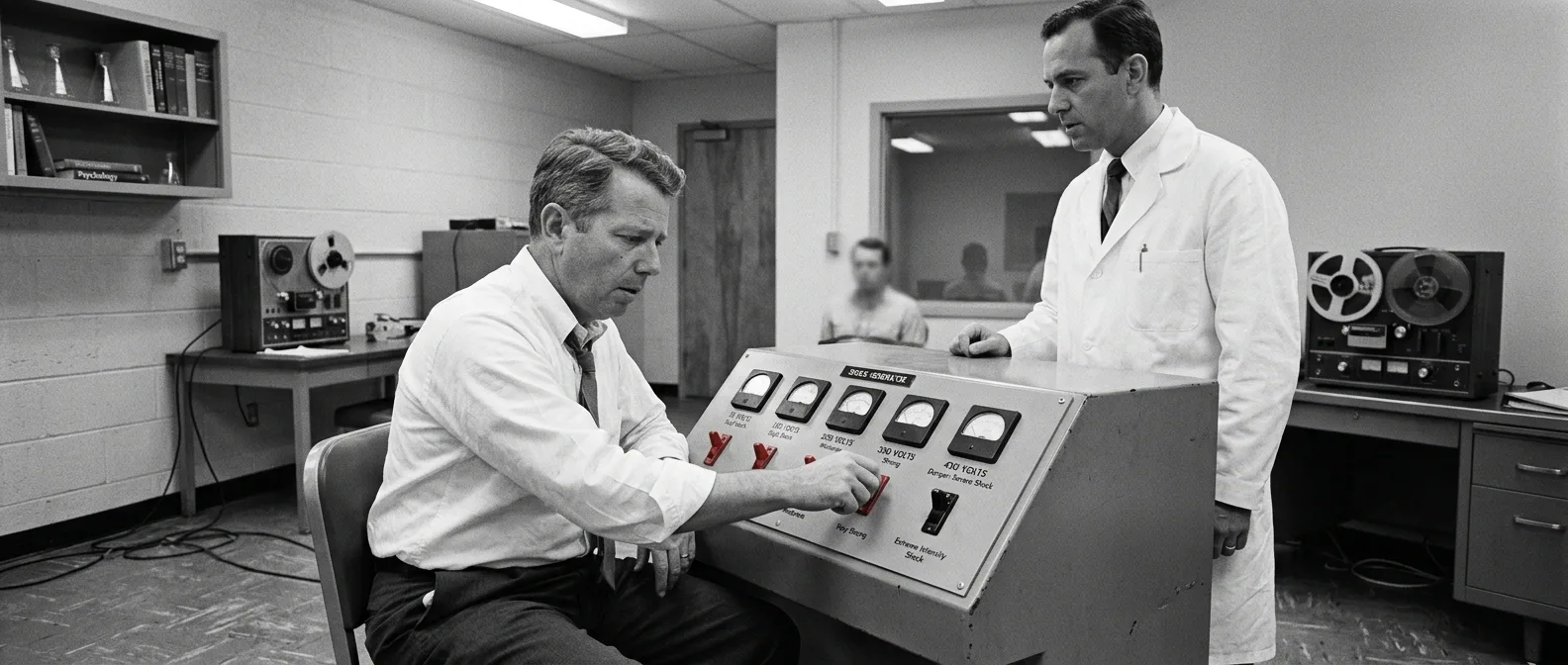
The room was in the basement of Linsly-Chittenden Hall at Yale. From outside, nothing unusual — a university building like any other. Inside, Milgram had staged a psychological thriller. Two chairs, a desk, a shock generator with thirty switches — from 15 volts ("slight shock") up to 450 volts (labeled “XXX DANGER”). The machine looked real. It wasn't.
Each volunteer arrived and met two people: the “experimenter” — a serious man in a gray lab coat — and a supposed second volunteer, the “learner.” In reality, both were actors. The “learner” was James McDonough, a pleasant fifty-year-old accountant — Milgram chose him deliberately because he looked “innocent, common, like someone's uncle.” A draw was held that appeared random but was rigged: the volunteer always became the “teacher” and McDonough always the “learner.”
The “learner” was led to the adjacent room and strapped to a chair. Electrodes were attached to his wrist — ceremonially, slowly, so the volunteer could see that “this is real.” Then the door closed. The volunteer sat before the shock generator, with the experimenter standing behind. No one explained what was really being studied.
The experiment began innocently. The “teacher” read word pairs — “blue box,” “nice day,” “wild bird” — and the “learner” had to remember them. Every wrong answer meant an electric shock. And each new shock was 15 volts stronger than the last.
15–60 voltsNothing remarkable. The “learner” doesn't react. The volunteer relaxes. This is nothing — like static electricity.
The four prods
The experimenter never shouted. Never threatened. Never raised his voice. He had only four phrases, used in sequence when the volunteer hesitated:
"Please continue."
"The experiment requires that you continue."
"It is absolutely essential that you continue."
"You have no other choice. You must continue."
That was it. No violence, no weapon, no blackmail. Just a calm man in a coat telling you to go on. And that was enough. It was enough because the experimenter represented something larger than himself — he represented science, the university, knowledge, order. He represented what Milgram later called the "agentic state": the moment a person transfers moral responsibility to an authority above them.
The results
Before the experiment began, Milgram asked forty psychiatrists what they expected. Their prediction: only 1–2% would go all the way to 450 volts — “sadists, psychopaths, the dark fringe of human nature.” Reality shattered them.
The findingOf the forty participants in the first series of experiments, twenty-six — exactly 65% — pressed the final switch. They went all the way to 450 volts. They pushed through the screams, through the pounding on the wall, through the silence. They pressed “XXX DANGER” and waited for instructions.
📖 Read more: Jim Twins: Separated at Birth, Lived Identical Lives
Inside their heads
After the experiment, Milgram spoke individually with each volunteer. The word that recurred most often was “orders.” “He told me to continue.” “I figured he knew what he was doing.” “I assumed he wouldn't ask me to do anything dangerous.” Some were relieved to learn the shocks weren't real. Others broke down — not because someone was harmed, but because they discovered they could have been.
A postal worker from New Haven who pressed the final switch said afterward: "I don't know why I didn't stop. I only know I wanted to stop. But that man stood behind me and I couldn't. I couldn't. It was as if someone had removed my will." Another, a high school teacher, stated: "Every time I pressed the switch, a voice inside me said stop. But another voice, louder, said: he knows better. He's a scientist."
The variations
Milgram didn't stop at one experiment. Between 1961 and 1962, he conducted eighteen variations, changing one variable each time. The results drew a map of human obedience — and its borders.
Variation: ProximityWhen the “learner” was in the same room — visible, present — the obedience rate dropped to 40%. When the volunteer had to physically press the “learner's” hand onto the electric plate, it fell to 30%. Distance makes violence easier.
The earthquake in the scientific community
Milgram published the results in 1963 in the Journal of Abnormal and Social Psychology. The reaction was explosive. Psychologists, philosophers, journalists — everyone responded. Some refused to believe the numbers. Others accepted them and felt horror. Bruno Bettelheim, himself a camp survivor, declared the experiment “as unethical as what it was trying to study.” Diana Baumrind, a psychologist at Berkeley, accused Milgram of causing psychological harm to the volunteers.
The ethical debate was fierce — and fair. Many volunteers experienced genuine distress: trembling, crying, nervous laughter, panic attacks. Some reported nightmares weeks later. Milgram maintained that no one suffered permanent damage — a follow-up one year later showed that 84% of participants were “glad” they had taken part. But the question remained: how far can science go to prove a fear?
Replications around the world
The experiment was repeated dozens of times, in dozens of countries. The results were nearly identical everywhere — proving that obedience to authority is not an American phenomenon but a human one.
Germany, 1971Obedience rate: 85%. Researchers noted that German volunteers were more formal, less likely to question the experimenter. The shadow of the war still hung heavy.
📖 Read more: Kitty Genovese: Murder in Front of 38 Bystanders
Milgram after the experiment
The experiment made him famous — and destroyed him academically. Harvard refused to grant him tenure, partly due to the ethical controversy. He moved to the City University of New York, where he continued doing original research — he studied the “small world” phenomenon (the six degrees of separation theory), behavior in urban environments, the power of television. But no one remembered him for any of that. He was always “the man with the electric shocks.”
In 1974 he published the book “Obedience to Authority,” in which he described in detail the experiments, the variations, the reactions. The book became a classic — but Milgram never found peace again. Colleagues claimed the experiments haunted him. “He wanted to prove something about Eichmann,” a friend said, “and he discovered something about all of us.”
He died on December 20, 1984, of a heart attack, at just fifty-one years old. His funeral was small. His legacy was immense.
What it means for us
The Milgram experiment is not about some “bad people” in some faraway university. It is about the postal worker, the engineer, the teacher, the accountant. It is about people who pay bills, love their children, shop at the supermarket. People like you and me. And it shows that under the right conditions — a lab coat, a calm voice, a structure that removes responsibility — almost anyone can do something terrible.
This doesn't mean we are condemned. Milgram's variations also show the way out: proximity to the victim increases empathy. The dissent of even one person breaks the cycle. Contradictory authority nullifies obedience. Resistance is possible — but it is not automatic. You have to learn to recognize the moment you transfer your conscience to someone else.
The deepest message of the experiment is not that people are evil. It is that people are vulnerable — vulnerable to structures, to roles, to badges of authority. Eichmann was no monster. He was the employee who never questioned an order. And the Milgram experiment proved that Eichmann was not the exception. He was statistically probable.
EpilogueIn the basement of Yale, a machine with thirty switches sits behind one-way glass. It doesn't work anymore — it never did. But that doesn't matter. What matters is that hundreds of people sat before it and pressed every switch, down to the last one, because someone in a lab coat told them to continue.
If they asked you, would you stop?
Before you answer, remember: 65% believed they would stop. No one believed they would go all the way to 450 volts. And they did.
The only shield is not kindness. The only shield is awareness. Knowing that obedience is not a virtue — it is a reflex. And reflexes don't think. You do. If you remember that, perhaps — perhaps — you'll be part of the 35%.