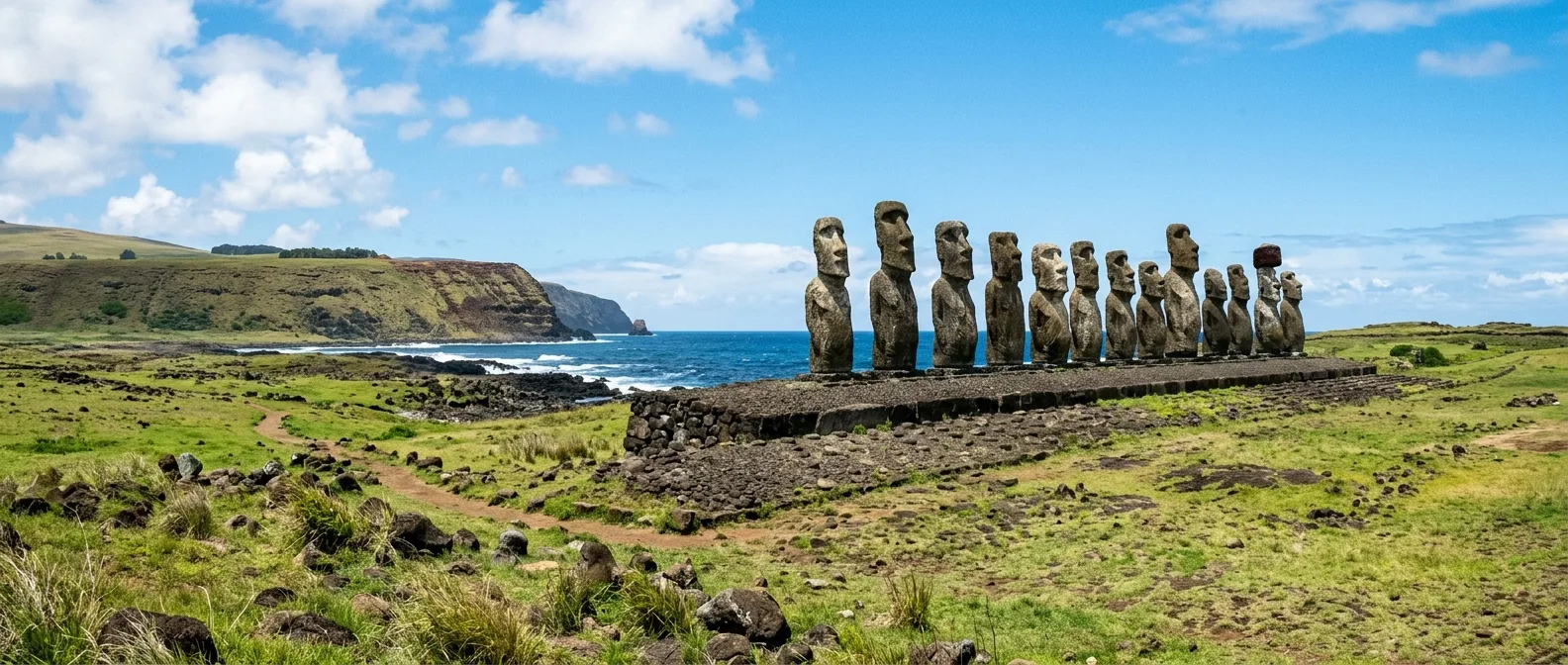
The Faces of the Pacific
900 stone giants, an island lost in the middle of the ocean, and a civilization that looked to the stars
📖 Read more: Pompeii: The City Frozen in Time
An island at the end of the world
There is a spot in the Pacific Ocean, 3,540 kilometers west of Chile and 1,900 kilometers east of Pitcairn Island, where there is nothing. Literally nothing — only water, wind, and horizon. And there, like a green triangle tossed into the void, sits Easter Island. Or, as its inhabitants call it: Rapa Nui — “Great Rapa” — or Te Pito te Henua — “The Navel of the World.”
The island is small — 23 kilometers long, 11 kilometers wide, 163 square kilometers total. It was formed by three volcanoes (Rano Kao, Rano Raraku, Terevaka) joined by lava flows. There is no natural harbor. No rivers. Vegetation is minimal — today only 31 indigenous flowering plants remain.
But on this small, bare island, someone in the past carved, transported, and erected over 900 giant stone statues — the Moai. And that remains one of the greatest archaeological mysteries on the planet.
Who were the builders
For decades, pseudoscientists and “ancient alien theorists” claimed the Moai couldn't have been made by humans. They required alien help, mythical giants, lost civilizations. The truth, however, is simultaneously simpler and more impressive: the Moai were built by the Rapa Nui people — Polynesian seafarers who reached the island sometime around 800–1200 CE.
The Rapa Nui belonged to the great Polynesian family — seafaring peoples who explored the Pacific in double-hulled canoes, navigating by stars, waves, and clouds. They most likely originated from the Marquesas Islands. When they reached Rapa Nui, they found an island covered in forests — giant palms, trees, shrubs. They settled, cultivated sweet potatoes, and began to build.
Their traditions divided the population into two groups: the “Long-Ears” (the aristocratic builders) and the “Short-Ears” (the laborers). This social division would play a role in the final catastrophe.
Rano Raraku: the factory of giants
Nearly all Moai were carved in one place: the volcanic quarry of Rano Raraku, on the island's southeastern side. There, the tuff — a porous volcanic rock — was soft enough to carve with stone tools but hard enough to withstand the centuries.
The sculptors used tools made of obsidian — volcanic glass — which was abundant on the island. They carved the statues directly into the bedrock, lying on their backs, then detached them. Dozens of unfinished Moai remain at Rano Raraku — some nearly complete, frozen at the moment work stopped forever. Each statue required teams of five to six specialized carvers working for months on end. The “master sculptors” were respected members of Rapa Nui society — they were compensated with food and enjoyed social prestige comparable to that of priests.
The largest unfinished Moai (known as “El Gigante”) measures 21 meters tall — roughly the height of a seven-story building — and weighs an estimated 270 tons. Had it been completed and transported, it would have been one of the largest carved statues in the world.
"Our ancestors had no iron, no wheels, no animals. They had only stones, ropes, and faith. And that was enough." — Rapa Nui tradition
How the statues “walked”
Transportation is the big question. How do you move 14-ton statues (on average) over distances up to 18 kilometers, without wheels, without draft animals, without iron?
The traditional theory was wooden rollers and sleds — tree trunks on which the statues were rolled. This theory, also supported by Thor Heyerdahl, conveniently explained the deforestation: they needed so many trees for transport that they eventually destroyed their own forests.
But the most striking theory came in 2011, when researchers experimentally demonstrated that the Moai could literally “walk.” By rocking a replica Moai left and right with ropes — like moving a refrigerator across a room — a small team managed to move it several meters. Rapa Nui tradition always claimed the statues “walked” to their positions — and perhaps it was right all along. The experiment, designed by archaeologists Carl Lipo and Terry Hunt, required just 18 people to move a five-ton replica. The largest platform on the island, Ahu Tongariki, hosts 15 restored Moai standing in a row — it was reconstructed in 1992 with Japanese funding after a devastating tsunami in 1960 had scattered the statues across the landscape.
Some statues had red stone “topknots” (pukao) on their heads, carved from red scoria at a second quarry at Puna Pau. Their eyes were white coral with obsidian pupils — only when the eyes were placed did the statue “come alive” and gain spiritual power.
📖 Read more: Tutankhamun's Curse: Coincidence or Truth?
The collapse — or the adaptation?
The classic narrative — popularized by Jared Diamond in “Collapse” — is tragic: the Rapa Nui people destroyed their island's forests to transport the statues. Without trees, they couldn't build canoes for fishing. Without roots, the soil eroded. Crops vanished. Civil war broke out between “Long-Ears” and “Short-Ears.” The statues were toppled. The civilization collapsed.
This story is compelling, but modern research challenges it. Many archaeologists now believe deforestation was partly caused by Polynesian rats — which ate the palm seeds, preventing regeneration. The Rapa Nui didn't “self-destruct” — they adapted: they developed stone gardens (manavai), used volcanic rocks as fertilizer, and transitioned from fishermen to farmers.
As Moai production ceased, a new religious practice emerged: the worship of Tangata Manu — the Birdman. Each year, athletes from every clan swam to a small offshore islet to retrieve the first egg of a migratory seabird called the sooty tern. The winner became the sacred leader for one year — a transition from hereditary power to competitive ritual that reflected the island's shifting social dynamics.
The real destruction came from elsewhere. In 1722, Dutch admiral Jacob Roggeveen “discovered” the island on Easter day — hence the name. He found a population of about 3,000 still worshiping the Moai. But the worst hadn't started yet.
The real catastrophe
In 1774, British explorer James Cook found an island in chaos — fewer than 700 men and fewer than 30 women. Most Moai had been thrown face-down. A violent upheaval had occurred between 1722 and 1774 — most likely civil war.
But the final massacre came in 1862, when slave traders from Peru raided the island and captured approximately 1,500 people — including the king, the priests, and everyone who knew the old script (rongorongo). Most died in Peruvian mines. The few who returned brought smallpox and tuberculosis. By 1877, the population had fallen to 111 people.
In 1888, Chile formally annexed Easter Island. Instead of protection, further oppression followed: a Scottish sheep-ranching company turned the island into a vast ranch, confining the Rapa Nui people to the town of Hanga Roa behind barbed wire fences. Until 1966, the islanders did not even hold Chilean citizenship.
The knowledge was lost. The rongorongo script — one of the very few independently developed writing systems in the world — was never deciphered. The names of the statues, their stories, their songs — all erased. That was the real collapse: not ecological, but colonial.
"They didn't destroy themselves. They were destroyed. The truth of Rapa Nui is not a moral lesson — it's a crime." — Modern archaeologists
The faces still watching
Today, Easter Island is a UNESCO World Heritage Site (since 1995). Its population exceeds 7,500 — many of Polynesian descent — and tourism forms the economic backbone. Every February, islanders of all ages compete in revival contests: carving, tattooing, reed-boat building, traditional singing and dancing.
The Moai still stand — some restored, some fallen, some buried to their necks at Rano Raraku. Recent excavations revealed that many “heads” visible above ground actually have entire bodies buried beneath — with detailed reliefs carved on their backs. Every dig brings new surprises.
But the real mystery isn't how the statues were transported — we more or less understand that now. The mystery is why. Why did a people on a small island in the middle of nowhere dedicate entire generations — hundreds of years, thousands of labor hours, countless resources — to carving stone faces that watch over their villages?
The answer is perhaps the most human one possible: so they wouldn't be forgotten. The Moai aren't statues — they are memory. They are one people's way of saying: “We were here. We lived. We built. Remember us.” And a thousand years later, we stand before them — and we remember.
— The End —