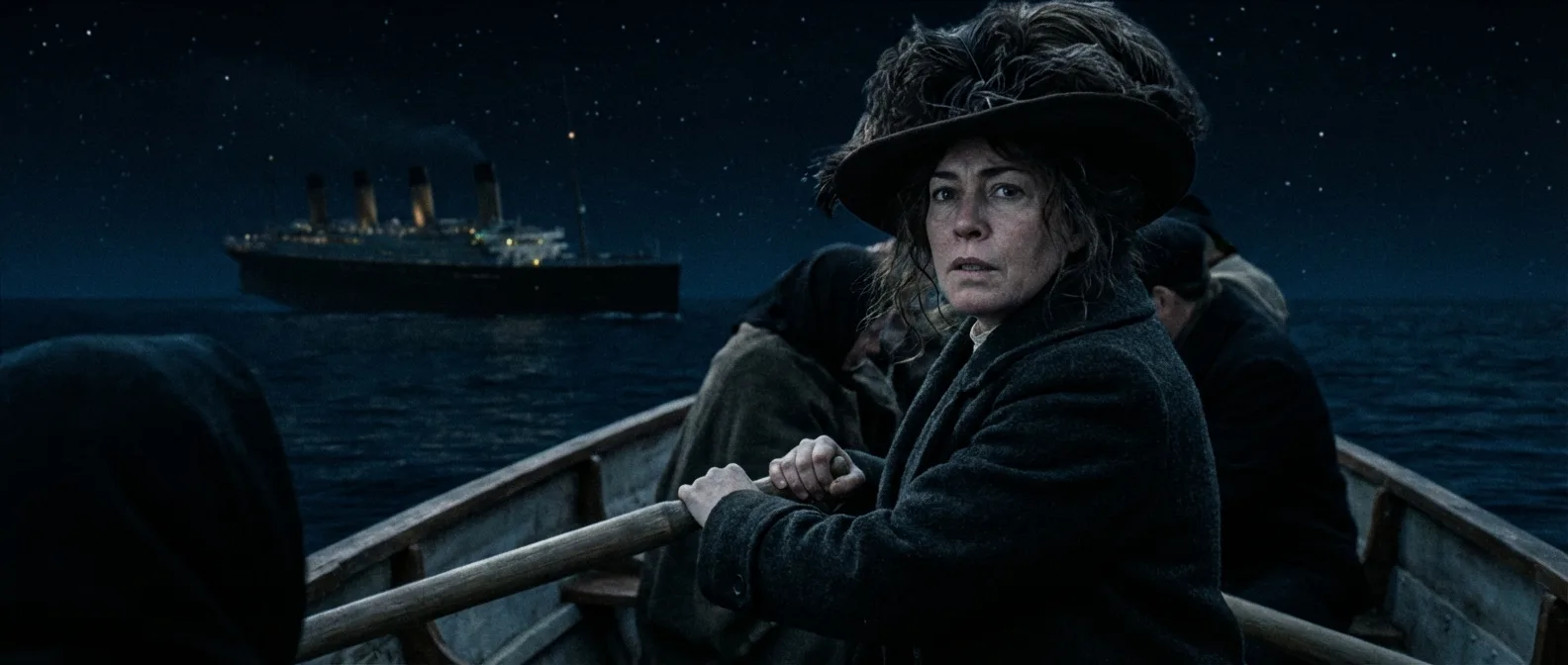
Molly Brown: The Unsinkable Woman of the Titanic
A True Story
📖 Read more: The Book That Predicted the Titanic 14 Years Before
A girl from the mud flats of Missouri
Margaret Tobin was born on July 18, 1867, in a cramped two-room cottage near the Mississippi River in Hannibal, Missouri — the same small town that Mark Twain had once made famous. Her father, John Tobin, was an Irish immigrant who worked the furnaces at the Hannibal Gas Works. Her mother, Johanna, took in laundry to help feed six children. There was no running water, no indoor plumbing, and barely enough food to go around. Margaret would later say she grew up “with more grit than groceries.”
She attended school only through the eighth grade, then went to work at thirteen — stripping tobacco leaves in a factory alongside other children from the poorest families in town. But Margaret was restless. She devoured books in secret. She listened to the steamboat men talk about cities far upriver and down. She dreamt of a life that did not smell of boiled cabbage and coal smoke.
In 1886, at eighteen, Margaret followed her older brother Daniel west to Leadville, Colorado — a boomtown high in the Rocky Mountains where silver and gold had drawn thousands of fortune seekers. She found work in a dry goods store, sewing carpet and stitching curtains. And it was there, at a church picnic in the thin mountain air, that she met James Joseph Brown.
Gold in the mountain
Margaret married J.J. Brown in the Church of the Annunciation in Leadville. He was twelve years her senior, a self-educated mining engineer with no fortune of his own. She later recalled telling a friend that she wanted to marry a rich man, but instead fell in love with a poor one. “I thought I'd rather have love than money,” she said. “Then I decided I'd have both.”
Boarding the ship of dreams
By 1912, Margaret and J.J. had separated — though never divorced. She was traveling through Europe and Egypt with her daughter Helen when a telegram arrived: her first grandchild was ill. Margaret cut the trip short and booked passage on the first available ship heading to New York. That ship was the RMS Titanic, departing from Cherbourg, France on April 10, 1912.
She boarded as a first-class passenger, cabin number 102 on B Deck. Over the next four days she charmed fellow travelers with stories of Colorado mining camps, played cards in the lounge, and organized a collection for a women's hospital in New York. She was forty-four years old, solidly built, with bright auburn hair and a personality that filled any room she entered.
On the evening of April 14, the Titanic was steaming at near-maximum speed through calm, freezing waters. The stars were brilliant. The sea was flat as glass — “like a millpond,” one survivor would later say. Margaret had retired to her cabin and was reading a book when, at 11:40 p.m., a faint shudder ran through the ship. She barely noticed it. Many passengers did not. It felt like the ship had grazed something — perhaps a sandbar, perhaps nothing at all.
📖 Read more: The Message in a Bottle That Was Answered a Century Later
It was not nothing. It was an iceberg. And the Titanic had less than three hours to live.
The night the ocean opened
The iceberg scraped along the starboard side of the Titanic, buckling steel plates and popping rivets across six forward compartments. Seawater began pouring in at a rate that the pumps could not match. Within an hour, the ship's designer, Thomas Andrews, told Captain Smith the truth: the Titanic would sink. There was no question of “if” — only “when.” And there were lifeboats for only 1,178 of the 2,224 people on board.
"Turn this boat around"
The screams lasted approximately twenty minutes. Over 1,500 men, women, and children were in the water, clinging to wreckage, crying for help. The water temperature was 28 degrees Fahrenheit — cold enough to kill a person in fifteen to thirty minutes. Of the twenty lifeboats launched, only one went back to pick up survivors.
Margaret Brown demanded that Lifeboat No. 6 be one of them.
Quartermaster Hichens refused. He told the women they would be swamped — that the drowning people would capsize the boat, drag them all under. He said the suction from the ship would pull them down. He said they should be grateful they were alive and keep rowing away.
Margaret stood up in the boat, steadied herself against the cold swell, and told Hichens that if he did not turn the boat around, she would throw him overboard and do it herself. Several women backed her up. Hichens cursed at them but eventually relented, though only partially — they did not row back to the site of the sinking directly. Margaret continued to argue, continued to push, continued to row. She kept the women rowing through the freezing night, singing songs to keep their spirits up, sharing what little water they had, and refusing to let despair take hold.
Hichens, by contrast, had collapsed into fear. He told the women they were doomed, that no rescue was coming, that they would drift until they starved or froze. Margaret told him to be quiet. When he would not stop, she threatened him again. She took effective command of the boat.
After nearly three hours adrift in the darkness, a green flare appeared on the horizon. It was the RMS Carpathia, a Cunard liner that had received the Titanic's distress signal at 12:20 a.m. and turned immediately to full speed, racing 58 miles through an ice field in the dark. Captain Arthur Rostron of the Carpathia had posted extra lookouts, prepared all lifeboats, heated blankets, brewed coffee, and cleared every public room to receive survivors. It was an act of extraordinary seamanship and compassion.
The unsinkable years
The Titanic disaster made Margaret Brown a national figure, but she refused to be defined by a single night on the Atlantic. In the years that followed, she channeled her fame into causes that mattered to her — and there were many.
She threw herself into the campaign for women's suffrage, marching alongside activists demanding the right to vote. She ran for the United States Senate — not once, but twice, years before women were even permitted to hold federal office. She did not win, but she did not expect to. The point was to prove it was possible. The point was to force the conversation.
She worked tirelessly for the families of Titanic victims, pressuring the White Star Line to compensate survivors and establish a memorial fund. She pushed for stronger maritime safety laws — more lifeboats, better communication equipment, mandatory ice patrols in the North Atlantic. Many of these reforms were eventually adopted.
During the Ludlow Massacre of 1914, when Colorado National Guard troops and company guards attacked a camp of striking miners and their families, killing twenty-one people including eleven children, Margaret rushed to the scene. She organized medical aid, publicized the atrocity, and condemned the mine owners publicly — even though many of them were her Denver neighbors.
During the First World War, Margaret volunteered with the American Committee for Devastated France, working near the front lines to rebuild destroyed villages and assist refugees. She was awarded the French Legion of Honor — one of the first American women to receive the distinction.
She never stopped learning. She never stopped traveling. She raised funds for literacy programs, supported struggling artists, and donated to disaster relief efforts around the world. The girl from the mud flats of Hannibal had become a force that no society ballroom and no frozen ocean could contain.
EpilogueMargaret “Molly” Brown died on October 26, 1932, at the Barbizon Hotel in New York City. She was sixty-five years old. Doctors found that she had been suffering from a brain tumor. She was buried beside J.J. Brown at the Cemetery of the Holy Rood in Westbury, New York — the couple reunited in death after years apart in life.
Her story was later adapted into a Broadway musical and a 1964 film, both titled “The Unsinkable Molly Brown.” The nickname — which she never actually used during her lifetime, preferring Margaret or Maggie — became inseparable from her legend. In 2016, her Denver home on Pennsylvania Street was restored and reopened as a museum dedicated to her life.
But strip away the Broadway lights and the Hollywood gloss, and what remains is something more powerful than any stage production. A girl born into poverty who refused to accept that poverty was her destiny. A woman mocked by high society who responded not with retreat but with generosity. A passenger on a doomed ship who picked up the oars when the man in charge could not. Margaret Brown was not unsinkable because she survived the Titanic. She was unsinkable because nothing — not poverty, not prejudice, not the freezing Atlantic — ever convinced her to stop rowing.