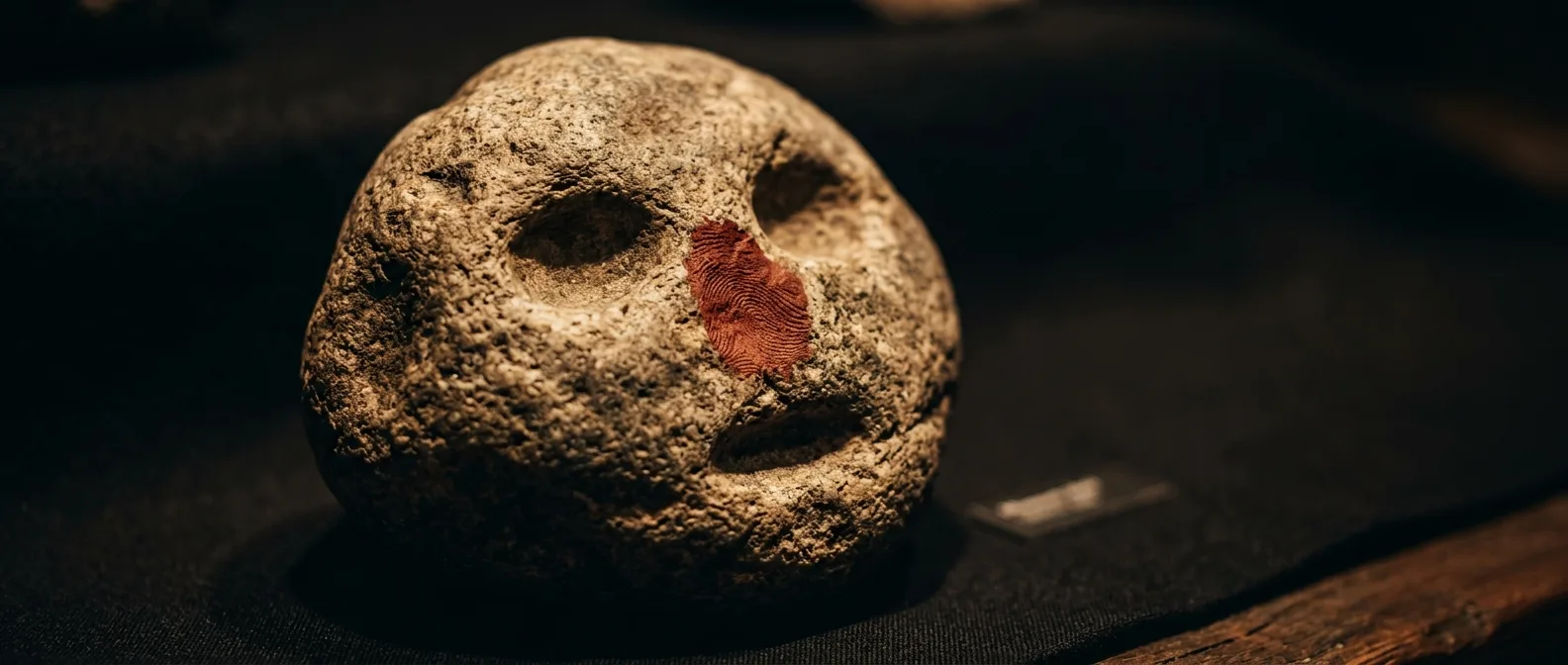
Five kilometers from a river, a Neanderthal picked up a rock that looked like a face. They dipped their finger in red ochre paint and pressed it where the nose should be. The result? History's first known fingerprint—43,000 years old.
The discovery at Spain's Abrigo de San Lázaro rock shelter just shattered another assumption about Neanderthals. This time it's not just cave paintings or tools—it's something deeply personal. A fingerprint preserved intact for hundreds of centuries.
Summer 2022. David Álvarez Alonso's team from Madrid's Complutense University started digging through sediment layers dating between 43,000 and 42,000 years ago. Among the usual tools and archaeological debris, one rock stood out. Bigger than the rest at 21 centimeters long, with something that immediately caught their attention: a red dot.
📖 Read more: The Ship Found Sailing Alone with the Table Still Set
🔬 When CSI Meets Archaeology
"From the first moment we saw it had a red dot," recalls Álvarez Alonso. What they didn't expect was needing to call the cops to solve the mystery—even if it was 43,000 years late.
Spain's National Police forensics team was initially skeptical. How do you analyze a "crime scene" that old? The breakthrough came with multispectral imaging—a technique that examines surfaces under different wavelengths of light.
The result was stunning: ridge patterns of a fingerprint emerged clearly through the red paint. Bifurcations, convergence points, all the characteristics you'd expect from a modern print.
Analysis showed the Neanderthal fingerprint likely came from a male, based on comparisons with fingerprint databases. The rock itself didn't come from the shelter's immediate environment—someone carried it from the Eresma River, five kilometers away.
🎨 The Face in the Stone
The fingerprint isn't what makes this discovery extraordinary. It's the arrangement of elements on the rock that's mind-blowing. Two small, symmetrical cavities at the top—like eyes. One larger cavity in the center—like a mouth. And the red dot precisely where the nose should be.
Researchers ran Monte Carlo statistical simulations to calculate the odds of this being random. The result? Just 0.31% chance the red dot's alignment with the cavities happened by accident.
"This isn't just a fingerprint," the researchers explain. "It's the signature of someone who handled this object with purpose beyond utility."
📖 Read more: 1918 Flu: The Pandemic That Killed 50 Million
🧬 Rewriting the Neanderthal Story
For decades, Neanderthals were considered mentally inferior to modern humans. Pop culture portrayed them as violent "cavemen" without creative abilities—a narrative that dominated for years. Things started changing in the 1950s.
Today, in 2026, we know Neanderthals buried their dead with care, crafted sophisticated tools, and used medicinal plants. Two percent of modern European and Asian DNA comes from Neanderthal interbreeding—instead of separate species, they were close enough to reproduce.
Art Spanning Millennia
The San Lázaro discovery isn't unique. In 2018, a Science study documented 65,000-year-old cave art in Spain—long before modern humans reached Europe. At Maltravieso and Ardales caves, Neanderthals had created geometric patterns and hand stencils.
In France, scientists found shell jewelry made by Neanderthals 43,000 years ago. At southeastern Spain's Cueva de los Aviones cave, they discovered pigments and perforated shells dating 115,000 years.
Neanderthals appear to have had cultural capacity shared with modern humans. They weren't savage monsters—they were recognizably human.
John Hawks, paleoanthropologist, University of Wisconsin-Madison
📖 Read more: 33 Miners Trapped 69 Days Deep Underground
⚡ A Signature from the Past
What makes this discovery particularly significant is the intention behind creation. Unlike other Neanderthal fingerprints found in German resins—likely byproducts of toolmaking—this appears deliberate.
The rock has no obvious utilitarian value. It was found in a layer where other stones show hammer marks—but not this one. Someone chose it for another reason. They looked at it and saw a face. Made it more human.
Fingerprint
History's first known, with complete preservation of ridges and bifurcations
Red Ochre
Natural pigment used worldwide for art and ceremonies
Pareidolia
The tendency to see faces in random objects—a fundamental human trait
21st Century Tech for Paleolithic Mysteries
Analyzing the find required cutting-edge technology. 3D laser scanning, electron microscopy, multispectral imaging, and mineralogical analysis worked together to reveal the stone's secrets.
First, they had to confirm the red dot wasn't a natural rock feature. Next, verify the pigment was applied by humans, not natural processes. Finally, prove the fingerprint was real.
🎯 What It Means for Us Today
Why does a 43,000-year-old fingerprint matter? Because it changes how we see our ancestors—and ultimately ourselves. It shows the need to create, to express, to leave a mark on the world isn't new.
"This is another piece of evidence pointing in the same direction," notes José Ramos-Muñoz from the University of Cadiz. "The oldest art consists of dots, lines, and stains, and we keep finding more evidence of this."
The discovery raises broader philosophical questions. If Neanderthals had the same mental capacity as modern humans, if they could create symbolic art, then what exactly makes us different? Maybe the Neanderthal-Homo sapiens divide is less clear than we believed.
Gonzalo Santonja, Spanish cultural official, described the discovery as "the oldest portable object painted on the European continent" and "the only portable art object painted by Neanderthals."
The Future of Research
Researchers believe they're still at the beginning. "We've barely scratched the surface of the iceberg," says Alistair Pike from the University of Southampton, a pioneer in dating cave art. "We could do this for our entire lives."
Technology keeps evolving, offering new ways to "read" archaeological finds. Each discovery adds pieces to the human evolution puzzle—or in the Neanderthals' case, completely changes the picture we had.
At Spain's San Lázaro, 43,000 years ago, a Neanderthal looked at a rock and saw possibilities. They carried it from the river, brought it to their shelter, and gave it life with a simple touch of their finger. They didn't know they'd leave their signature on history—or did they?