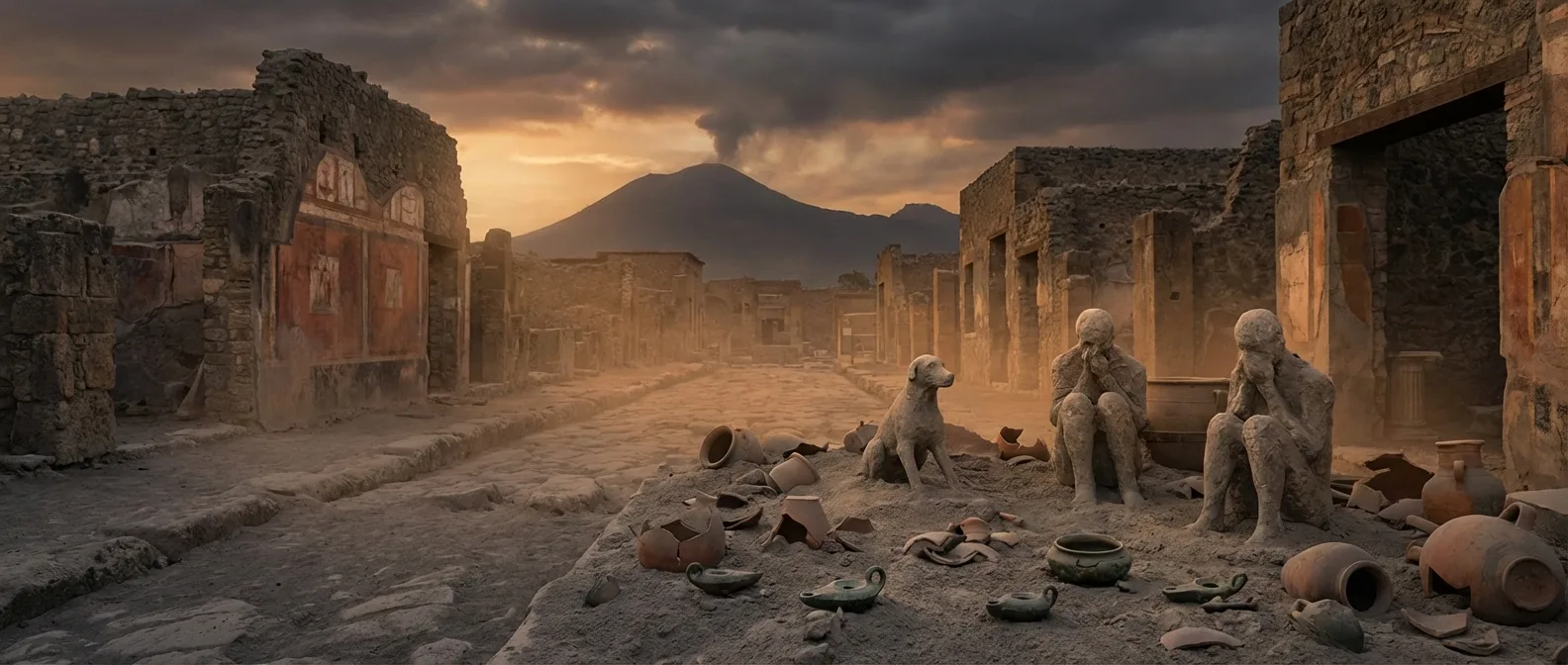
Pompeii: The City Frozen in Time
On the morning of August 24, 79 AD, the sun rose over a city of 11,000 people in southern Italy.
📖 Read more: Moai Statues: Who Built Them on Easter Island?
A city full of life
Pompeii was not a small provincial town. It was a thriving urban center of the Roman Empire — a city with forums, theaters, public baths, gymnasiums, paved streets, and an amphitheater that seated 20,000 spectators. It sat on the Bay of Naples, built on top of ancient volcanic rock — though no one at the time understood what that meant.
Its residents were merchants, bakers, doctors, priests, slaves, politicians, and craftsmen. The walls were covered in graffiti — election posters, love messages, insults, jokes. Pompeii was cosmopolitan, noisy, alive. It had inns, brothels, luxurious villas with mosaic floors and frescoes that would be considered erotic by modern standards. It was, in short, a deeply human city.
The soil around Vesuvius was extraordinarily fertile — precisely because it was volcanic. Vineyards stretched across the mountain's slopes. Pompeian wine was known throughout the Roman Empire. Death, quite literally, was feeding them from beneath their feet.
The warnings that went unheard
Seventeen years before the catastrophe, in 62 AD, a powerful earthquake struck Pompeii. Buildings collapsed, the Temple of Jupiter sustained severe damage, and several residents were killed. Instead of leaving, the Pompeians rebuilt. The houses were reconstructed larger, the mosaics more intricate. The city recovered.
In the years that followed, small tremors became frequent — so frequent that residents grew accustomed to them. Water sources dried up mysteriously. Some wells began producing warm water. Dead fish appeared in the Sarno River. Today we know these were classic precursory signs of an eruption. Back then, no one had the knowledge to interpret them. The word “volcano” did not even exist in Latin.
The eruption
Around 1:00 PM on August 24, 79 AD, Vesuvius erupted. An enormous cloud of ash, rock, and gases was blasted 33 kilometers into the sky — a tower of destruction visible from hundreds of kilometers away. Pliny the Younger, stationed at Misenum 35 kilometers to the west, later described this moment in two letters to the historian Tacitus — the only surviving eyewitness accounts.
📖 Read more: Voynich Code: The Book Nobody Can Read
The cloud, now called a “Plinian column” in his honor, resembled an enormous pine tree: a tall trunk spreading into branches at the top. During the first hours, pumice — chunks of frothy volcanic rock — began raining down on Pompeii. At first it was light. Within hours, it covered everything. Roofs collapsed under the weight.
Many residents fled immediately — on foot, by cart, by boat. But many stayed. Some believed it would pass. Some could not leave — slaves, the elderly, the sick. Some returned to their homes to collect money or valuables. It was a fatal mistake.
The pyroclastic surges
The worst was not the ash. It came in the early morning hours of August 25, when the Plinian column collapsed. Instead of rising, the material began to fall — a scorching mixture of gas, ash, and volcanic fragments, known as a pyroclastic surge, swept down the slopes of Vesuvius at speeds exceeding 100 kilometers per hour.
The temperature inside the surge reached 300–700 degrees Celsius. Death was instantaneous. The victims did not suffocate or burn — their brain fluids boiled and their skulls cracked from the thermal pressure. Modern studies from the University of Naples Federico II revealed that some victims died in fractions of a second — before they could even react.
Four successive pyroclastic surges struck the city that night. The neighboring town of Herculaneum was hit first. Pompeii received the subsequent waves. By morning, the city lay buried under 6 meters of ash, pumice, and pyroclastic deposits. Approximately 2,000 people had perished within Pompeii alone.
The elder Pliny
Pliny the Elder — uncle of the young Pliny — was admiral of the Roman fleet at Misenum and one of the most important naturalists of antiquity. When he saw the column of smoke above Vesuvius, he did not run. Instead, he ordered his ships to sail toward the bay — initially out of scientific curiosity, then to rescue friends near the volcano.
Pliny landed at Stabiae, south of Pompeii. There, according to his nephew, the elderly admiral dined calmly, bathed, and slept — while ash accumulated outside. In the morning, he tried to flee but collapsed on the beach, likely overcome by toxic gases. He died there, at the age of 55. His body was found two days later — intact, as if sleeping.
📖 Read more: Tutankhamun's Curse: Coincidence or Truth?
The silence of 1,700 years
After the eruption, Pompeii vanished. Literally. The Romans knew that somewhere beneath lay a city, but excavation was impossible. Gradually, the location was forgotten. The area became known as “La Civita” — an anonymous field sitting atop ruins.
In 1592, architect Domenico Fontana, while digging an aqueduct, discovered walls and inscriptions. No attention was paid. The true discovery came in 1748, when Charles III of Spain, King of Naples, funded excavations. What they found was staggering: an entire city, nearly intact, frozen in time.
Streets with ruts carved by cart wheels. Thermopolia with vessels still in place. Bakeries with loaves of bread — charred but whole. Frescoes with colors as vivid as if painted yesterday. The ash had created an impenetrable shell that blocked air, moisture, and time itself.
The casts of death
In 1863, archaeologist Giuseppe Fiorelli developed a technique that would become synonymous with Pompeii. As the victims' bodies decomposed inside the hardened ash, they left voids — negative impressions. Fiorelli poured plaster into these cavities.
The results were devastating. Human forms were revealed in their final moments. A mother embracing her child. A man covering his face with his hands. A couple holding each other tightly. A dog chained to its leash, writhing in agony. Some still clutched keys, coins, jewelry. These casts are not statues — they are real people, frozen at the instant of their death.
Today, CT scanning reveals even more. Inside some casts, researchers have found bones, teeth, and even remnants of clothing. A recent study revealed that many victims had remarkably healthy teeth — the result of a diet rich in fluoride from the volcanic water supply.
No other archaeological site has given us such a rich portrait of everyday Roman life. Pompeii was not a monument — it was a city. And that means it reveals what historians rarely find: ordinary life.
We know what they ate (bread, olives, fish, figs, shrimp). What they drank (wine flavored with honey). Where they were entertained (theater, gladiatorial combat, baths). What was written on their walls (over 11,000 graffiti have been recorded — from campaign slogans to love poems). We know they had laundries that used urine as bleach. We know their elections were so competitive that candidates painted the walls in red letters.
We also know the darker sides. The brothels — called “lupanaria” — were widespread. Slavery was omnipresent. The villas were simultaneously spaces of luxury and exploitation. Pompeii was no utopia — it was a world violent, vibrant, and contradictory, much like our own.
Vesuvius today
Vesuvius is not dead. It is active — one of the most dangerous volcanoes on the planet. Its last eruption was in 1944, during World War II, when it destroyed a village and several American bombers at a nearby airfield. It was small compared to 79 AD.
Today, more than 3 million people live in the “red zone” around Vesuvius — the zone of maximum danger. Naples, Italy's third-largest city, sits just 9 kilometers away. The Italian government has drafted an evacuation plan for 600,000 residents, but experts doubt it can be executed within 72 hours — the estimated warning time before a major eruption.
Volcanologists monitor Vesuvius continuously. Seismographs, satellites, gas sensors — all operate around the clock. The question is not “if” it will erupt again, but “when.” And no one knows whether it will be like 1944 or like 79 AD.
Pompeii is not merely an archaeological site. It is a snapshot — a photograph of an entire city taken at the moment of death. The streets, the houses, the objects, the bodies — everything remained, as if time stopped on August 24, 79 AD. Two millennia later, we return there and see ourselves. Because Pompeii does not only show us how the Romans lived — it shows us how quickly everything can end, and how easily we turn a blind eye to the signs.