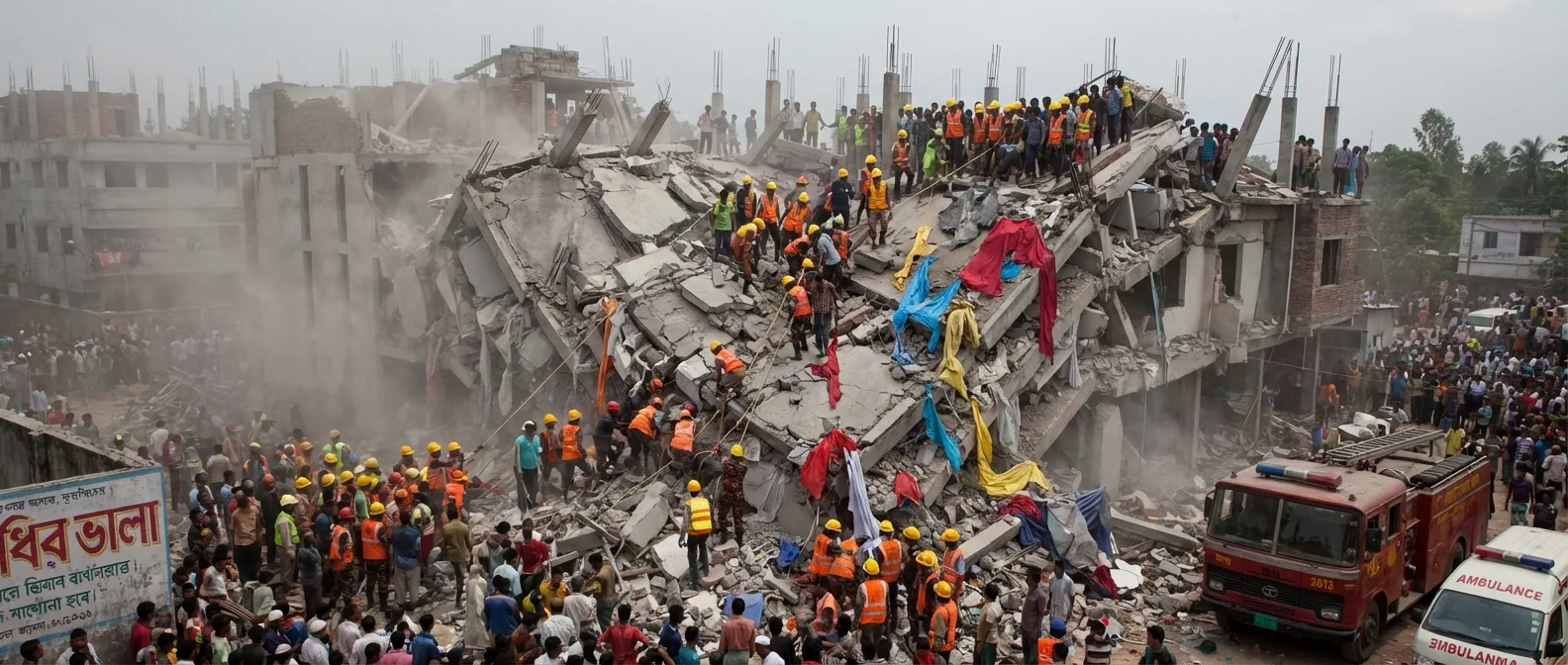
Rana Plaza: The Truth Behind Cheap Clothes
Rana Plaza, Dhaka, Bangladesh — April 24, 2013.
📖 Read more: The History of Consumption: Why We Always Want More
The cracks that were ignored
On April 23, 2013, one day before the disaster, workers at Rana Plaza spotted deep cracks in the building's walls and columns. An engineer summoned to the scene demanded immediate evacuation. The ground-floor shops and a bank housed in the building closed at once. But the five garment factories on the upper floors had orders to deliver.
The building's owner, Sohel Rana, was a local politician with connections. That evening he appeared on television and declared the building “perfectly safe.” Factory managers threatened the workers: “If you don't come tomorrow, you lose a month's pay.” In a country where the minimum wage for garment workers was $38 per month, this threat amounted to a death sentence.
"We asked if it was safe to go in. They told us that if we didn't, we would never be paid again." — Surviving worker, testimony to the Inquiry Commission
On the morning of April 24, thousands of workers entered the building. Many were crying. Some prayed before walking through the door. At 8:45 a.m. local time, shortly after the backup generators kicked in, Rana Plaza collapsed. Completely. Within 90 seconds, eight floors became nine meters of rubble.
Beneath the rubble
What followed was one of the most harrowing rescue chapters in modern history. Without heavy machinery during the first critical hours, local residents and volunteers dug with their bare hands. Hearing voices from within the wreckage, they desperately tried to reach those trapped inside. The Bangladesh army eventually deployed, but the delay cost lives.
Some workers survived trapped under slabs of concrete for days. Reshma Begum, a nineteen-year-old seamstress, was found alive after 17 days. She had managed to drink rainwater seeping through the cracks. Her rescue was broadcast live around the world — a moment of hope amid absolute devastation. But for every survival story, there were hundreds that did not end well.
"I could smell death. I was lying next to the bodies of my colleagues. Every hour I asked myself if I would be next." — Reshma Begum, 17 days beneath the rubble
The final toll: 1,134 dead, over 2,500 injured, hundreds left with permanent disabilities. It was the worst industrial disaster in the history of the garment industry — and one of the deadliest structural collapses in peacetime anywhere in the world.
The names on the labels
When rescue teams began digging through the debris, they found something beyond human bodies: labels. Hundreds of thousands of labels bearing familiar names — Primark, Walmart, Benetton, Mango, Joe Fresh, The Children's Place, Matalan. Clothes that within weeks would have hung on store racks in London, New York, Toronto, and Madrid.
The revelation was devastating. The companies initially tried to deny any connection. But the documentation was irrefutable — order slips, photographs of half-finished garments with logos still sewn in, correspondence between factories and buyers. Rana Plaza was not a hidden sweatshop. It was part of an enormous, fully documented supply chain.
Bangladesh's garment industry was then the second largest in the world after China. Over 4 million workers — 80% of them women — labored in more than 5,000 factories, many of which were housed in buildings that lacked the most basic safety standards. The factories at Rana Plaza had been built atop a structure originally designed for shops and offices — without reinforcement for the heavy industrial machinery and its vibrations.
The anatomy of fast fashion
To understand why 1,134 people died that morning, one must understand how the global fast fashion industry works. The logic is simple and ruthless: Western companies do not own the factories. They “rent” them — placing orders with local contractors while driving prices down. The contractor who submits the lowest bid wins the contract.
This creates a perpetual race to the bottom. To cut costs, contractors slash everything: safety, building maintenance, wages, rest periods. A garment worker in Bangladesh worked 14 to 16 hours a day, six days a week, sewing clothes that would sell for 100 times her labor cost. A short-sleeve T-shirt that retails for €5 costs approximately 12 cents in labor.
"Fast fashion isn't cheap. Someone always pays. It's just not us." — Elizabeth Cline, author of Overdressed: The Shockingly High Cost of Cheap Fashion
The major brands knew about the conditions. Internal audits had documented the problems — but fines were nonexistent and sanctions meaningless. The pressure for fast delivery and low prices was suffocating. In a country where the textile industry accounted for 80% of exports, the government had minimal incentive to enforce strict regulations.
Sohel Rana and the flight
Within hours of the collapse, Sohel Rana vanished. He was a middle-aged politician, a member of the ruling Awami League party, with a reputation for ignoring every rule in the book. He had added three extra floors to the building without any permit whatsoever. On a plot that was originally swampland — the worst possible foundation for a multi-story structure.
Four days after the tragedy, Rana was arrested near the Indian border as he attempted to flee the country. His capture was broadcast live. Thousands of citizens took to the streets demanding justice. Crowds were waiting for him, chanting slogans — some calling for the death penalty. He was ultimately charged with murder along with 37 others, including factory owners and engineers.
"He knew the building was dangerous. He knew the cracks meant demolition, not work. He forced them inside because production could not stop." — Bangladesh Prosecution Authority
The trial dragged on for years. The judicial process in Bangladesh was slow and politicized. Several witnesses received threats. But for the first time in a developing nation, an industrialist faced serious criminal charges for worker deaths. The Rana Plaza case set a legal precedent.
The awakening — reforms and resistance
Rana Plaza was not the first garment factory tragedy in Bangladesh. Five months earlier, 112 workers had burned alive at the Tazreen Fashion factory, where the emergency exits were locked. But the scale of Rana Plaza was impossible to ignore.
Less than a month after the collapse, over 200 companies signed the “Accord on Fire and Building Safety in Bangladesh” (Bangladesh Accord). It was a legally binding framework — not a voluntary code, but a real obligation. Companies committed to funding inspections, building repairs, and worker training. It was a historic achievement — with gaps.
Several American companies, including Walmart, refused to sign. Instead they created their own initiative, the “Alliance for Bangladesh Worker Safety” — a voluntary framework with no legal obligation, widely criticized as inadequate. The difference is crucial: under the Accord, if a company refuses to pay for repairs, it can be sued. Under the Alliance, it cannot.
Compensation and reality
A year after the collapse, the Rana Plaza Trust Fund was established under the supervision of the International Labour Organization (ILO). The goal was to raise $30 million for compensation. It took two years of pressure for the fund to be fully met — revealing just how unwilling the brands were to take responsibility.
The families of the dead received an average of approximately $25,000 per victim. By Western standards, a laughable sum — morally inadequate. For Bangladesh, it was unprecedented, yet minimal compared to the magnitude of the loss. Thousands of injured survivors — many with amputations, spinal injuries, and permanent disabilities — faced a lifetime without the ability to work in a country with no social safety net.
"They gave me money for my daughter's death. As if her life had a price. As if $25,000 is worth a daughter." — Father of a victim, interview with the Clean Clothes Campaign
What changed, what remains the same
Today, over a decade later, the picture is mixed. On one hand, the Accord — renamed the International Accord for Health and Safety in the Textile and Garment Industry — has inspected over 1,600 factories and identified more than 130,000 safety hazards, with 90% of them corrected. Factories in Bangladesh are unquestionably safer today.
On the other hand, wages remain desperately low. After years of struggle, the minimum wage was raised, but it still falls short of a living income. Workers toil under exhausting conditions, often without the right to organize. And the fundamental structure of fast fashion — low prices, rapid turnover, exploitation of cheap labor — remains largely intact.
An “ethical fashion” movement has grown across Europe and America. Organizations like the Clean Clothes Campaign, Fashion Revolution, and Remake make visible what the companies want invisible. Every year on April 24 — the anniversary of Rana Plaza — millions of people post photographs of their clothes turned inside out on social media, asking: "#WhoMadeMyClothes?"
EpilogueRana Plaza was not a random accident. It was the logical outcome of a system designed to make money while ignoring human lives. A building without minimal safety standards, filled with women working for pennies, sewing clothes for billion-dollar companies. Its collapse revealed the truth hidden behind every cheap label: that the price we pay at the register is never the real price.
The 1,134 victims were not numbers. They were Shakila, Bilkis, Noor Jahan, Mohammad. They were mothers, daughters, sisters. They were people who woke up that morning, got dressed, felt afraid — and went to work because they had no choice. Their memory reminds us that every time we buy clothes, we vote. And our vote carries weight — enough to hold a building up or bring it crashing down.