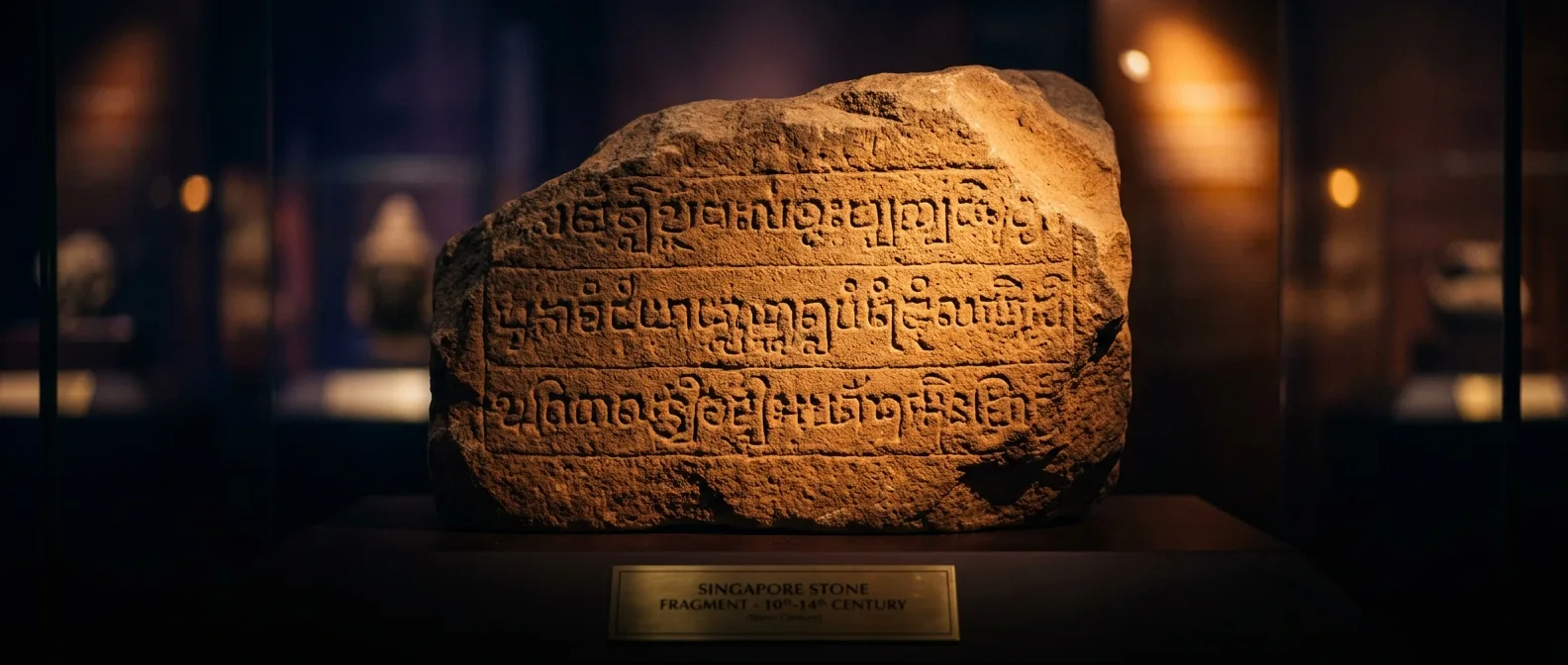
A sandstone slab sits in Singapore's National Museum, three meters by three. Only a fragment remains of what was once a 50-line monument — and nobody has been able to read it for 700 years. Until now.
Dr Francesco Perono Cacciafoco and his team at Xi'an Jiaotong-Liverpool University have built something that sounds like science fiction: an AI system called "Read-y Grammarian" that can learn the surviving characters and predict the missing pieces. This could be the first time we hear the Singapore Stone speak.
It sounds impossible. But it works.
📖 Read more: Antikythera Mechanism: A 2,000-Year-Old Computer
🏺 The Mystery Born in 1843
The story starts in 1819 on the banks of the Singapore River. British colonists discover a massive sandstone monument covered in characters they've never seen before. Even Sir Stamford Raffles himself — founder of Singapore — tries to crack it. No luck.
By 1843, plans for a fort override archaeological value. The British blow up the monument. Lieutenant-Colonel James Low manages to save three fragments and ships them to the Royal Asiatic Society's Museum in Calcutta for study. They arrive in 1848.
The Tragic Disappearance
In 1918, Singapore's Raffles Museum asks Calcutta to return the fragments. Only one comes back. The other two vanish forever — nobody knows what happened to them.
Today, all we have is: one piece of the original stone, sketches made in 1837 by William Bland and James Prinsep before the destruction, and copies of the three recovered fragments. That's it. Nothing else.
📖 Read more: Asch Experiment: Do You Lie Just to Fit In?
⚡ A Script From Another World
The Singapore Stone isn't just an ancient inscription. It's something far stranger. Its writing system is unique — found nowhere else on Earth. Not even in other texts.
It resembles Javanese Kawi somewhat, but doesn't actually match any known writing system. Like it emerged from nowhere and vanished just as quickly. Researchers have dated it between the 10th and 14th centuries, but without readable text they can't be certain.
Some connect it to the Majapahit empire. Others to the legendary hero Badang. Most researchers have filed it in the same category as the Phaistos Disc and Linear A: unsolvable puzzles.
The Cryptolinguistics Problem
There's an unwritten rule in cryptolinguistics: the more text you have, the better your chances of cracking it. You need enough material for frequency analysis, pattern recognition, statistical calculations. The Singapore Stone has the opposite problem: minimal material, unique script, unknown language.
It's every cryptographer's nightmare.
🔬 Read-y Grammarian: The Prediction Engine
Enter Read-y Grammarian. The system works in a peculiar way: first it digitizes the inscription and maps each available character to an alphanumeric code. It records the exact position and line of every symbol.
Then it applies frequency analysis and statistical calculations — based on linguistic patterns of human languages — to predict which characters might have filled the gaps.
Digital Philology
Applies digital philology and epigraphic techniques for analyzing ancient inscriptions
Prediction Algorithm
Functions as a "prediction machine," analyzing text step by step
The system can adapt to different reference languages. You can adjust the syntax (grammatical rules) of Javanese or Austronesian languages, modify the morphology (how words are formed). The algorithm generates different possible versions of the text, and the research team evaluates which ones make linguistic sense.
Without Human Bias
Read-y Grammarian's big advantage is something humans can't avoid: it has no interpretive bias. It doesn't "want" the inscription to say something specific. It just analyzes data and suggests solutions.
This approach lets researchers map phonemes to each character in the text, helping identify possible words. It dramatically speeds up the comparative process — you can test the script against various candidate languages to find matches.
📖 Read more: Bermuda Triangle: What Really Happens There
📊 What They've Discovered So Far
Cacciafoco's team has achieved something that seemed impossible: they've reconstructed several possible versions of the complete text. For the first time in centuries, there's a complete text of the Singapore Stone — or at least computational reconstructions.
This is a significant achievement, because the monument was almost completely destroyed. Reconstructing the original inscription would be impossible without our algorithm.
Dr Francesco Perono Cacciafoco, Xi'an Jiaotong-Liverpool University
This doesn't mean they can "read" the inscription — yet. But now they have enough material for frequency analysis, pattern recognition, statistical studies. The tools they need to break the code.
The Next Phase
The team is already developing a more advanced version of the system that will generate systematic transcriptions much faster and in greater numbers. It will also incorporate elements of historical phonology to improve results.
📖 Read more: Bhopal Tragedy: The Worst Industrial Disaster
🧩 Why It's So Difficult
The problem with deciphering the Singapore Stone isn't just technical. It's multiple. First, you have an unknown writing system transcribing an unknown language — the worst possible scenario for a cryptographer.
Second, the fragments are too small for reliable statistical analysis. You can't do frequency analysis with so little data. It's like trying to solve a 1000-piece puzzle with only 50 pieces — and without the picture on the box.
Third, there's no other text for comparison. Every ancient script that's been deciphered had variants, dialects, other similar texts. The Singapore Stone is an orphan script — unique in the world.
The Michael Ventris Case
Of course, deciphering impossible codes has been done before. In 1952, architect Michael Ventris managed to crack Linear B — also an unknown writing system transcribing an unknown language (Mycenaean Greek). But he had far more texts at his disposal. And even then his work was considered nearly impossible.
Here we're worse off. But we have something Ventris didn't: AI.
🎯 What It Means for the Future
Read-y Grammarian isn't just for the Singapore Stone. Its adaptive architecture allows reconstruction of any fragmented text — manuscripts, papyri, inscriptions. With minor adjustments it can work across different languages and periods.
This means thousands of ancient texts considered unreadable might finally "speak." The impact on historical research will be enormous.
If the team finally manages to read the Singapore Stone, it won't just be a scientific success. It will be the first time AI has cracked an ancient undeciphered script. A precedent that will forever change archaeology and historical linguistics.
Questions That Remain
When we finally read the inscription — and "when" seems more realistic than "if" — what will we learn? Will it relate to the legendary Badang? Will it reveal connections to the Majapahit empire? Or something completely different?
And more importantly: if we can reconstruct and read a text lost for 700 years, what else can we resurrect from the past?
The Singapore Stone stands there, silent in Singapore's museum. But its silence may soon break. And when that happens, we'll hear a voice from the 13th century — thanks to 21st-century technology.