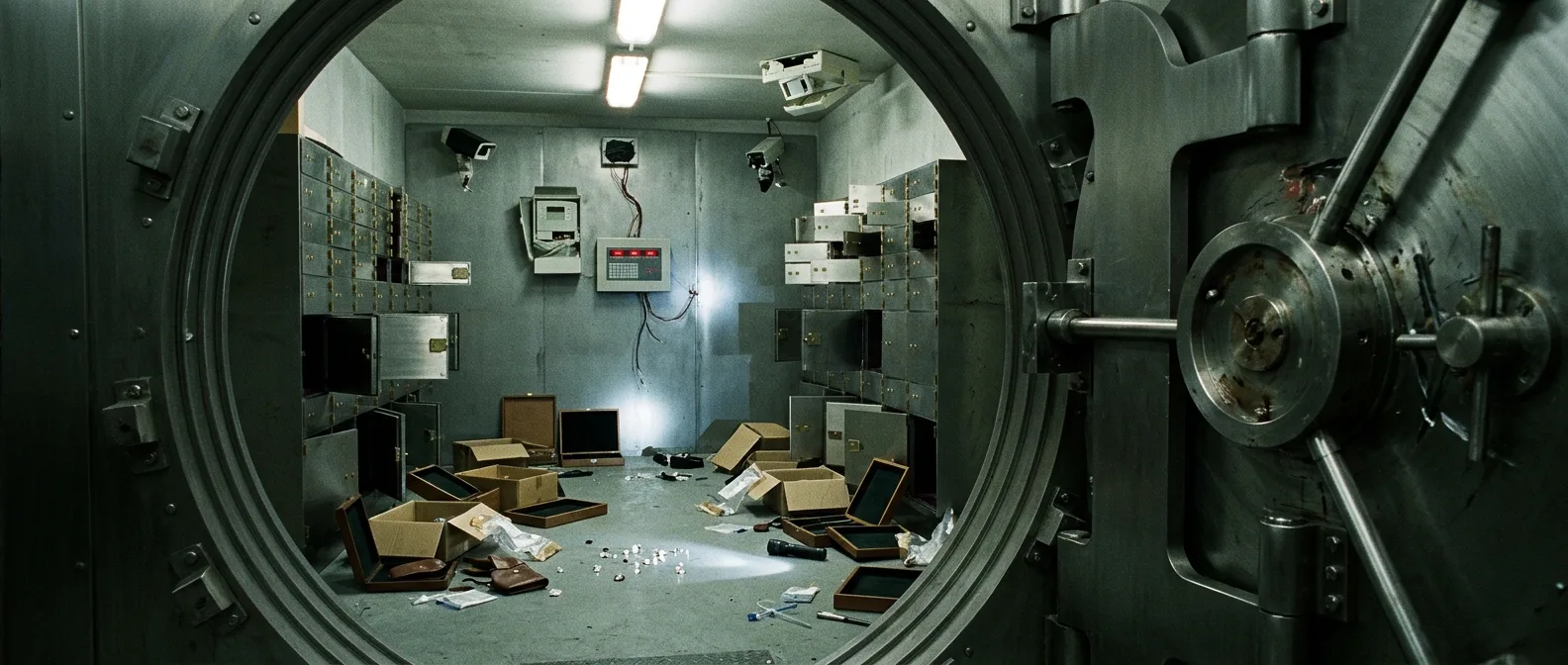
The 100 million diamond heist in Antwerp
On the morning of Monday, February 17, 2003, security guards at the Antwerp Diamond Centre descended two floors underground to begin their weekly routine.
📖 Read more: The Gardner Museum Art Heist: $500 Million Mystery
The diamond mile
Antwerp has been the diamond capital of the world for more than five centuries. In a small neighborhood near the Central Station, four streets form a district where eighty percent of the world's rough diamonds change hands every year. Dealers walk casually through the streets carrying fortunes in folded tissue paper. Trust is the currency — handshakes close deals worth millions. At the heart of this neighborhood stood the Antwerp Diamond Centre, a fortress-like building at Schupstraat 1 that housed the private vault where dealers stored their most precious goods between trades.
The vault was no ordinary safe. It sat two floors underground, behind a series of security barriers that the building's operators considered impenetrable. There were ten layers of protection in total: an outer perimeter with infrared sensors, a locked steel gate, a heavy vault door with a combination dial and a key, a second set of magnetic sensors, seismic detectors that could pick up drilling vibrations, Doppler radar to detect movement inside the vault, a light sensor that triggered an alarm if anyone switched on a lamp, and a final layer of magnetic contacts on every individual cabinet door. A closed-circuit camera system monitored the hallways. The combination to the vault door was changed regularly, and access was restricted to a handful of authorized personnel.
It was, by any reasonable standard, one of the most secure private vaults in the world. And yet a small team of Italian thieves, working patiently and methodically over two years, managed to defeat every single one of those ten layers — without triggering a single alarm.
The School of Turin
Leonardo Notarbartolo was a Sicilian-born jewel thief who had been stealing since his teenage years. By the time he turned forty, he had built a quiet reputation in the criminal underworld of northern Italy. He was not flashy or violent. He was patient, meticulous, and gifted with mechanical devices. He belonged to a loose network of professional thieves based in and around Turin — a group that Italian police had nicknamed the “School of Turin.” They were specialists. They did not rob banks at gunpoint or deal drugs. They planned intricate heists against high-security targets, and they took their time doing it.
In early 2000, Notarbartolo flew to Antwerp and rented a small office in the Antwerp Diamond Centre itself. He registered as a diamond merchant and obtained all the necessary credentials. He paid his rent on time. He attended trade shows. He chatted with his neighbors. Nobody suspected that he was there for one purpose alone: to study the vault.
Over the next two years, Notarbartolo observed every detail. He noted which guards worked which shifts. He mapped the camera positions and their blind spots. He watched how the vault door was opened and committed the routine to memory. He befriended a building concierge and, through careful manipulation, obtained information about the alarm systems. On at least one occasion, he was given a private tour of the vault itself, walking past the very detectors he would later defeat.
Back in Turin, Notarbartolo assembled his crew. The details of every member were never fully established, but investigators believe there were at least four core operatives. One was known only as “The Genius” — a locksmith and alarm specialist with extraordinary skill. Another was “Speedy,” an expert driver responsible for logistics and transportation. A third, “The Monster,” provided physical muscle for the heavy vault work. Together with Notarbartolo, who served as the planner and inside man, they formed one of the most effective burglary teams European law enforcement had ever encountered.
📖 Read more: El Chapo's Escape Through a 1.5 km Tunnel
Cracking ten layers
The team spent months building replicas of the vault's security systems — reconstructing them from photographs, technical manuals, and observations that Notarbartolo smuggled out of the building. They tested and retested their methods in rented workshops near Turin. Every layer of security had to be defeated silently and reliably. If any single alarm triggered, the operation was over.
The infrared heat sensors were perhaps the most elegant challenge. “The Genius” discovered that the sensors could be blinded by a thin sheet of polyester film — the same kind used in overhead projectors — sprayed with a light coating of hairspray. The film, carefully positioned over the sensor, allowed the team to pass without registering a body-heat signature. It was astonishingly simple.
The magnetic contacts on the vault door were neutralized with custom-built aluminum plates and strong magnets that held the contact points in place even after the door was opened. The seismic detectors, designed to register drilling vibrations, were irrelevant — the team never drilled. They came in through the door itself. The Doppler radar, which detected movement inside the sealed vault, was defeated by placing a large polystyrene shield in front of it, dampening the signal return. The light sensor was handled with a piece of dark tape.
The combination lock on the vault door proved the greatest obstacle. Notarbartolo had secretly recorded the vault custodian entering the combination on a hidden camera. But combinations changed regularly, and they could not count on having the current one. “The Genius” solved this by constructing a custom device — a small cylinder that attached to the dial face and measured the subtle changes in resistance as the tumblers inside the lock aligned. It took practice, but on the night of the heist, the vault door opened in under thirty minutes.
The weekend
The team chose the weekend of February 15–16, 2003. It was deliberate. That Saturday was Valentine's Day, and millions of Europeans were focused on restaurants and romance, not vaults and alarms. More importantly, the Diamond Centre was closed from Friday evening until Monday morning — giving them roughly sixty hours of uninterrupted access.
On Friday evening, Notarbartolo entered the building using his legitimate tenant key. He descended to the vault level and disabled the camera system by rewinding and looping the surveillance tape — a technique straight out of a heist film, except it actually worked. He then opened a side entrance and let the rest of the team into the building.
They worked through the night and into Saturday. Layer by layer, they dismantled the vault's defenses. When the heavy door finally swung open, they found themselves standing in a room the size of a large bedroom, its walls lined floor to ceiling with numbered steel safety deposit boxes. They had brought bolt cutters, pry bars, and custom shims. One by one, they forced the boxes open and emptied them into duffel bags.
📖 Read more: Frank Abagnale: Pilot, Doctor, None of the Above
They were not greedy in the sense of time — they were extraordinarily fast. In a single sustained effort, they cracked one hundred and twenty-three of the one hundred and sixty boxes. Some contained loose diamonds wrapped in tissue paper. Others held gold bars, bundles of cash in multiple currencies, jewelry, and bearer bonds. A few contained personal documents and family heirlooms that would never be recovered. The team packed everything into bags, cleaned up their tools, and exited the building before dawn on Sunday.
They drove south toward Brussels and then onward toward France, heading for the Italian border. The vault would remain undiscovered for another day and a half.
A bag of garbage on the E19
The heist was flawless in execution but spectacularly careless in its aftermath. Somewhere along the E19 highway south of Antwerp, one of the team members tossed a large garbage bag out of the car window. Perhaps they were nervous. Perhaps they assumed it would disappear into a landfill. It did not.
A local farmer named August Van Camp found the bag the following morning near his property in the town of Tervuren. Inside, he discovered half-eaten salami, empty juice boxes, rubber gloves, strips of adhesive tape, a broken VHS cassette, and — crucially — a small envelope bearing the logo of the Antwerp Diamond Centre. Van Camp called the police.
Forensic investigators descended on the garbage bag with a thoroughness that matched the thieves' own precision. They recovered DNA from the salami and the juice boxes. They lifted partial fingerprints from the tape. The broken VHS cassette turned out to be the surveillance tape from the Diamond Centre's camera system — the one Notarbartolo had removed and was supposed to destroy. It still contained fragmentary footage.
Within days, Belgian police identified Leonardo Notarbartolo through his tenant records at the Diamond Centre. His DNA matched samples from the garbage bag. Interpol issued an alert, and Italian police arrested him at his apartment in Turin on February 25 — barely a week after the heist. He was found with a small number of loose diamonds, a fake Belgian identity card, and a one-way ticket to an undisclosed destination.
The trial and the missing millions
Notarbartolo was extradited to Belgium and stood trial in Antwerp in 2005. He maintained a peculiar defense: he admitted he had been in the vault but claimed he was merely a lookout, hired by a diamond dealer who wanted to retrieve his own property for insurance fraud purposes. The story was creative but unconvincing. The court sentenced him to ten years in prison — the maximum for theft without violence under Belgian law.
📖 Read more: Golden State Killer: DNA Caught Him 40 Years Later
His accomplices proved harder to catch. “Speedy” was identified and convicted in absentia. “The Genius” was never conclusively identified by prosecutors. “The Monster” remained a shadow. Italian police suspected they knew who some of these men were, but the evidence was circumstantial and cross-border cooperation in the early 2000s was cumbersome.
The diamonds were never recovered — at least not in any meaningful quantity. Of the estimated one hundred million dollars in stolen goods, Belgian authorities recovered less than a fraction of one percent. The gemstones were almost certainly broken down, recut, and scattered through the global diamond trade within weeks of the robbery. Diamonds, unlike cash, carry no serial numbers. Once recut, a stone is essentially a new stone. The stolen fortune dissolved into the market like sugar into water.
Notarbartolo served his sentence and was released in 2009. In 2009, he gave a remarkable interview to Wired magazine in which he described the heist in cinematic detail. He insisted the vault contained far more than one hundred million — perhaps as much as four hundred million — and hinted that some box holders had inflated their insurance claims. Belgian prosecutors investigated these allegations but never filed charges against any of the diamond dealers.
The heist that changed Antwerp
The Antwerp Diamond Centre heist sent shockwaves through the global diamond industry. Within months, every major diamond vault in Belgium, the Netherlands, the United Kingdom, and Israel underwent comprehensive security upgrades. Biometric scanners replaced combination locks. Heat-sensor technology was overhauled. Closed-circuit cameras switched from analog VHS to digital recording with encrypted off-site backup. The era of loopable surveillance tape was over.
The Belgian government created a specialized diamond crime unit within the federal police, staffed with investigators who understood both gemology and the mechanics of vault security. Insurance companies rewrote their underwriting standards for diamond storage, demanding higher premiums and more rigorous vetting of tenants in shared facilities.
For Antwerp's diamond district, the heist was both a humiliation and a wake-up call. The neighborhood's centuries-old culture of handshake deals and trust-based transactions was forced to reckon with the reality that professional criminals could infiltrate the system by simply pretending to be legitimate merchants. Background checks became mandatory. Surveillance expanded. The diamond mile became, paradoxically, both more secure and less trusting.
Hollywood inevitably came calling. The heist inspired several film treatments and was widely compared to the fictional capers in “Ocean's Eleven” and “The Italian Job.” Notarbartolo himself reportedly fielded offers from production companies, though no authorized adaptation has been released. Scott Selby's 2010 book “Flawless: Inside the Largest Diamond Heist in History” remains the most comprehensive account, painstakingly reconstructed from court documents, police interviews, and Notarbartolo's own testimony.
EpilogueThe Antwerp diamond heist endures in criminal history not because of its violence — there was none — but because of its audacity and craftsmanship. A team of four or five men, armed with hairspray, aluminum foil, polyester sheets, and extraordinary patience, defeated a vault that the industry considered invincible. They spent two years planning, executed flawlessly over a single weekend, and walked away with a fortune that the world will almost certainly never see again. And yet they were caught — not because of a flaw in their method, but because someone tossed a bag of garbage out of a car window. The lesson, if there is one, cuts both ways: no security system is perfect, but neither is any criminal. Somewhere between brilliance and carelessness, between the vault door and the highway shoulder, lies the thin line that separates legend from prison.