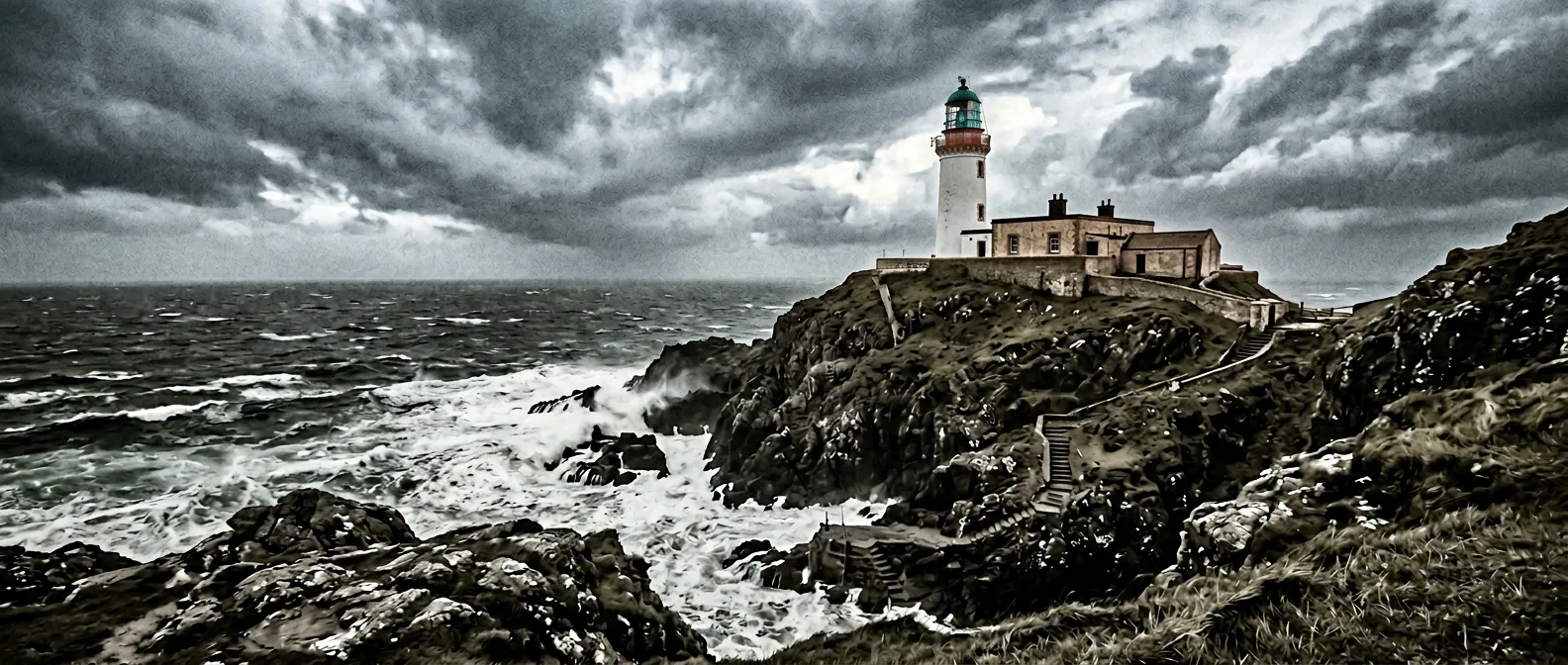
The Eilean Mor Mystery
Three lighthouse keepers, a barren island off the Scottish coast, and a mystery that remains unsolved after more than a century
📖 Read more: The Village That Vanished Overnight Without Any Explanation
The ship that arrived at a dark lighthouse
On December 26, 1900, a small supply vessel was approaching the Flannan Islands — an uninhabited cluster of rocky islets in the remote Outer Hebrides, off the northwest coast of Scotland. Captain James Harvey had Joseph Moore aboard, the replacement keeper. Christmas gifts for the three lighthouse men were still in the hold, wrapped — gifts that no one would ever open.
As the ship neared the landing platform on Eilean Mor, Harvey noticed something troubling. Nobody was waiting on shore. Protocol was clear: whenever the supply vessel arrived, a keeper was supposed to be standing at the dock. But the dock was empty. Harvey sounded his horn. He fired a flare. Nothing.
Joseph Moore rowed ashore alone. He climbed the steep steps carved into the rock face leading up to the lighthouse — 150 feet above the sea. He would later report an overwhelming sense of dread throughout the long ascent. Something was wrong. And the worst was waiting for him at the top.
What was found — and what wasn't
The lighthouse door was unlocked. In the entrance hall, Moore immediately noticed that two of the three oilskin coats were missing. He entered the kitchen: on the table sat a half-eaten meal. A chair had been overturned, as though someone had leapt from their seat in a hurry. The wall clock had stopped.
He searched every room. Bedrooms, storage room, the lantern mechanism. There was no one. Three men had vanished without a trace, as though the earth had swallowed them — or rather, as though the sea had pulled them under. Moore ran back to the ship, breathless. Harvey immediately ordered a search of the entire island. Nothing.
Harvey quickly sent a telegram to the mainland. The words were dry, military, but you could sense the horror between the lines:
"A dreadful accident has happened at Flannans. The three Keepers — Ducat, Marshall and the occasional — have disappeared from the island. No sign of life was to be seen." — Captain Harvey's telegram
Who were the three keepers? James Ducat was the Principal Keeper — an experienced, reliable professional with years of service. Thomas Marshall was the Second Assistant, the youngest in both age and experience, but known for his meticulous log-keeping. And Donald “William” McArthur was the Occasional — a hardened mariner, known along the Scottish coast as a tough brawler and hard man.
This matters: we're not talking about three amateurs. They were professionals who understood the sea, the winds, the waves. They lived on an island that was hostile — treeless, exposed to the elements — but they were equipped for it. Their lighthouse stood 150 feet above sea level. They should have been perfectly safe.
Eilean Mor — meaning “Big Island” in Gaelic — had been known for centuries. It was named after Saint Flannan, a 6th-century Irish bishop who built a chapel there. Local shepherds used to bring sheep to graze but would never stay overnight — fearful of the spirits said to haunt those rocks. Superstition? Perhaps. Or perhaps something more.
The logbook of dread
A few days after the discovery, Robert Muirhead — superintendent of the Northern Lighthouse Board, who personally knew all three men — arrived on the island for an official investigation. He found nothing beyond what Moore had already reported. Except for one thing: the lighthouse log.
In the entry for December 12, Thomas Marshall had written about “severe winds the likes of which I have never seen before in twenty years.” He also noted that James Ducat — the Principal Keeper — had been “very quiet,” and that McArthur, the hard-as-nails ex-sailor, had been “crying.”
Why would a hardened mariner weep over a storm? These men lived inside storms. Storms were their daily reality. What had frightened them so badly?
The entry for December 13 was even more chilling: the storm was still raging, and “all three of us have been praying.” Three experienced lighthouse keepers, safe inside a solidly built lighthouse 150 feet above the sea, were praying. Something here doesn't add up.
“Storm ended, sea calm. God is over all.” — Final log entry, December 15, 1900
Muirhead carefully examined the landing platform and surrounding area. There he found something significant: ropes strewn across the rocks — ropes that were normally stored in a wooden crate secured to the supply crane, 70 feet above the platform. The crate had been dislodged. Something had struck down there — something with tremendous force.
The most probable theory, and the one Muirhead included in his official report, went like this: two of the keepers descended to the landing platform — wearing their oilskins — to secure equipment after rough weather. A massive wave swept them away. The third, hearing their screams, rushed outside without stopping to put on his coat — which explains the third oilskin left hanging in the lighthouse.
Is it plausible? Yes, almost. “Rogue waves” — giant swells that appear without warning — are a well-documented phenomenon in the North Atlantic. They can reach heights of 80 feet or more. Such a wave could easily have scoured the landing platform — even if the weather appeared relatively calm.
But there are holes in this theory. Why was no body ever found? The coasts around the Flannan Isles aren't that remote — shipwreck victims had washed ashore there before. Why was the Occasional in a state of panic two days before? And that logbook — those entries about a storm that didn't exist — what exactly were they describing?
The theories — from reasonable to paranoid
In the century-plus since, dozens of theories have been proposed for the three keepers. Some are logical. Some are absurd. And some fall somewhere in between.
The first category — “natural causes” — includes, beyond the giant wave, the possibility of a rock slide. Sections of the island are unstable, and a dislodged boulder could have dragged men into the sea. There's also the waterspout theory — a rare maritime phenomenon that creates centrifugal force and can suck people off a cliff edge.
The second category — “human causes” — includes darker scenarios. A mental breakdown, perhaps? Three men locked on a desolate island through winter, cut off from the world, may have lost their minds. Perhaps one killed the other two and then threw himself into the sea. The overturned kitchen chair, Ducat's silence, McArthur's tears — they fit this narrative rather well.
And there's the third category: foreign invaders, pirates, smugglers. Or, if we push further still, alien abduction — a theory that sounds ridiculous but which hundreds of websites very earnestly perpetuate. Eilean Mor, they say, is an “anomaly point” — something like our very own Bermuda Triangle.
📖 Read more: Frane Selak: The Luckiest Unluckiest Man
Voices in the wind
In the decades that followed, lighthouse keepers who replaced the three vanished men reported something strange: voices in the wind. Names — the names of the three dead men — carried like whispers over the rocks. The sound always came from the sea, on moonless nights, when the wind struck the crags at a peculiar, almost melodic frequency.
Was it autosuggestion? Most likely. Imagine being sent to an island where three men vanished mysteriously. Every dark night, every sound in the wind, every shadow would seem like something. The human brain is a pattern-recognition machine — and when there are no patterns, it invents them.
But that didn't stop the legends from taking root. Wilfrid Wilson Gibson, a British poet, wrote a poem entitled “Flannan Isle” just a few years after the events, turning the mystery into literature. The phrase “God is over all” — the final line of the logbook — became a symbol of the inexplicable. Films, books, documentaries, podcasts — the world cannot let this story go.
And perhaps that's the most chilling part of all: you don't need a supernatural explanation for something to haunt you. Silence is enough. Three men set foot on this island, lived there, kept a logbook, ate, slept, prayed — and then, as though they had never existed, they vanished. The sea returned nothing. Not a button, not a shoe, not a bone.
For over a hundred and twenty-four years, the Eilean Mor lighthouse has continued to shine. It was automated in 1971 — it no longer needs people. Perhaps that's the only real solution: leave the lights burning and never send anyone up there again.
— The End —