Operación Esperanza
Four children, a plane that fell into the jungle, and a survival miracle that shook the world
📖 Read more: The Girl Who Walked 11 Days Alone Through the Jungle
The fall
On May 1, 2023, a single-engine Cessna 206 took off from Araracuara, a remote community in the heart of Colombia's Amazon region. Destination: San José del Guaviare, the capital of the department of the same name. Aboard the aircraft were the pilot, an adult aide, Magdalena Mucutuy Valencia — a woman from the Huitoto indigenous people — and her four children.
Lesly was 13. Soleiny was 9. Tien Noriel was 4. And little Cristin was just 11 months old — a baby who hadn't yet celebrated her first birthday. They were traveling to escape a region controlled by FARC dissidents — armed factions that continued to terrorize indigenous communities despite the 2016 peace agreement. Magdalena, 34 years old, had decided she could no longer raise her children in that environment of constant violence and fear. Instead of safety, they found the worst nightmare imaginable.
Somewhere over the jungle canopy, the engine failed. The aircraft plunged into the dense vegetation. The pilot, the aide, and the mother were killed on impact. But the four children — inside a shattered airplane, surrounded by the dark, humid, lethal Amazon jungle — were alive.
Alone in the most dangerous place on Earth
The Amazon isn't a forest — it's a living organism that wants to kill you. Humidity approaches 100%. Temperatures rarely drop below 25°C, even at night. Snakes, spiders, jaguars, army ants, caimans — the list of things that can end you is endless. And beyond the wildlife, there's the space itself: miles of dense forest without markers, without paths, without visibility.
Annual rainfall in the region exceeds 3,000 millimeters — nearly triple that of Western Europe. The risk of infection from a single insect bite is very real: mosquitoes carry malaria and dengue fever, while leeches create hemorrhagic wounds that refuse to heal in the perpetual moisture.
Four children — a teenager, a nine-year-old girl, a four-year-old boy, and a baby — suddenly found themselves entirely alone in this world. Their mother was dead. There was no radio, no phone, nothing. Only the jungle, the sun that never pierces the canopy, and a baby that needed milk.
But Lesly, the 13-year-old, possessed something no survival manual can teach: instinctive knowledge of the jungle. She was a daughter of the Huitoto people — an indigenous community that has lived in the tropical forest for centuries. Her grandmother had taught her which fruits are safe, where to find water, how to read the movements of animals. This knowledge, passed down through generations, would save four lives.
40 days
The earliest days were the most critical. Lesly found some cassava flour in the plane's cargo — food she used primarily to feed baby Cristin. She mixed the flour with water and created a paste the infant could swallow. It wasn't milk, but it was nourishing — cassava provides carbohydrates, energy, life.
As the days passed, the children moved deeper into the jungle, away from the wreckage. Lesly identified edible seeds and fruits. They ate whatever the jungle offered. They drank water from streams and leaves. They slept beneath makeshift shelters built from branches.
At night, Lesly sang traditional Huitoto songs to calm her siblings and keep the younger ones from crying — sounds that could attract predators. She rationed food with strict discipline, always feeding baby Cristin first, then Tien, and herself last. There were days when she ate nothing at all, giving every scrap to her brothers and sisters.
Think about what this means in practice. A 13-year-old carrying a baby, holding a 4-year-old's hand, looking after a 9-year-old sister — all of it without adult help, without medicine, without tools. Every night was pitch black. Every sound could mean death. And she never gave up.
"Lesly was the mother, the doctor, the guide, and the guard. Her siblings believed in her more than in anything else." — Family relative
Operación Esperanza — The search
Meanwhile, the world had not abandoned these children. The Colombian military launched a massive search operation codenamed “Operación Esperanza” — Operation Hope. Over 100 soldiers and indigenous trackers were deployed into the jungle, combing through miles of impenetrable vegetation.
📖 Read more: The Man Who Was Struck by Lightning 7 Times
The aircraft wreckage was found two weeks after the crash, on May 16. The adults' bodies were there. But the children were not. Initially, many believed they had already perished — a baby, three weeks in the jungle, without food? Impossible.
But the indigenous trackers refused to give up. Using traditional tracking techniques — broken branches, footprints in the mud, discarded fruit shells — they detected signs of life. The children were moving. They were alive. Helicopters flew over the jungle broadcasting a recorded message from their grandmother in the Huitoto language, begging them to stay still. Food packages were dropped from the air at locations where the children were believed to be.
The search covered approximately 320 square kilometers of dense jungle terrain. The children's father, Manuel Ranoque, joined the search alongside more than 150 indigenous volunteers who knew the forest intimately. A tracking dog — a Belgian Malinois named Wilson — was also lost in the jungle during the operation, creating a second survival story that captivated Colombia for months afterward.
The moment the world exhaled
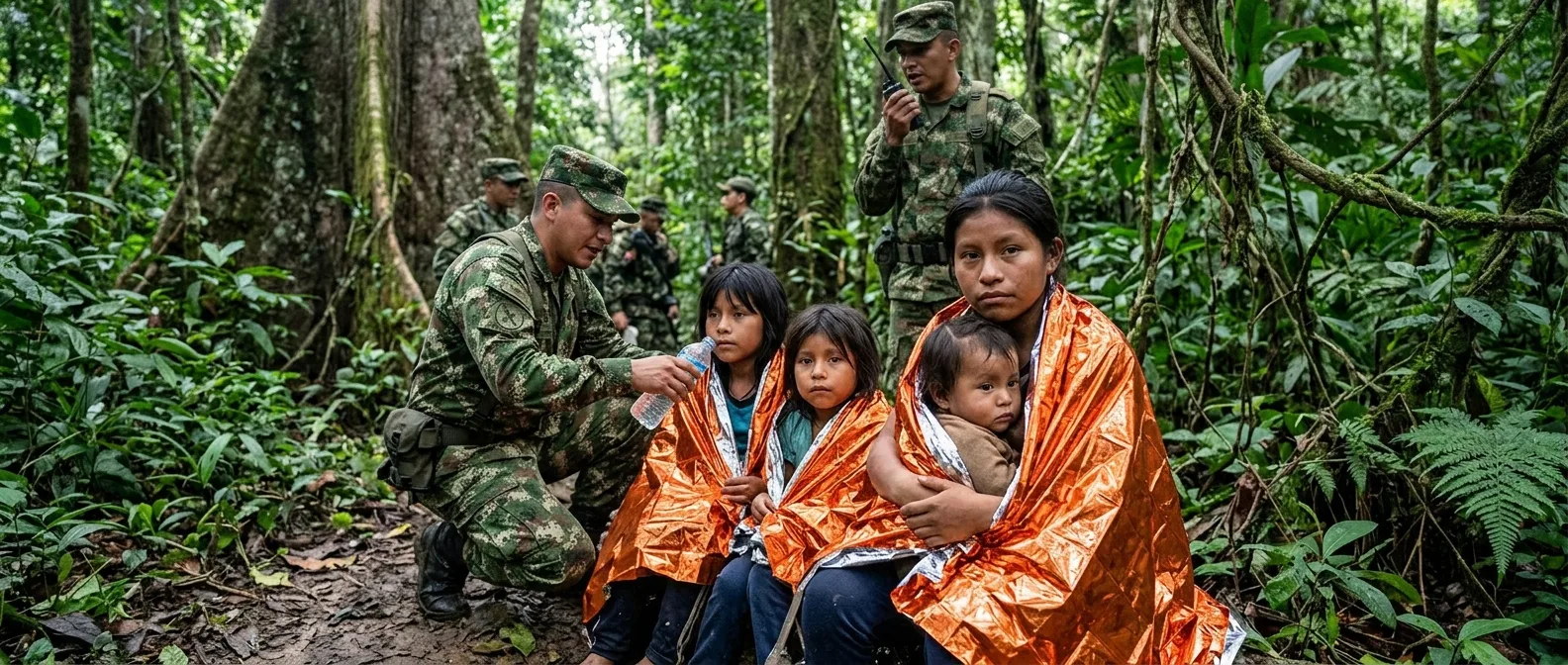
On June 9, 2023 — forty days after the crash — a team of trackers located the four children. They were found approximately 5 kilometers from the wreckage, beneath a makeshift shelter built from branches. They were dehydrated, malnourished, covered in insect bites — but alive. All four of them.
Baby Cristin, 11 months old, weighed less than five kilograms. Tien, the four-year-old, was gaunt but steady. Soleiny had scratches everywhere but still had strength. And Lesly — the 13-year-old who had kept three people alive for forty days in the world's harshest jungle — looked exhausted but unbroken. She had not cracked.
Colombian President Gustavo Petro announced the news to the world. “Joy for the whole country!” he wrote. Videos from the rescue — soldiers weeping, indigenous trackers embracing the children, helicopters rising above the canopy — went viral within seconds.
The children were airlifted to the Military Hospital in Bogotá, where they were treated for weeks. Cristin was in critical condition due to severe malnutrition — she weighed less than half the normal weight for her age. Doctors stated that if the rescue had been delayed by even one more week, the baby most likely would not have survived. The older children suffered from parasitic infections, dehydration, and dozens of infected insect bites that required sustained medical treatment.
"These children are children of the jungle. The jungle raised them, fed them, protected them. It's not a miracle — it's culture." — Indigenous community leader
What the jungle taught us
The story of the four children isn't just a survival tale. It's a story about knowledge — that quiet, invisible knowledge passed down through centuries of living within an ecosystem. Lesly didn't read jungle manuals. She didn't take survival courses. She knew which fruits to eat because her grandmother knew, and the grandmother before her, and the one before that.
In the Western world, indigenous knowledge is often treated as a curiosity — an anthropological exhibit. But in this story, that exact knowledge made the difference between life and death. A child from New York, Madrid, or London would not have survived three days. The Huitoto children survived forty.
This story also highlighted the region's problems. The mother had been traveling with her children to escape the violence of armed groups — guerrillas, paramilitaries, drug traffickers — who control vast swaths of the Colombian Amazon. The joy of the rescue temporarily obscured darker realities: Colombia's indigenous peoples live under constant threat, and their “freedom” is confined to small pockets within a jungle controlled by men with guns.
Ultimately, what remains from this story isn't just the image of four children emerging from the jungle. It's the image of a 13-year-old who — without a home, without a mother, with nothing but her hands and what her grandmother taught her — carried three lives on her shoulders for forty days. If heroism exists in its purest definition, then Lesly Mucutuy embodies it.
— The End —
📚 Sources:
- BBC News — Colombia jungle children found alive after 40 days
- CNN — Four children rescued after surviving 40 days in Colombian jungle
- The Guardian — Missing children found alive in Amazon after plane crash
- The New York Times — Children rescued from Colombian jungle after 40 days
- Associated Press — Colombia children found alive after 40 days in jungle