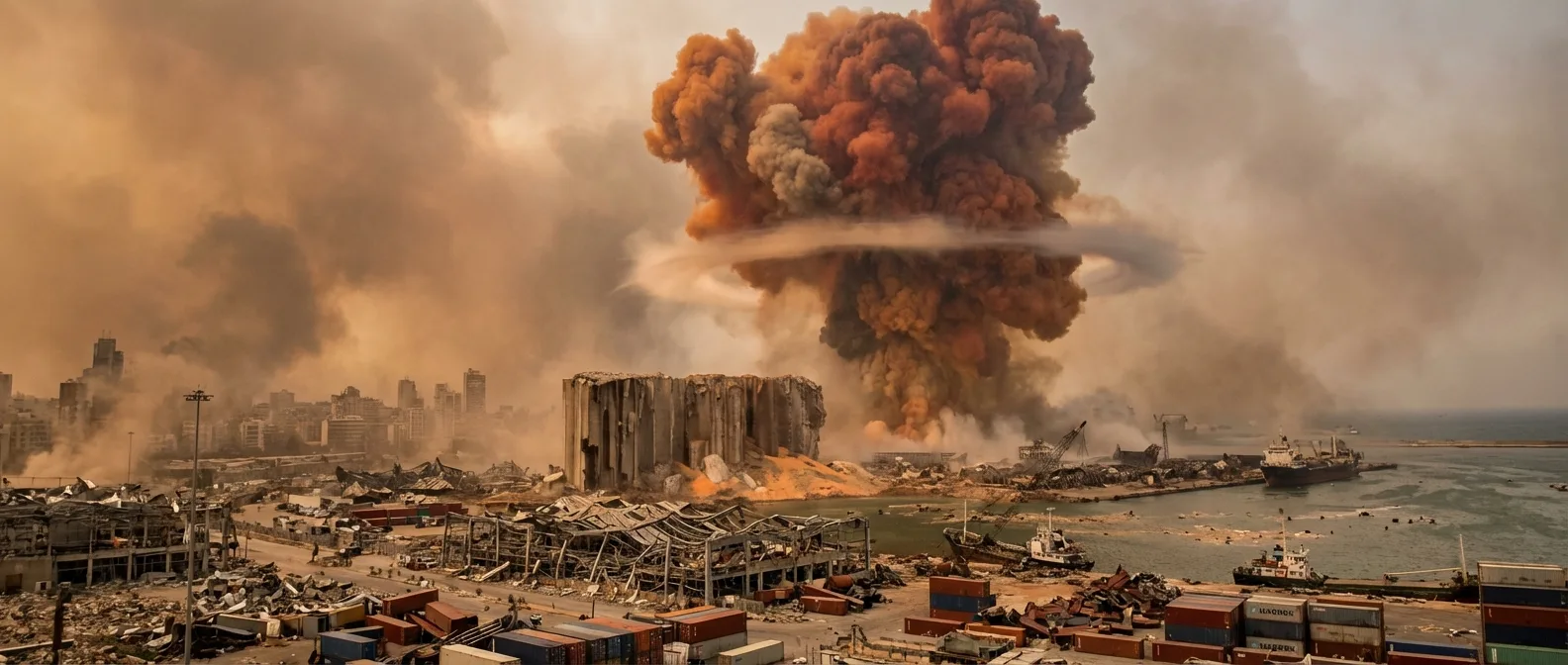
The Beirut Explosion of 2020 That Shocked the World
On August 4, 2020, at 6:08 p.m.
📖 Read more: Hachiko: The Dog Who Waited 10 Years
The MV Rhosus
The story began on September 27, 2013, when the MV Rhosus — a Moldovan-flagged cargo ship — departed Batumi, Georgia, bound for Beira, Mozambique. It carried 2,750 tons of ammonium nitrate, a fertilizer widely used in agriculture but also a key ingredient in explosives. The shipment had been ordered by an African explosives manufacturer for mining operations.
The vessel was in poor condition. Its owner, Russian businessman Igor Grechushkin, was in financial trouble. Captain Boris Prokoshev was forced to dock in Beirut on November 21, 2013. By some accounts, the ship couldn't afford Suez Canal tolls. Others say mechanical problems forced the unscheduled stop. Heavy machinery was loaded onto the cargo hold doors, causing them to buckle and damaging the ship. After inspection, the vessel was deemed unseaworthy and forbidden to sail.
Stranded in port with $100,000 in unpaid bills, the Rhosus was seized. Of its nine crew members — eight Ukrainians and one Russian — five were repatriated with the help of the Ukrainian consul. The remaining four were forced to live aboard the ship for nearly a year, next to 2,750 tons of explosive material. A judge eventually allowed their repatriation on compassionate grounds.
In February 2014, port authorities transferred the ammonium nitrate to “Hangar 12” — a metal structure with no air conditioning, no fire suppression, and below minimum safety standards. The ship itself sank in the harbor in February 2018. Its cargo remained in storage for 6 years and 5 months.
The warnings that were ignored
Between 2014 and 2020, at least 10 official letters were sent to courts, ministries, and prime ministers. The dates are documented: June 27 and December 5, 2014; May 6, 2015; May 20 and October 13, 2016; October 27, 2017. Each time, customs officials warned that 2,750 tons of ammonium nitrate sat in a warehouse beside a city center of 2 million residents.
Customs director Badri Daher requested guidance at least 6 times for transferring or selling the material. He proposed three solutions: re-exporting the cargo, transferring it to the Armed Forces, or selling it to a private Lebanese explosives company. Each request was procedurally declined due to errors by the customs officials — yet the officials kept submitting the same flawed requests instead of correcting them. Legal experts later pointed out that customs could have confiscated the material unilaterally, without a court order.
📖 Read more: How an Italian Stole the Mona Lisa
In a 2016 letter, the customs official wrote: "In view of the serious danger of keeping these goods in the hangar in unsuitable climatic conditions, we reaffirm our request for immediate re-export." According to Human Rights Watch, at least 6 prime ministers, 4 presidents, several ministers and generals knew about the danger. None acted.
The day — August 4, 2020
Around 5:45 p.m., fire broke out in Hangar 12. Workers had been using welding equipment on a door. Sparks fell on 30 to 40 nylon bags of fireworks stored inside the same warehouse, alongside the ammonium nitrate. The fire spread rapidly.
At 5:55 p.m., a team of nine firefighters and one paramedic — known as Platoon 5 — was dispatched to the scene. Over the radio, they reported that “something was wrong” — the fire was immense and produced “a crazy sound.” They entered the warehouse without knowing what was inside. Nobody warned them.
At 6:07:05 p.m., the first explosion — likely triggered by the fireworks — tore apart the warehouse with a force of 1.5 to 2.5 tons of TNT. At 6:08:18, just 33 seconds later, the main blast followed. A white mushroom cloud rose 1,000 to 1,300 feet, momentarily ringed by a condensation cloud. A red-orange plume — colored by nitrogen dioxide — blanketed the sky.
A shockwave radiated outward, leveling buildings within half a mile. Glass shattered 6 miles away. The seismic reading registered 3.3 on the Richter scale. Experts at the University of Sheffield estimated it was one of the largest non-nuclear explosions in recorded history — comparable to the Texas City disaster of 1947 and the Tianjin blasts of 2015. The explosion was heard in Cyprus, 150 miles away.
I saw the red smoke and grabbed my phone to film. That saved me — because I stood behind the wall. Seconds later, the wall in front of me disappeared.
All ten members of Platoon 5 — nine firefighters and one paramedic — were killed instantly. Among them was Sahar Fares, 25, Lebanon's first female firefighter. Their bodies were never recovered. Nazar Najarian, secretary-general of the Kataeb Party, died from a severe head injury. French architect Jean-Marc Bonfils was killed in his apartment — he had been live-streaming the warehouse fire on Facebook at the moment of the blast.
In the neighborhoods of Gemmayzeh and Mar Mikhael — two of Beirut's most vibrant areas, filled with cafes, bars, and galleries — century-old buildings collapsed. The grain silos, a massive structure with 120,000-ton capacity built in the 1960s, were shattered but partially survived — providing partial shielding for nearby port structures.
Hospitals were overwhelmed within minutes. Three sustained severe damage. Doctors operated in courtyards, without electricity, in darkness. The Red Cross couldn't dispatch ambulances — the streets were buried under rubble. At least 150 people were left permanently disabled. Among the dead were nationals from at least 22 countries, including 43 Syrians, 13 Armenians, and 34 refugees.
The justice that never came
The Diab government resigned on August 10, just six days after the blast, after massive protests. Tens of thousands of Lebanese flooded the streets, stormed ministries, and occupied public squares. Several members of parliament resigned in protest. The judicial investigation passed first to judge Fadi Sawan, then was reassigned to Tarek Bitar.
Bitar issued arrest warrants against ministers and officials — and the political establishment pushed back fiercely. Hezbollah and its allies demanded his removal. In October 2021, armed clashes erupted in Beirut during demonstrations against the probe. Over 25 recusal requests were filed. The investigation was frozen multiple times. Former Prime Minister Diab was charged with negligence alongside three former ministers — but denied all responsibility. Parliamentary immunity rules were weaponized to block every advance.
In January 2025, the investigation resumed under a new government. Ten people were charged. In September 2025, Grechushkin was arrested in Bulgaria under an Interpol red notice — but Bulgaria rejected the extradition request. Five years on, no one is in prison. The largest non-nuclear explosion in a city has no officially designated “responsible party.”
The explosion destroyed or damaged 77,000 residences. 300,000 people were left homeless in a city already drowning in economic crisis. Lebanon was facing currency collapse, hyperinflation, and fuel shortages. The poverty rate had already surpassed 50%. The blast struck a country already on its knees.
The grain silos stored 85% of Lebanon's wheat imports. Their destruction wiped out 15,000 tons of grain — leaving the country with less than a month's reserves. Bread prices skyrocketed. The healthcare system — already near collapse amid the COVID-19 pandemic — took a blow it couldn't absorb. Ninety percent of the city's hotels were damaged. Even Rafic Hariri Airport, 6 miles away, suffered structural damage.
The blast carved a crater 405 feet wide and 140 feet deep into the shoreline. Damage affected over half of Beirut, with costs estimated above $15 billion. International aid arrived swiftly — French President Macron visited within 48 hours. The International Charter on Space and Major Disasters was activated for satellite imagery. But much of the aid never reached citizens. The corruption that had left 2,750 tons of ammonium sitting forgotten in a warehouse consumed the reconstruction funds too.
The wound that won't close
The silos finally collapsed in August 2022 — piece by piece, broadcast live. Grain left inside had caught fire from fermentation combined with summer heat. The government had ordered demolition in April 2022, but victims' families objected — demanding the silos be preserved as a memorial. In August 2025, Lebanon's culture minister declared them a historic monument.
Beirut is recovering slowly — but the marks remain everywhere. Buildings with glass fragments. Holes in walls. Memorials on corners. Hangar 12 no longer exists — in its place is a crater filled with seawater.
The story of Beirut is not simply a story of an explosion. It is the story of a state that knew, and did nothing. 218 lives were lost not because of an accident — but because of indifference. And indifference, in Beirut, proved more lethal than 2,750 tons of ammonium nitrate.