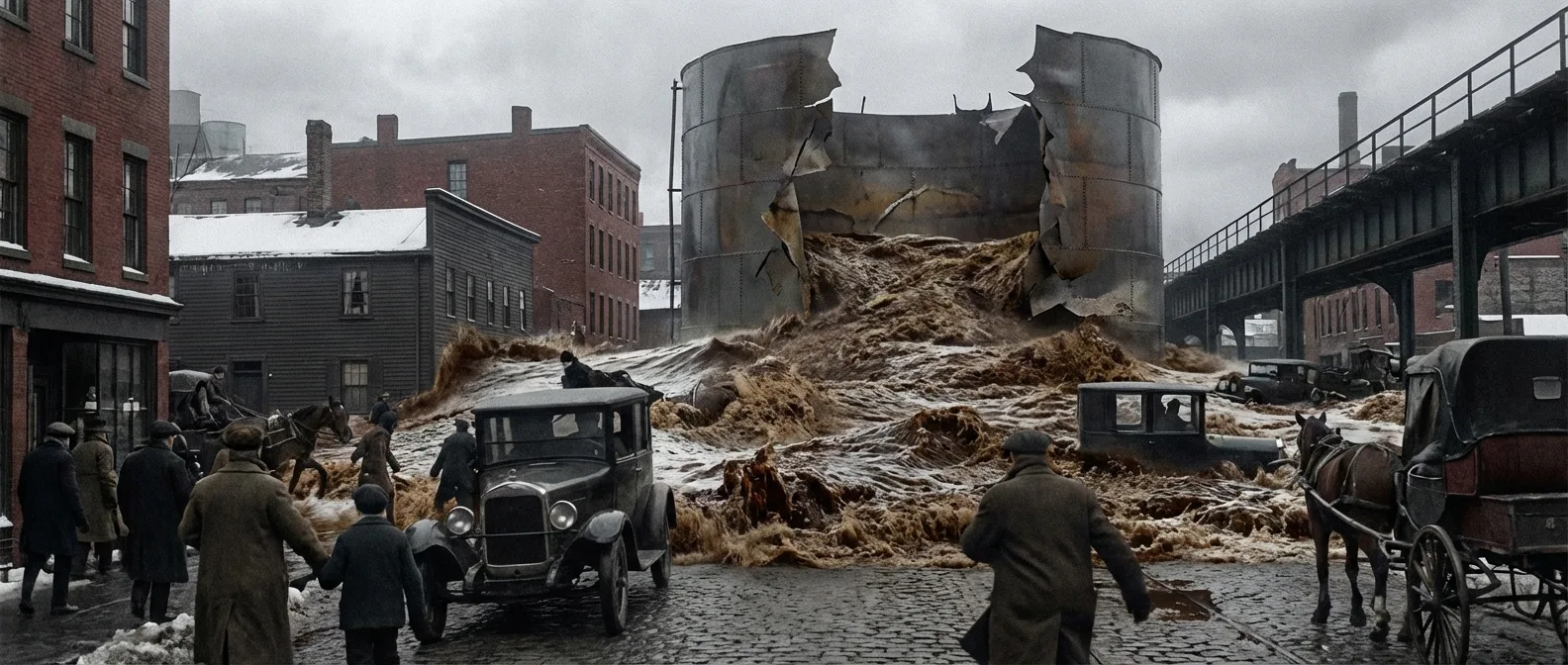
The Boston molasses flood: sweet death
On January 15, 1919, just after noon, a massive storage tank in Boston's North End neighborhood burst without warning.
📖 Read more: Donner Party: The Settlers Who Resorted to Cannibalism
The Tank in the North End
Boston's North End was, in the early twentieth century, a densely packed enclave of immigrants — mostly Italian and Irish — living in narrow, low-rise tenements along tight streets near the harbor. Right in the heart of this neighborhood, on Commercial Street, the United States Industrial Alcohol Company (USIA) had installed a massive cylindrical steel tank.
The tank was built in 1915, hastily and poorly. It stood 50 feet tall with a diameter of 90 feet — capable of holding over 2.3 million gallons of molasses. Molasses was not merely a sweet byproduct — it was the raw material for producing industrial alcohol, used in munitions during the First World War and in alcoholic beverages before Prohibition.
USIA was in a rush. The Eighteenth Amendment to the United States Constitution — Prohibition — was set to take effect on January 17, 1920. The company wanted to convert as much molasses as possible into alcohol before the window closed. The tank was filled again and again, without adequate inspections, without proper maintenance, without respect for basic safety standards.
The company knew the tank had problems. Residents complained about the leaking molasses constantly. Instead of repairing it, USIA painted the tank brown — so the molasses stains would not show. The construction overseer, Arthur Jell, had no engineering training whatsoever. No hydraulic pressure test had ever been conducted on the tank. No one had checked whether the walls were thick enough to bear the loads they were expected to carry.
January 15, 1919 — The Day Time Stopped
The day began unusually warm for January. Temperatures had surged from around 2°F the day before to above 40°F — a meteorological anomaly that later proved to be a critical factor. The sudden temperature rise caused the molasses inside the tank to ferment, dramatically increasing the internal pressure.
At 12:30 in the afternoon, the tank's seams began to give way. A sound like machine-gun fire erupted — the rivets were shooting out like bullets. And then the tank opened. It did not merely crack — it exploded. Massive steel fragments were launched dozens of yards. One piece of metal sliced clean through a column of the elevated railway.
📖 Read more: The Triangle Fire: The Tragedy That Changed Labor Rights
What followed was unthinkable. A tsunami of molasses — dark, dense, warm — swept through the streets at 35 miles per hour. The wave stood nearly 25 feet high in its first seconds. Buildings collapsed like cardboard. One house was flipped upside down. The Engine 31 firehouse was engulfed — crew members were trapped beneath the rubble. A truck was lifted off the ground and hurled into a residence.
A Wave Without Water
Molasses is not water. It is three times denser, extraordinarily sticky, and as it cools it grows even more viscous. This meant victims could not simply swim or breathe — the molasses wrapped around bodies, filled lungs, glued hands to the ground. Those not killed by the force of the wave died of asphyxiation — slowly, agonizingly, struggling to breathe inside a mass of sugary sludge.
The testimonies of rescuers are nightmarish. Firefighters, police officers, sailors from a nearby naval yard — all rushed to the scene. But they moved slowly through the molasses, which in places was more than three feet deep. Every step was a battle. Tools slipped from their grip. Hands stuck fast. Ropes became soaked and useless.
The buildings surrounding the tank were reduced to rubble. The house at 529 Commercial Street collapsed entirely, burying an entire family. A section of the elevated railroad was warped beyond repair. Horses, dogs, and cats were found stuck in the molasses, motionless, as if frozen in amber. Animals that were not killed instantly had to be put down by police officers — there was no way to free them.
The Victims
The final toll was 21 dead and 150 injured. The victims were mostly workers, immigrants, and residents of the North End — people who never asked for the tank, had no say in its placement, and never profited from it. Among the dead was mail carrier Flaminio Gallerani, caught mid-route in the path of the wave. Ten-year-old Maria Distasio, collecting firewood for the family stove near the tank. Firefighter George Layhe, found trapped beneath the ruins of his own station.
Identifying some of the victims took weeks. Bodies were coated in dried molasses, deformed by the force of the wave, buried under the debris of collapsed buildings. The last body was discovered four months later, in spring — when the warmth began to melt the final crusted layers of molasses.
📖 Read more: Rana Plaza: The Truth Behind Cheap Clothes
Cleanup of the North End took months. The molasses had penetrated every crack, every basement, every drainage pipe. Thousands of gallons of saltwater were used under pressure. Boston Harbor remained brown for months. Residents claimed that on hot summer days they could smell molasses in the streets for decades afterward.
The Cause — Profits Over Safety
The tank was doomed from the moment it was built. Arthur Jell, the USIA overseer in charge of its construction, had no engineering knowledge. He never requested a structural analysis. The walls were thinner than the minimum required — in some places, the steel was nearly 50% thinner than basic engineering standards demanded. The tank was never tested with water — a simple, inexpensive procedure that would have immediately revealed its weaknesses.
The company knew. From the very first day of operation, the tank showed leaks. Residents complained regularly. USIA responded in the most cynical way imaginable: instead of reinforcing the tank or reducing its capacity, they painted the walls brown so the stains would not show. The decision captured the philosophy of the era perfectly: the appearance of safety instead of actual safety.
USIA's rush had a clear cause: Prohibition. The Eighteenth Amendment, which would ban alcohol production, had already been ratified and was set to take effect within months. The company wanted to process every last drop of molasses into alcohol before the market closed. So they filled the tank again and again, beyond every safe limit — pre-Prohibition profits mattered more than the lives on the streets below the tank.
The Company Blamed Anarchists
USIA's response after the disaster was as revealing as the negligence itself. Rather than accept responsibility, the company adopted a breathtakingly brazen strategy: they blamed anarchists for blowing up the tank.
The times lent credibility to this claim. In 1919, the United States was gripped by a climate of terrorist hysteria — the so-called Red Scare. Italian anarchists, particularly the group around Luigi Galleani, had carried out bombing attacks in American cities. USIA exploited this climate of fear, arguing that the tank did not break — it was bombed. According to the company, radical immigrants had targeted the tank as a symbol of American industry.
📖 Read more: Shackleton: 2 Years Trapped in Antarctica
The theory had no evidence whatsoever. No trace of explosives was ever found. No anarchist group claimed responsibility. But the company persisted — because the alternative was far more costly: admitting that the tank was defective, that the construction was shoddy, that they had placed profits above human lives.
The Trial That Changed Everything
The victims' families did not accept the anarchist story. They filed a massive lawsuit against USIA — one of the first major class-action corporate liability cases in American legal history. The trial began in 1920 and lasted five full years — an unprecedented judicial marathon.
The court-appointed auditor, Colonel Hugh W. Ogden, examined over 900 witnesses — engineers, residents, company employees, metallurgical experts. His finding was devastating: the tank collapsed due to structural inadequacy. The walls were thinner than required. No stress test had been performed. The construction was careless. The company knew about the leaks and did nothing.
The ruling in favor of the plaintiffs was issued in 1925. USIA was ordered to pay damages of $628,000 — equivalent to roughly $11 million today. But the significance of the case far exceeded the money: it was one of the first times an American court recognized that a corporation could be held responsible for deaths caused by negligent construction.
The molasses case became legal precedent — the foundation upon which later laws governing corporate liability, construction safety, and consumer protection were built. Before Boston, companies could build virtually anything without meaningful consequences. Afterward, the world — slowly, gradually — began to change.
The Legacy of a Sticky Tragedy
The Boston Molasses Flood remains one of the strangest industrial disasters in history. It is easy to hear the title and laugh — molasses, after all, sounds like a joke. But there is nothing funny about a 25-foot wave that drowns people in a sticky mass while they cannot even scream.
The tragedy revealed something more important than the defects of a tank: it revealed the defects of a system. An era in which corporations operated without rules, workers died without compensation, and poor immigrants were invisible until they became victims. The North End neighborhood, with its Italian and Irish immigrants, never had a voice in where a tank holding thousands of tons of molasses would be placed. Nobody asked them.
Today, on the site of the destroyed tank, there is a small park — Langone Park, recently renovated, with a modest plaque describing the events of that day. Most passersby read it with disbelief — a molasses flood sounds like an urban legend, something too absurd to be true. But it was true. And 21 people died so the world could learn something that today seems obvious: that a company that builds defective things must pay when those things kill. The molasses was eventually washed from the streets of Boston. But the stench of negligence — that lingers forever.