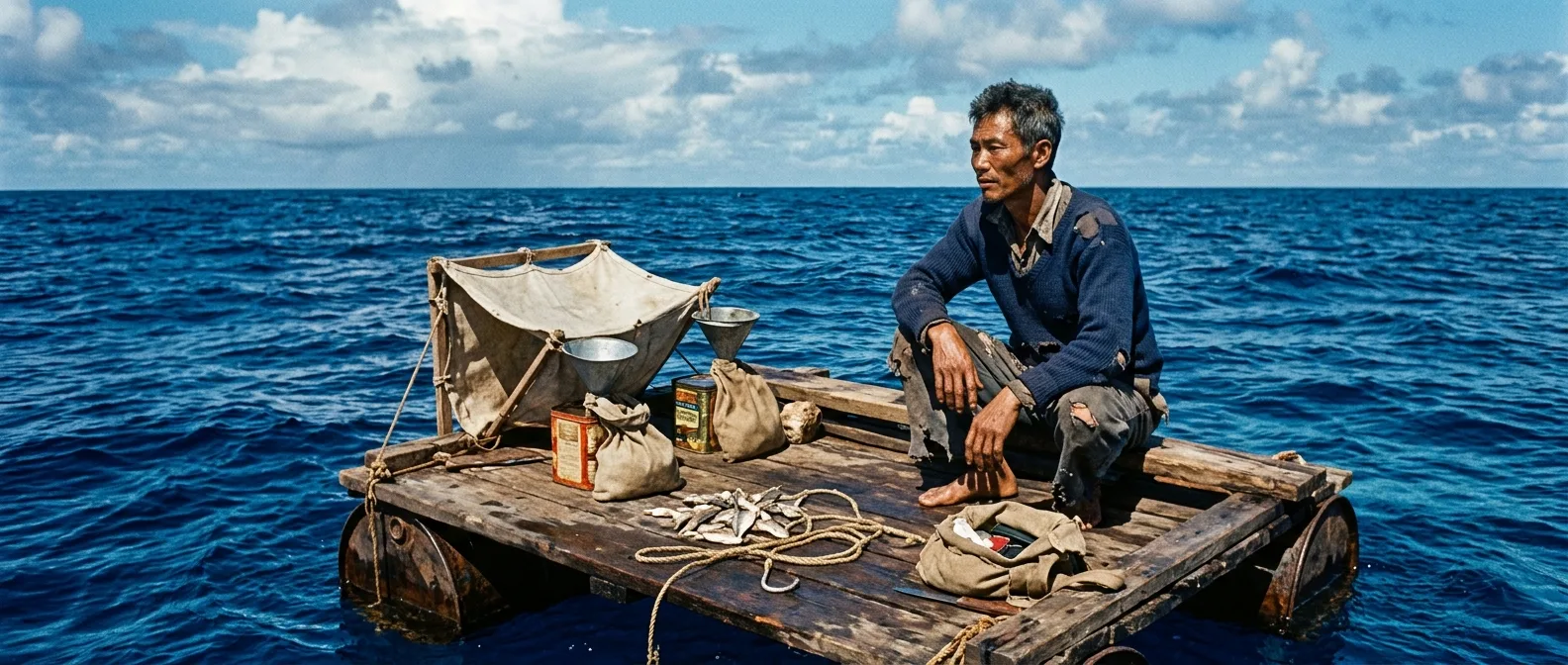
The castaway who survived 133 days alone on a raft
On November 23, 1942, a German submarine launched a torpedo at the British merchant vessel SS Ben Lomond, southeast of the Brazilian coast.
📖 Read more: The Ship Found Sailing Alone with the Table Still Set
The Second Steward
Poon Lim was born in 1918 on Hainan Island in China, into a poor fishing family. China was engulfed in civil wars and Japanese invasions. At the age of 16, Poon decided the sea would be his only hope. He signed on to British ships as a second steward — the lowest rank on the crew. He worked in the galley, carried supplies, scrubbed decks. He was invisible.
In November 1942, he was aboard the SS Ben Lomond, a merchant vessel transporting supplies from Cape Town to Suriname. German U-boats dominated the Atlantic at that time. The “Battle of the Atlantic” was in full swing — thousands of merchant ships were being sunk every month. The crew knew the danger. But no one could prepare for what followed.
The Torpedo
The torpedo from U-172 struck the SS Ben Lomond shortly after noon. Poon Lim was below deck when the explosion tore apart the bow. The ship began sinking almost immediately. The young Chinese man jumped into the water before he could even grab a life jacket. He swam through oil, wreckage, and screams. Of the 55 people on board, only two made it into the water alive — but the second man was lost within hours.
After nearly two hours in the water, Poon spotted a square wooden raft — one of those that wartime vessels carried as backup rescue equipment. It measured roughly 2.5 by 2.5 meters, built of hardwood, with a small storage compartment. Inside he found a few biscuits, a 40-liter water jug, some flares, a flashlight, a length of rope, and several tins of food. Supplies for perhaps ten days — for someone very careful.
Poon Lim was alone in the middle of the South Atlantic, thousands of kilometers from any coastline. He had no compass. He had no map. He did not know exactly where he was. But he knew something no one could take from him: he knew the sea.
The First Days — Discipline
Instead of collapsing into panic, Poon Lim reacted with composure that special forces soldiers would envy. On the very first day, he established a rationing system. The biscuits would be eaten in small pieces, twice a day. The water would be measured in sips — three in the morning, three in the evening. There was no margin for error.
He built a routine. Every morning he checked his supplies. Every midday he scanned the horizon for ships or aircraft. Every afternoon he exercised — push-ups on the raft, stretching, swimming around it (always tied by rope). He knew that if he stopped moving, if he let his limbs go stiff, it would be only a matter of time before death.
In truth, this manual record-keeping was far more important than it seems. Without reference to time, the human mind collapses. The sense that “I know how many days have passed” was his psychological anchor.
The Inventor of Necessity
By day ten, the biscuits were gone. The water was diminishing rapidly. Poon Lim faced the most primal question: how does one eat in the middle of the ocean?
The answer came from his childhood on Hainan. He pried a nail from the raft and bent it into a hook shape using the metal base of the flashlight as a hammer. He cut a strip from a tin can and fashioned it into a blade. He used fibers from the rope as fishing line. Leftovers from the tins became bait. And within hours, the first fish — a small tuna — lay on the raft.
By eating raw fish, Poon managed to secure both protein and fluids. The eyes and internal organs of fish — though revolting to contemplate — are rich in water and nutrients. The young castaway consumed them immediately after catching, before they softened in the sun. The remaining parts he dried on the raft as reserves.
For fresh water, he constructed an improvised rain-collection device. He used a piece of fabric from his clothing, stretched between two sticks, draining into the storage container. Every tropical storm became a blessing — though simultaneously a danger, as the waves threatened to capsize the raft.
The Battle with the Sharks
After the first weeks, sharks began circling the raft. The smell of fish and food scraps attracted them. Poon Lim addressed the problem with remarkable calm: he fashioned an improvised spear from a piece of the raft's wood and a metal fragment he had sharpened to a point.
📖 Read more: Frane Selak: The Luckiest Unluckiest Man
One day, a small shark drew close enough to strike. Poon hit it with the spear, dragged it onto the raft, and killed it. He drank its blood — rich in fluids — and ate its flesh raw. The fins he dried in the sun. It was the first time he felt that he was not merely a victim — he was a hunter.
Birds were another source of food. Poon lay motionless on the raft with a piece of fish in his hand, waiting until a seabird approached closely enough. He seized it with bare hands. The feathers were not discarded — he used them as insulation at night, when temperatures over the open ocean drop dramatically.
The Ships That Did Not Stop
During the course of 133 days, Poon Lim sighted several ships and aircraft. None stopped. Once, a merchant vessel passed so close he could see the figures on deck. Poon shouted, waved, used the one remaining flare he had. The ship continued on its way. They probably saw him — but in wartime, stopping in the middle of the Atlantic could mean a torpedo.
A US Navy aircraft spotted him once and dropped a marker buoy near him. Poon waited days for a rescue vessel. It never came. It was later determined that a storm had swept the buoy away, and the search ships could not find him.
Each such failure was a psychological blow. Hope that surges skyward and then collapses entirely is more destructive than steady despair. But Poon had an internal resilience mechanism that would not switch off: “If I die, I will die trying. I will not sit and wait.”
Day 133
By April 1943, Poon Lim's raft had drifted slowly westward, near the coast of Brazil. On April 5, three Brazilian fishermen in a small boat spotted him. What they saw froze them in place: a skeletal body, blackened by the sun, covered in sores and salt, lying on a wooden platform strewn with fish bones and dried strips of meat. A human being transformed into something between a hermit and a primitive hunter.
Poon Lim was alive. He could stand on his feet — something that shocked the doctors. He weighed just 59 kilograms, down from 72 before the shipwreck. But his reflexes worked. His eyes focused. His mind was clear. He was transferred to a hospital in Belem, where he recovered in three weeks — remarkably fast given the conditions.
After the Sea
King George VI of Britain awarded him the British Empire Medal (BEM). The Royal Navy studied his story to improve its survival manuals. His techniques — improvised fishhooks, rainwater collection, raw fish consumption, psychological discipline — were incorporated into the Royal Navy's survival training programs.
Poon Lim eventually settled in the United States, where he obtained American citizenship. He worked quietly in the import-export business. He did not seek publicity. He never wrote a book. He did not sell his story. When asked whether he would spend another 133 days on the ocean, he replied calmly: “I hope no one will ever have to break my record.”
Poon Lim's record was never broken. It remains to this day in the Guinness Book of Records as the longest survival time of a single person on a raft in the open sea. Eighty years later, no one has come close to the number 133.
What the Raft Meant
The story of Poon Lim is not merely a survival story. It is a story about the limits of the human mind. On a raft measuring 2.5 meters, without technology, without help, without hope of rescue, a young man decided he would not die. And that decision — that negative certainty — kept him alive.
Psychologists who later studied his case identified several factors. First, Poon never treated the situation as “waiting for rescue.” He treated it as “life” — a new, harsh, microscopic life, but life nonetheless. Second, his childhood experience as a fisherman's son gave him practical skills that an urban Western sailor would not have possessed. Third — and perhaps most importantly — Poon Lim expected nothing from anyone. He had learned from a young age that the world owes nothing to anyone.
Some people survive at sea because they are found quickly. Some because they have equipment. Poon Lim survived because he refused to be a victim — and turned every second into action. Every fishhook he fashioned, every raindrop he collected, every morning workout on the raft was a declaration: “I am still here.”
EpiloguePoon Lim died on January 4, 1991, at the age of 72, in Brooklyn, New York. He had lived a quiet life after the war — so quiet that many of his neighbors never knew that the calm elderly Chinese man on the corner held a world record that no one had managed to surpass. His raft was never preserved — it was lost somewhere on the docks of Belem. But the number remains: 133 days, alone, in the middle of nowhere. A square of wood on the Atlantic, a man who refused to sink, and a rope with 133 knots — the most austere narrative of human endurance ever written.