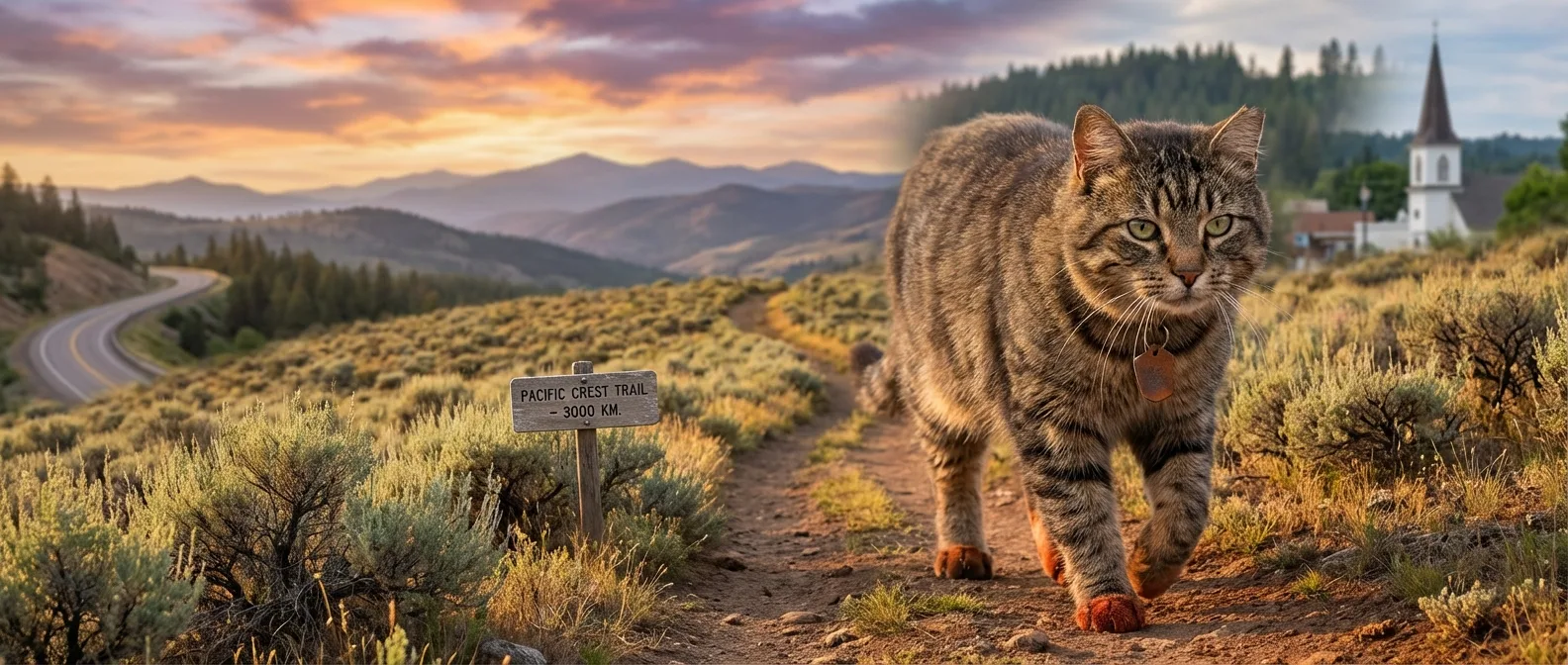
The Cat That Traveled 3,000 km to Get Home
A True Story
📖 Read more: Tarrare: The Man Who Ate Everything
The most famous story: Holly
Holly was a four-year-old tortoiseshell cat that lived with her owners, Jacob and Bonnie Richter, in West Palm Beach, Florida. She was primarily an indoor cat, microchipped, and the family considered her a full member of the household. In November 2012, the family went on a trip to Daytona Beach — 200 miles to the north — and brought Holly along.
During a walk, fireworks startled Holly. Running in panic, she vanished within seconds. The Richters searched for days, posted flyers, contacted local rescue groups and veterinarians. Nothing. The story was eventually picked up by The New York Times and became international news.
Holly's story is remarkable — but there are stories even more astonishing. Cats that traveled far greater distances, through winters, mountains, and deserts.
How do they do it? The science behind the phenomenon
How does a cat — an animal without GPS, maps, or a smartphone — find its way across thousands of kilometers? The answer is not simple, and scientists are still investigating.
Magnetic field: Research shows that cats (and many animals) possess magnetite — microscopic iron particles — in their brains. These may function as an internal compass, allowing them to sense the Earth's magnetic field.
📖 Read more: The Beirut Explosion of 2020 That Shocked the World
Olfactory maps: A cat's nose has 200 million olfactory receptors (humans have 5 million). Some researchers believe cats create “scent maps” — recognizing odors associated with specific places.
Acoustic signals: Cats hear ultrasonic frequencies that humans cannot detect. Some researchers theorize that low-frequency sounds — from rivers, highways, even the ocean — may serve as navigation landmarks.
Celestial navigation: Some researchers believe cats use the position of the sun during the day and possibly the stars at night as reference points — much like migratory birds. In a 1922 experiment at the University of Kiel, cats transported in darkened boxes could still orient themselves, but with reduced accuracy — suggesting that visual cues play a role in their navigation.
Psi-trailing: The most mysterious theory — unproven but not disproven. Researcher Joseph Rhine studied dozens of cases of animals finding their owners in places they had never been. The explanation? Nobody knows.
📖 Read more: The Explosion That Leveled a City Without Any Bombs
In a 1954 experiment, researcher Frances Herrick placed cats in enclosed boxes at distances of up to 10 kilometers. Most found their way home — even though they had never seen the route.
Why not all of them?
The important question: why do some cats travel thousands of kilometers while others get lost two blocks away?
The answer seems to lie in the animal's personality, the relationship with its owner, and outdoor experience. Cats that have lived both indoors and outdoors, that hunt, that explore — those have the tools. Strictly indoor cats get lost far more easily.
The bond also matters. Animals with a strong emotional connection to their owners — those that sleep beside them, follow them around, seek affection — seem to have a stronger motivation to return.
📖 Read more: The Fake Anastasia Romanov: Anna Anderson's 60-Year Deception
Age plays a role too: younger cats tend to return more often, likely because they have more energy and endurance. And there is the factor of luck: highways, predators, disease, extreme weather. The cats that return are the survivors — we don't know how many tried and didn't make it.
Something that can't be explained
Holly came home after 200 miles. Murka after 3,000 kilometers. Ninja after 1,600. Howie after 1,600 through the Australian outback. Sugar found her owners in a place she had never set foot. No scientist can fully explain how.
What we do know: every year, thousands of lost cats return home across distances that defy logic. Biology offers some answers — magnetism, olfaction, hearing. But none explain the extreme cases. Something drives these animals forward — through snow, deserts, highways, unknown dangers — guided by an instinct we cannot yet name. And perhaps that is the most captivating part of this story — that science still does not have the final answer, and may never fully have it.
Perhaps the answer doesn't lie in magnetic compasses or olfactory receptors. Perhaps it lies in something simpler — and more inexplicable: the instinct of home. The need to return to where you belong. This is true for cats. And perhaps — it is true for us too.