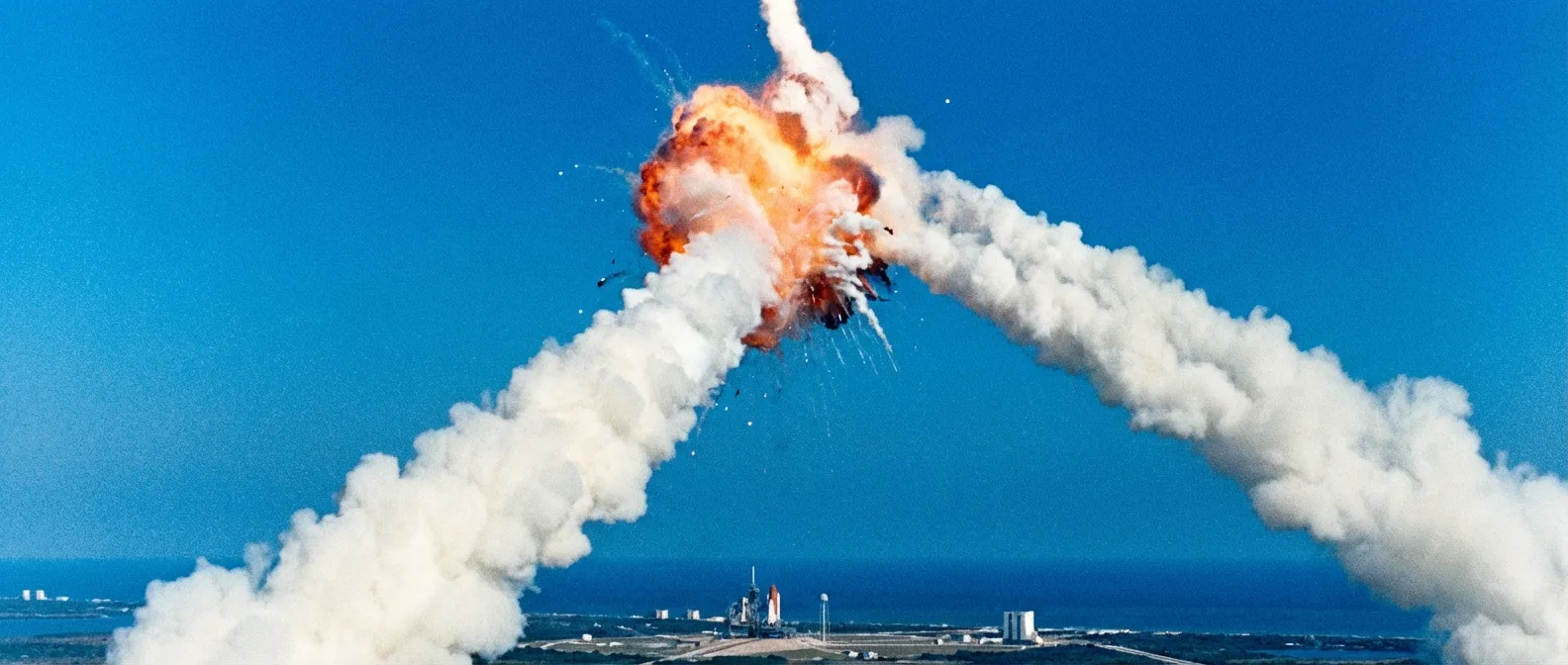
The Challenger Explosion: 73 Seconds of Horror
On January 28, 1986, the Space Shuttle Challenger launched from Kennedy Space Center in Florida.
📖 Read more: 33 Miners Trapped 69 Days Deep Underground
Mission STS-51-L
Mission STS-51-L was the 25th flight of the Space Shuttle program and the 10th for Challenger. The crew consisted of 7 members: Commander Dick Scobee, Pilot Michael Smith, Mission Specialists Judith Resnik, Ellison Onizuka, and Ronald McNair, Payload Specialist Gregory Jarvis, and Christa McAuliffe. It was a crew of emblematic diversity: McNair was the second African American astronaut in space, Resnik the second American woman, and Onizuka the first Asian American. NASA wanted this mission to represent all of America.
McAuliffe was the star attraction. NASA had created the “Teacher in Space” program to bring space closer to the general public. McAuliffe, a 37-year-old teacher from Concord, New Hampshire, was selected from 11,000 applicants. She planned to conduct two live lessons from orbit: one about daily life in space and another on fluid dynamics in zero gravity. McAuliffe had left behind her husband Steven and their two children, Scott and Caroline. Before leaving, she told her students: “If I'm given the opportunity, I'm going into space on your behalf.”
The launch had already been postponed five times — due to bad weather and technical problems. NASA was pushing for launch. President Reagan planned to mention the mission in his State of the Union address that evening. The pressure was enormous. NASA was already facing criticism for the delays — media outlets mocked the agency as unreliable, while Congress threatened budget cuts unless the shuttle program could demonstrate a regular flight schedule.
The night before — The engineers who warned
The evening before launch, a team of engineers from Morton Thiokol — the company that manufactured the Solid Rocket Boosters (SRBs) — urgently requested a teleconference with NASA. The reason: the temperature forecast for the morning was 36°F. No launch had ever taken place at such a low temperature.
Roger Boisjoly, Thiokol's lead engineer, was emphatic: the O-rings — the rubber sealing rings at the joints of the SRBs — lose their elasticity in cold temperatures. He presented data showing that below 53°F, the O-rings fail to seal properly.
Boisjoly had written an internal memo six months earlier, in July 1985, warning that an O-ring failure would have “catastrophic” consequences. No one acted on it.
📖 Read more: The Cat That Traveled 3,000 km to Get Home
The teleconference lasted hours. Thiokol's engineers unanimously recommended postponement. But NASA management reacted with anger. Lawrence Mulloy, the SRB program manager, asked irritably: “When do you want me to launch — next April?” Thiokol's management, under pressure, overruled their own engineers' recommendation. The launch was approved.
Boisjoly looked at me and said: “Arnie, people are going to die tomorrow.” None of us slept that night.
73 seconds
At 11:38 a.m. local time, the engines ignited. Challenger lifted off — seemingly normally. No one in mission control had any indication of trouble. The astronauts' families watched with smiles. Thousands of schoolchildren in classrooms across the country stared at their television screens. At Concord High School, McAuliffe's students had gathered in the auditorium, holding banners and cheering. At the space center, McAuliffe's parents watched from a special VIP viewing stand.
What no one could see was that at T+0.678 seconds — less than one second after ignition — smoke appeared at the right joint of the SRB. The O-ring had failed. Hot gases were escaping.
At 59 seconds, the flame eroded through the wall of the SRB and reached the external hydrogen tank. At 73 seconds, the tank exploded. The cameras captured a white sphere — two SRB rockets flying uncontrollably in opposite directions — and a cloud of white smoke forming a Y-shape.
The crew cabin was not destroyed in the initial breakup — it separated intact and continued to rise for several seconds before beginning its fall. At least three crew members activated their emergency oxygen systems — meaning they survived the initial explosion.
The cabin struck the ocean at approximately 200 mph, roughly 2 minutes and 45 seconds after the initial fireball. The impact was fatal. The exact moment of the crew's death remains undetermined — but they most likely survived at least several seconds after breakup, and possibly until impact. The recovery operation lasted 75 days. NASA retrieved wreckage from the Atlantic seabed at depths of 100 feet, using underwater robots and divers. The crew remains were identified in April 1986 and buried privately.
📖 Read more: The Hindenburg Disaster: Live on Radio
The reaction — a nation in shock
The image of the Y-shaped cloud became one of the most recognizable photographs of the 20th century. CNN reporter Tom Mintier was the first to say live: “It looked like there was a major malfunction.” In schools, teachers turned off televisions in front of children who didn't understand what had happened.
President Reagan canceled his State of the Union address and instead delivered a televised message to the nation. The speech, written by Peggy Noonan, is considered one of the greatest presidential addresses in American history. Reagan closed by quoting poet John Gillespie Magee: “We touched the face of God.” The phrase was later inscribed on the Astronaut Memorial at Cape Canaveral.
The future doesn't belong to the fainthearted — it belongs to the brave. The Challenger crew was pulling us into the future, and we'll continue to follow them.
The Rogers Commission and Feynman
President Reagan ordered the creation of an independent commission chaired by former Secretary of State William Rogers. The “Rogers Commission” included some of the brightest minds of the era — among them Nobel physicist Richard Feynman, known for his work in quantum electrodynamics and his role in the Manhattan Project.
Feynman proved to be the commission's most effective and fiercely independent member. During a televised hearing, he performed a simple but devastating experiment: he dipped a piece of O-ring material into a glass of ice water and showed that it completely lost its resilience. The image — an elderly physicist dunking a rubber ring into a glass of water — became a symbol of how simple logic can expose bureaucratic inertia.
Feynman added a personal appendix to the final report: "For a successful technology, reality must take precedence over public relations — for nature cannot be fooled."
📖 Read more: The History of Data: Why Our Personal Information Has Value
The culture of failure
The Rogers Report revealed that NASA had known about the O-ring problem for years. At least 7 previous flights had shown evidence of seal erosion. Rather than grounding the fleet, managers “normalized” the degradation — classifying it as an “acceptable risk.”
Sociologist Diane Vaughan from Columbia University coined the term “normalization of deviance” to describe what happened. Each time a problem didn't lead to catastrophe, it became “normal.” The line of acceptable risk shifted silently, until the unacceptable became routine.
Roger Boisjoly, the engineer who had warned, testified before the commission. His testimony made headlines worldwide. But his company isolated him — transferring him to a role with no responsibilities. He was forced to resign and fell into depression. Later, he dedicated his life to engineering ethics education, visiting universities across the country to teach future engineers about the moral duty to speak up. He received the Award for Scientific Freedom and Responsibility from the AAAS in 1988. He passed away in 2012, still haunted by the memory of that teleconference.
73 seconds that changed NASA
After Challenger, NASA suspended flights for 32 months. The O-rings were completely redesigned — now featuring a triple-seal system instead of double. The decision-making process was restructured. In theory. In practice, 17 years later, Columbia disintegrated during re-entry — again due to a known but “normalized” problem.
Christa McAuliffe never taught her lesson from space. But her story still inspires generations of educators. In 2007, Barbara Morgan — McAuliffe's backup — finally flew to space, 21 years later. She carried a photograph of Christa with her, along with the lesson plan McAuliffe never got to teach.
Those 73 seconds were not merely a technical failure. They were the moment when a rubber ring worth a few cents revealed that arrogance, political pressure, and silence in the face of danger can kill. Today, more than 40 schools across America bear the name of Christa McAuliffe — a living reminder that every teacher can inspire, even through tragedy.