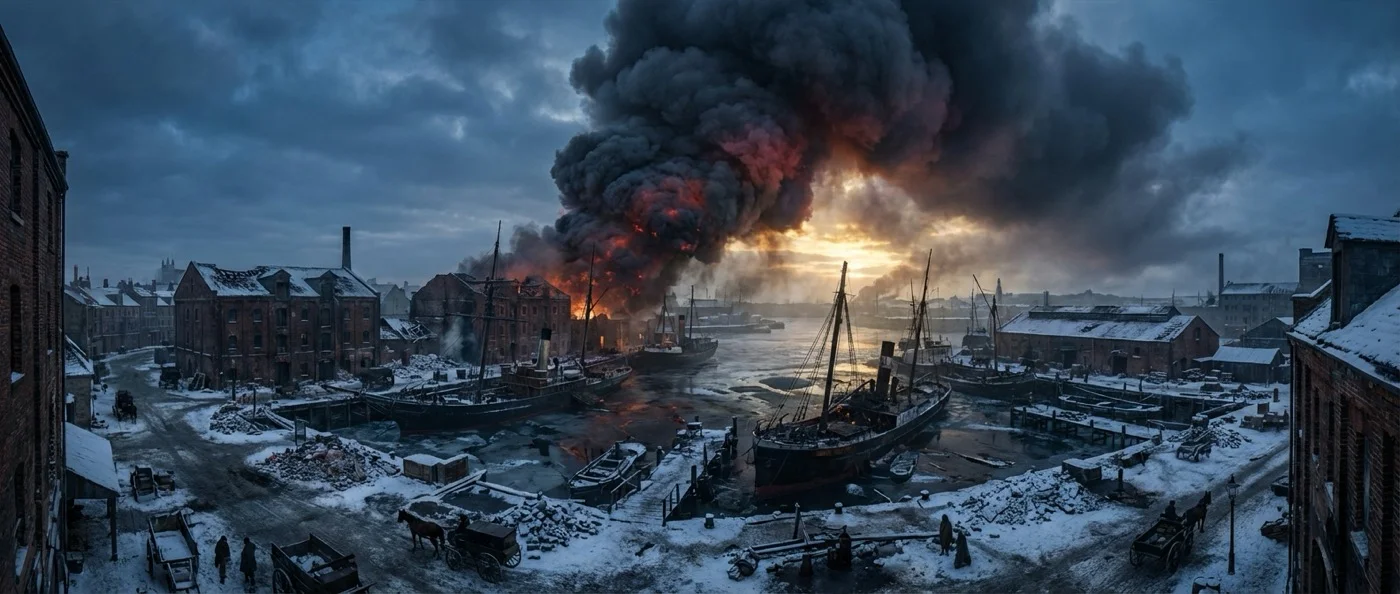
The Explosion That Leveled a City
Halifax, December 6, 1917 — The largest non-nuclear explosion in history
Prologue
An Ordinary Morning
On December 6, 1917, the sun rose over the harbor of Halifax, Nova Scotia, Canada, like any other winter morning. World War I was raging in Europe, and this small Canadian city of 65,000 inhabitants had been transformed into a key supply port for the Allied forces. Convoys full of soldiers, ammunition, and supplies departed from here for the battlefields of France.
Nothing that morning suggested that within a few hours, this city would become the theater of the largest non-nuclear explosion humanity had ever known. An explosion without a bomb, without an enemy attack, without intent. Just a collision of two ships. And 2.9 kilotons of destruction.
Nothing that morning suggested that within a few hours, this city would become the theater of the largest non-nuclear explosion humanity had ever known. An explosion without a bomb, without an enemy attack, without intent. Just a collision of two ships. And 2.9 kilotons of destruction.
— i —
❧ ❧ ❧
Chapter One
The Two Ships
The French cargo ship SS Mont-Blanc had arrived from New York late on the evening of December 5. It was loaded to the brim — but its cargo was not food or clothing. It carried 2,300 tons of picric acid, 200 tons of TNT, 35 tons of benzol in barrels on deck, and 10 tons of gun cotton. It was a floating arsenal.
On the other side of the harbor, the Norwegian SS Imo was preparing to depart. Chartered by the Belgian Relief Commission, it was traveling empty to New York to pick up humanitarian supplies. Its departure had been delayed due to a late coal resupply.
To exit the inner harbor of Bedford Basin, the Imo had to pass through a narrow passage — the so-called Narrows. There, that morning, it would meet the Mont-Blanc.
On the other side of the harbor, the Norwegian SS Imo was preparing to depart. Chartered by the Belgian Relief Commission, it was traveling empty to New York to pick up humanitarian supplies. Its departure had been delayed due to a late coal resupply.
To exit the inner harbor of Bedford Basin, the Imo had to pass through a narrow passage — the so-called Narrows. There, that morning, it would meet the Mont-Blanc.
⚓ Harbor regulation: Ships were required to travel on the right side of the channel and not exceed 5 knots. Before the war, ships with dangerous cargo were not permitted inside the harbor — but the threat of German submarines had relaxed this regulation.
— 1 —
❧ ❧ ❧
Chapter Two
The Collision
At 7:30 in the morning, the anti-submarine nets were opened and both ships entered the Narrows — heading toward each other. The pilot of the Mont-Blanc, the experienced Francis Mackey, spotted the Imo at a distance of 1.2 kilometers. Something was wrong: the Imo was moving much faster than permitted, on the wrong side of the channel.
A drama of whistles began. Mackey blew once — “I have right of way.” The Imo responded with two blasts — “I will not yield.” Mackey blew again. Two blasts again. Sailors on nearby ships, hearing the signals, understood what was coming and gathered to watch.
Both ships cut engines, but inertia was driving them toward each other at a slow pace. Mackey could not run aground — the terror of an impact on the explosives cargo prevented him. He ordered a hard left turn in a desperate evasion attempt. The ships were nearly parallel when suddenly the Imo put its engines in reverse. The combination of its light weight (it was traveling empty) and the propeller torque swung its bow directly into the Mont-Blanc.
It was 8:45 AM. The Imo's bow wedged into Cargo Hold No. 1 of the Mont-Blanc.
A drama of whistles began. Mackey blew once — “I have right of way.” The Imo responded with two blasts — “I will not yield.” Mackey blew again. Two blasts again. Sailors on nearby ships, hearing the signals, understood what was coming and gathered to watch.
Both ships cut engines, but inertia was driving them toward each other at a slow pace. Mackey could not run aground — the terror of an impact on the explosives cargo prevented him. He ordered a hard left turn in a desperate evasion attempt. The ships were nearly parallel when suddenly the Imo put its engines in reverse. The combination of its light weight (it was traveling empty) and the propeller torque swung its bow directly into the Mont-Blanc.
It was 8:45 AM. The Imo's bow wedged into Cargo Hold No. 1 of the Mont-Blanc.
— 2 —
❧ ❧ ❧
Chapter Three
Twenty Minutes of Fire
The collision was not violent — it was slow, almost gentle. But the benzol barrels on deck overturned. The liquid covered the deck and flowed into the hold. As the Imo disengaged, it produced sparks inside the Mont-Blanc's hull. The benzol ignited.
The Mont-Blanc's crew, surrounded by thick black smoke, immediately understood what was coming. Captain Aimé Le Médec ordered the ship abandoned. The sailors jumped into lifeboats shouting to every ship they encountered that the Mont-Blanc was about to explode — but no one could hear them amid the chaos.
The abandoned ship drifted and ran aground at Pier 6, in the Richmond district. And there began a spectacle that would kill hundreds.
The burning ship magnetized the entire city. Residents came out into the streets, stood at the windows of homes and offices, to watch the “spectacular” fire. Firefighters, unaware of what the ship was carrying, rushed to the pier. Canada's first motorized fire engine, the Patricia with its 8-member crew, headed straight for the scene.
At that moment, thousands of pairs of eyes were fixed on the fire through window glass.
The Mont-Blanc's crew, surrounded by thick black smoke, immediately understood what was coming. Captain Aimé Le Médec ordered the ship abandoned. The sailors jumped into lifeboats shouting to every ship they encountered that the Mont-Blanc was about to explode — but no one could hear them amid the chaos.
The abandoned ship drifted and ran aground at Pier 6, in the Richmond district. And there began a spectacle that would kill hundreds.
The burning ship magnetized the entire city. Residents came out into the streets, stood at the windows of homes and offices, to watch the “spectacular” fire. Firefighters, unaware of what the ship was carrying, rushed to the pier. Canada's first motorized fire engine, the Patricia with its 8-member crew, headed straight for the scene.
At that moment, thousands of pairs of eyes were fixed on the fire through window glass.
— 3 —
❧ ❧ ❧
Chapter Four
The Last Message
At the Halifax railway depot, approximately 230 meters from Pier 6, telegraph operator Vincent “Vince” Coleman was working his shift. A sailor running away from the harbor warned him: the burning ship was full of explosives.
Coleman and his colleague William Lovett started running. But Coleman remembered something: a passenger train from Saint John, New Brunswick was on its way, just minutes away. Three hundred passengers were heading directly toward the epicenter.
Vince Coleman went back. Alone. He sat at the telegraph and began sending messages:
Coleman and his colleague William Lovett started running. But Coleman remembered something: a passenger train from Saint John, New Brunswick was on its way, just minutes away. Three hundred passengers were heading directly toward the epicenter.
Vince Coleman went back. Alone. He sat at the telegraph and began sending messages:
"Stop trains. Munitions ship on fire in harbor, heading for Pier 6 and will explode. I guess this will be my last message. Goodbye boys." — Vince Coleman, telegram, December 6, 1917
The message was heard at stations across the railway. The trains stopped. The 300 passengers were saved. But Vince Coleman never got up from his chair. He was killed at his post minutes later.— 4 —
❧ ❧ ❧
Chapter Five
9:04:35 — The Moment
At 9:04 and 35 seconds, the fire reached the Mont-Blanc's explosives cargo. What followed was the largest man-made explosion in history up to that point — and it would hold that title for nearly 30 years, until Hiroshima.
The numbers are beyond comprehension. Temperature of 5,000°C at the epicenter. Pressure of thousands of atmospheres. The shockwave started at a speed exceeding 1,000 meters per second. It was equivalent to 2.9 kilotons of TNT — Time magazine would later write that the Hiroshima atomic bomb was only 7 times more powerful.
The ship vaporized. White-hot pieces of iron rained down on Halifax and Dartmouth. A cloud of white smoke rose 3,600 meters into the sky. The explosion was heard in Cape Breton, 207 kilometers away.
The numbers are beyond comprehension. Temperature of 5,000°C at the epicenter. Pressure of thousands of atmospheres. The shockwave started at a speed exceeding 1,000 meters per second. It was equivalent to 2.9 kilotons of TNT — Time magazine would later write that the Hiroshima atomic bomb was only 7 times more powerful.
The ship vaporized. White-hot pieces of iron rained down on Halifax and Dartmouth. A cloud of white smoke rose 3,600 meters into the sky. The explosion was heard in Cape Breton, 207 kilometers away.
💥 Destruction in numbers: 1,782 dead. 9,000 injured. 1,630 homes destroyed. 12,000 more buildings damaged. 6,000 homeless. 25,000 without adequate shelter. Estimated damages: 35 million Canadian dollars (current value ~700 million).
An area exceeding 1.6 square kilometers vanished. The harbor floor was momentarily exposed as a massive volume of water was displaced. The resulting tsunami rose 18 meters above the tide level on the Halifax side, sweeping away boats, piers, and people.— 5 —
❧ ❧ ❧
Chapter Six
The City of the Blind
Firefighter Billy Wells was a member of the Patricia's 8-person crew. The shockwave hurled him through the air, tearing the clothes off his body. He was the sole survivor.
“The sight was horrific,” he recalled. "People were hanging from windows, dead. Some without heads. Some thrown onto telegraph wires."
But one of the most tragic aspects of the disaster was something no one had foreseen: the blindings. Thousands of residents had stood at their windows to watch the fire in the harbor. When the shockwave shattered the glass, shards were hurled into their faces.
Ophthalmologists who rushed to the city performed 249 enucleations — eye removals. 16 people lost both eyes. Halifax became known as a center for blind care, and the tragedy led to the founding of the Canadian National Institute for the Blind.
Large brick factories near the pier — such as the Acadia Sugar Refinery — were reduced to piles of rubble, killing most of their workers. The Richmond district, a working-class neighborhood in the northern part of the city, vanished entirely. Overturned stoves and oil lamps ignited fires across entire blocks, trapping people inside their homes.
“The sight was horrific,” he recalled. "People were hanging from windows, dead. Some without heads. Some thrown onto telegraph wires."
But one of the most tragic aspects of the disaster was something no one had foreseen: the blindings. Thousands of residents had stood at their windows to watch the fire in the harbor. When the shockwave shattered the glass, shards were hurled into their faces.
Ophthalmologists who rushed to the city performed 249 enucleations — eye removals. 16 people lost both eyes. Halifax became known as a center for blind care, and the tragedy led to the founding of the Canadian National Institute for the Blind.
Large brick factories near the pier — such as the Acadia Sugar Refinery — were reduced to piles of rubble, killing most of their workers. The Richmond district, a working-class neighborhood in the northern part of the city, vanished entirely. Overturned stoves and oil lamps ignited fires across entire blocks, trapping people inside their homes.
— 6 —
❧ ❧ ❧
Chapter Seven
The Blizzard
The first rescue efforts began immediately — neighbors and colleagues pulled victims from the rubble. British warships in the harbor sent rescue teams ashore. Camp Hill Hospital received 1,400 casualties on the first day alone.
The Massachusetts government sent an entire train full of doctors, nurses, and medical equipment. Relief trains arrived from every corner of the Atlantic Coast. But nature had one more blow in store.
The next day, a blizzard blanketed Halifax with 41 centimeters of heavy snow. Relief trains got stuck in snowdrifts. Telegraph lines, just repaired after the explosion, were cut again. The city plunged into isolation. Rescue teams were forced to halt their search for survivors, although the blizzard at least helped extinguish fires.
The Massachusetts government sent an entire train full of doctors, nurses, and medical equipment. Relief trains arrived from every corner of the Atlantic Coast. But nature had one more blow in store.
The next day, a blizzard blanketed Halifax with 41 centimeters of heavy snow. Relief trains got stuck in snowdrifts. Telegraph lines, just repaired after the explosion, were cut again. The city plunged into isolation. Rescue teams were forced to halt their search for survivors, although the blizzard at least helped extinguish fires.
"Imagine being buried under the rubble of your home, injured, in the dark — and then it starts to snow. That was the reality of thousands of people that night in Halifax." — Janet Kitz, «Shattered City», 1989
The last body — a watchman — was not found until the summer of 1919, nearly two years later.— 7 —
❧ ❧ ❧
Chapter Eight
Legacy and Memory
The judicial inquiry that followed initially charged the captain of the Mont-Blanc and pilot Mackey. But higher courts — up to the Judicial Committee of the Privy Council in London — ruled that both ships bore equal responsibility. No one was ever convicted.
Reconstruction began immediately. British urban planner Thomas Adams designed a new neighborhood in place of the destroyed Richmond — with tree-lined boulevards, green spaces, and 326 homes built from an innovative fireproof material called Hydrostone. This neighborhood, which today bears the same name, is one of the most elegant districts in Halifax.
But perhaps the most touching legacy is a Christmas tree.
Reconstruction began immediately. British urban planner Thomas Adams designed a new neighborhood in place of the destroyed Richmond — with tree-lined boulevards, green spaces, and 326 homes built from an innovative fireproof material called Hydrostone. This neighborhood, which today bears the same name, is one of the most elegant districts in Halifax.
But perhaps the most touching legacy is a Christmas tree.
🎄 The Tree: In 1918, the city of Halifax sent a Christmas tree to Boston as a thank-you for the aid after the explosion. The tradition was revived in 1971 and continues to this day. Every year, Nova Scotia carefully selects a magnificent tree that is lit at Boston Common — a reception of gratitude between two cities, 108 years later.
The memory of the explosion was suppressed for decades. After the first anniversary, the city stopped holding memorial ceremonies. The second official commemorative event did not take place until the 50th anniversary, in 1967. Today, a bell tower at Fort Needham Hill overlooks “ground zero” — and every December 6, the city remembers.— 8 —
❧ ❧ ❧
Epilogue
The City That Was Rebuilt
The Halifax explosion was not an act of war. It was not a terrorist attack. It was not a bombing. It was an accident — a low-speed collision between two ships in a narrow harbor. And that makes it even more terrifying.
It shows how fragile a city can be. How quickly a navigation error, a delay in coal resupply, a wrong whistle blast, can lead to a disaster of biblical proportions.
Today, walking through the streets of Halifax, nothing evokes that morning in 1917. The city was rebuilt. But if you look carefully, you'll find pieces of the Mont-Blanc — iron fragments placed in memorials in neighborhoods, in parks, on streets. Silent reminders that the largest non-nuclear explosion in the world did not come from the sky. It came from the sea. From a morning that started like any other.
It shows how fragile a city can be. How quickly a navigation error, a delay in coal resupply, a wrong whistle blast, can lead to a disaster of biblical proportions.
Today, walking through the streets of Halifax, nothing evokes that morning in 1917. The city was rebuilt. But if you look carefully, you'll find pieces of the Mont-Blanc — iron fragments placed in memorials in neighborhoods, in parks, on streets. Silent reminders that the largest non-nuclear explosion in the world did not come from the sky. It came from the sea. From a morning that started like any other.
— the end —
· · · · ·
📖 Read more: Why We Stopped Downloading and Started Streaming Everything