The Gardner Museum art heist: 500 million
A True Story
📖 Read more: The Family That Vanished While Their Home Remained Untouched
A museum like a palace
The Isabella Stewart Gardner Museum in Boston is unlike any other museum in the world. Built in the early twentieth century in the style of a Venetian palazzo, with an interior courtyard filled with flowers, palm trees, and light, it houses one of the most extraordinary private art collections ever assembled. Isabella Stewart Gardner, a wealthy Boston cosmopolitan, had devoted her life to collecting masterpieces from across Europe — Rembrandt, Vermeer, Degas, Manet. She traveled extensively to Venice, Paris, and Florence, often accompanied by her advisor Bernard Berenson, one of the foremost art historians of the era. After the death of her husband Jack Gardner in 1898, she dedicated herself entirely to her vision of a museum that would itself be a living work of art.
In her will, Gardner left a strict instruction: nothing in the museum must ever be moved. Every painting, every sculpture, every piece of furniture must remain exactly where she placed it. If anything is relocated or removed, the entire collection must be sold. That instruction would take on tragic significance one night in 1990.
The night of March 18, 1990
Two men dressed as Boston Police officers knocked on the museum's side door. It was the night of St. Patrick's Day — the biggest celebration in Boston — and the surrounding streets were filled with drunk revelers. The museum's security system was tragically outdated: there were no cameras, only infrared motion detectors that recorded movement on paper — no images, no audio. Guards were paid just six dollars an hour. The night watchman, 23-year-old Rick Abath, a part-time musician working security, opened the door for them. He violated security protocol — he should not have admitted anyone without direct verification.
📖 Read more: The Great Escape from Alcatraz
The 13 stolen masterpieces
The works stolen that night constitute the largest theft of private property in history. Their value is estimated today at over 500 million dollars. Among them:
The Storm on the Sea of GalileeThe only seascape Rembrandt ever painted. Created in 1633, it depicts Christ and his disciples in a boat during a storm. One of a kind — there is no copy, no equivalent. If it appeared at auction, its value would easily exceed 200 million dollars. Also stolen was Rembrandt's portrait “A Lady and Gentleman in Black,” a landscape by Govaert Flinck — a pupil of Rembrandt — and an etching from the Dutch Golden Age.
The failed investigation
The FBI took over the case immediately. In the 35-plus years that followed, the investigation passed through dozens of theories, suspects, and dead ends. No arrest was ever made. No artwork was ever recovered.
📖 Read more: Flight 19: 5 Planes Lost in the Bermuda Triangle
The main theory focuses on Boston's Irish mob, particularly Whitey Bulger's gang. Bobby Donati, a known criminal, was considered a prime suspect — but he was murdered in 1991, one year after the heist. Carmello Merlino, an auto body shop owner with ties to organized crime, was arrested in 1999 while planning an armored car robbery — newspaper clippings about the Gardner heist were found in his home. Nothing was ever proven.
In 2013, the FBI held a public press conference and announced that they knew the identities of the two thieves. According to the investigation, David Turner and George Reissfelder — members of a criminal crew based in Dorchester — were the perpetrators. Reissfelder had already died of a drug overdose in 1991. Turner denied any involvement. Investigators later also examined Robert Gentile, a Connecticut mobster who allegedly referenced the stolen works in recorded conversations. Despite searches of his home, nothing was found.
Guard Rick Abath also came under scrutiny. That same night, 24 minutes before the thieves arrived, he had opened the museum's unauthorized side door — a move recorded by the security system. Coincidence? A test signal for the thieves? Abath always denied any involvement, but investigators never fully cleared him.
The 10-million-dollar reward
The museum currently offers a 10-million-dollar reward for information leading to the recovery of the works — the largest reward ever offered in a private case. The original reward was five million dollars, doubled in 2017 to mark the 27th anniversary of the theft. The offer comes with no conditions: even if someone involved in the theft returns the works, they will receive the full amount with no legal consequences.
📖 Read more: The Bank Heist Through a Tunnel in Brazil
But no one has talked. The silence stretches across more than three decades. Experts believe the stolen works passed through many hands — criminals, middlemen, possibly even foreign collectors. One theory holds that the works were shipped to Ireland. Another that they were destroyed in a fire. A third that they are hidden somewhere in the southeastern United States.
The empty frames
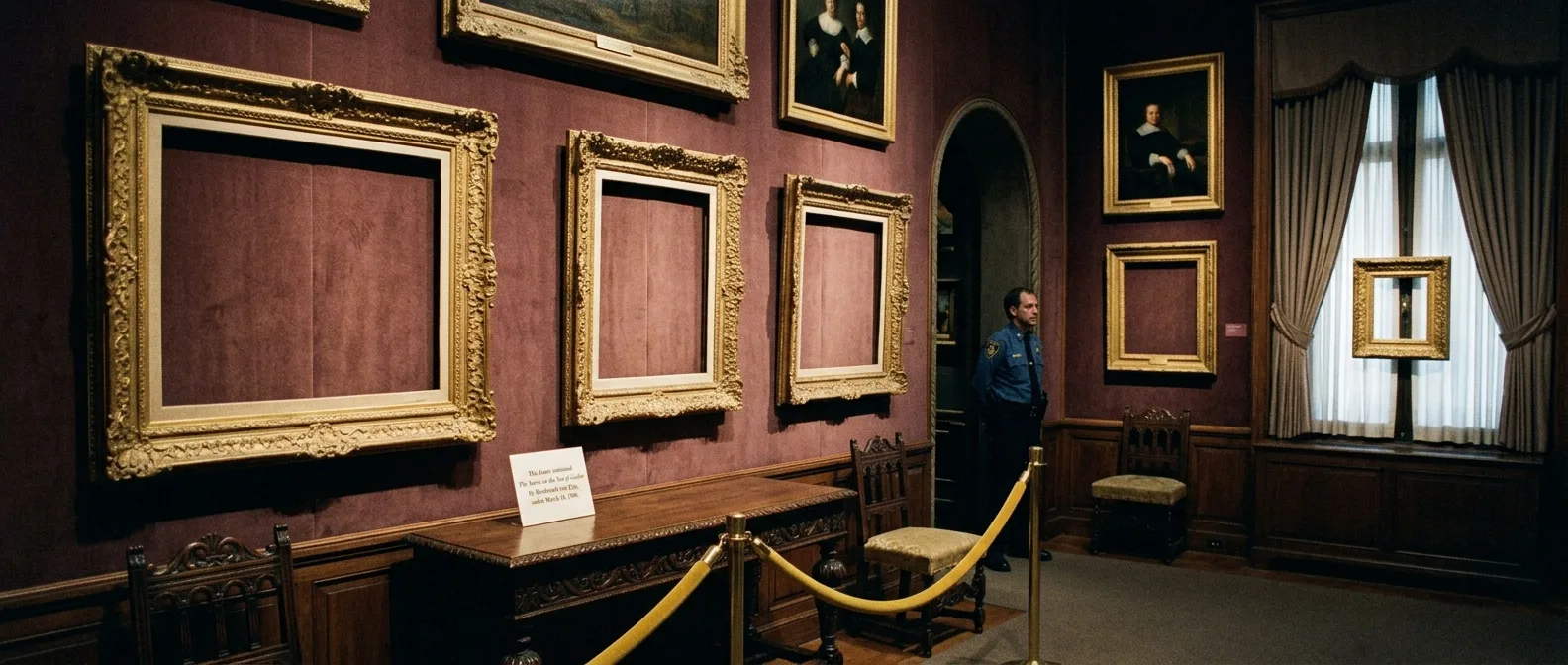
Because of Isabella Stewart Gardner's will, the stolen works cannot be replaced. In their place hang empty frames — black rectangles of void on walls of deep red velvet. Visitors stop before them, photographing nothing. Younger tour guides explain what you would see if the painting were still there.
Those empty frames have become a symbol: of a loss that cannot be healed, of a story without an ending, of art that may never see the light again. Some say the empty frames are now more powerful than the works themselves — because they change our relationship with seeing. You do not look at a masterpiece. You look at its absence.
Every year on March 18, the museum offers free admission to anyone named Isabella. A small, poetic gesture in memory of a woman who loved art so much she refused to be separated from it even after death.
The case reignited public interest in 2021 with the Netflix documentary “This Is a Robbery,” which examined every theory from the mob to the dark web's secret art market. Anthony Amore, head of museum security, continues to receive hundreds of tips each year — none have proven reliable.
EpilogueThe Gardner Museum heist remains the largest unsolved art theft in the world. The museum draws over 300,000 visitors each year, many coming specifically to see the empty frames. More than three decades later, the empty frames still hang on the same walls, exactly where Isabella placed them. The FBI has not officially closed the case. The 10-million-dollar reward remains active. And the Vermeer, the Rembrandt, and the Degas are somewhere in the world — in some basement, in some safe, behind some locked door — waiting, perhaps, for someone to bring them home.