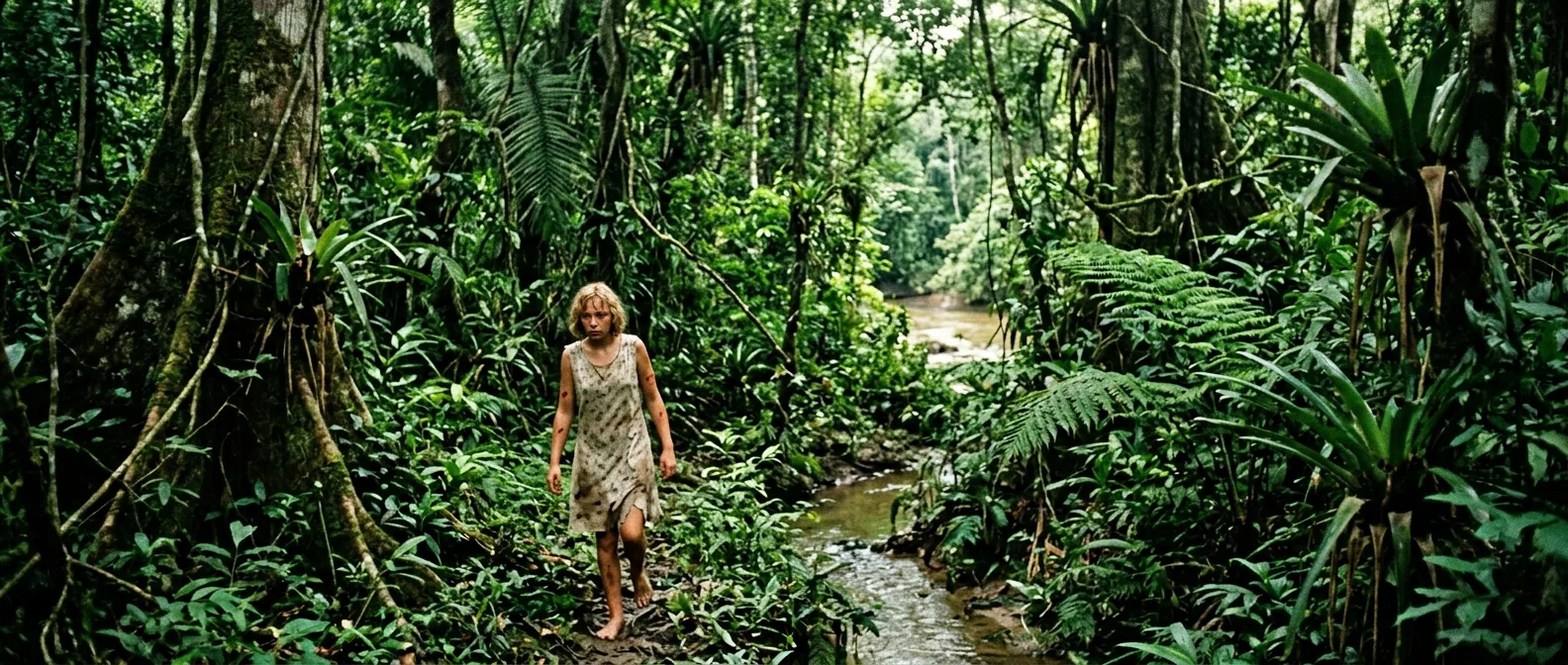
Flight 508
The girl who fell from the sky
📖 Read more: The Fisherman Who Survived 438 Days Alone in the Pacific
The flight had already been delayed seven hours. Passengers at Lima airport were growing restless — it was December 24, 1971, Christmas Eve, and everyone wanted to get home. Among them, a 17-year-old girl with her mother. Juliane Koepcke had received her high school diploma just the previous day. She was traveling to meet her father, a zoologist, at their research station deep in the Amazon.
Neither of them imagined that within less than an hour, the plane would disintegrate mid-air. That 91 people would die. And that Juliane would wake up alone, on the jungle floor, 3,000 meters below where she had been sitting — alive.
— 1 —Juliane Koepcke was born in Lima on October 10, 1954. Her parents, both German zoologists, had moved to Peru to study the wildlife of the tropical forest. Her father pressured the government to protect the jungle from loggers and colonizers. Her mother, an ornithologist, studied rare bird species.
Together they established the Panguana research station, deep inside the Amazon rainforest. There, young Juliane spent much of her childhood years. She learned to identify venomous snakes. To respect insects. To follow streams. Not to fear the jungle, but to understand it.
"I grew up knowing that nothing is truly safe — not even the solid ground beneath my feet."
— Juliane Koepcke, in an interview with the New York Times, 2021This upbringing — this instinctive knowledge of the forest — would prove to be the difference between life and death. But Juliane didn't know that yet.
— 2 —LANSA Flight 508 finally took off from Lima with 86 passengers and 6 crew members. Juliane sat in seat 19F, next to her mother. The flight was supposed to last just one hour to Pucallpa, in the east.
The first 25 minutes were calm. Then the aircraft entered a massive, dark cloud. The turbulence was violent. Packages and luggage shot out of the overhead compartments. Flowers, gifts, Christmas cakes — everything flew through the cabin.
Her mother was anxious. Juliane less so — she liked flying. But when she saw lightning around the aircraft, she grew afraid. She held her mother's hands. They couldn't speak. Around them, passengers were crying, screaming, praying.
Ten minutes later, a very bright light appeared on the left outer engine. Lightning. The mother said, very calmly:
"That is the end. It's all over."
— The last words Juliane's mother ever spokeThey were the last words Juliane ever heard from her.
— 3 —The aircraft nose-dived. Then, darkness. Screams. The deafening roar of engines. And suddenly — nothing. Juliane was outside the plane. Still buckled to her seat, she hung upside down in the air. The only sound, a whisper of wind.
"I hadn't left the plane. The plane had left me," she recalled later. She saw the green canopy of the jungle spinning as it approached. Then she lost consciousness.
She woke up the next day, lying on the jungle floor. She looked up, at the green canopy. First thought: “I survived a plane crash.” She called for her mother. Only the sounds of the jungle answered.
She had a broken collarbone. Deep gashes on her legs. A ruptured cruciate ligament in her knee. A concussion. A swollen eye. But she could stand. She could walk. She was alive.
The fall from 3,000 meters — approximately 10,000 feet — is almost always fatal. Juliane was likely saved by a combination of chance factors: the seat acted as a parachute, the dense jungle canopy absorbed part of the impact, and her young age aided her resilience.
Juliane was wearing a short sleeveless mini-dress and white sandals — one of which had been lost. Her glasses had disappeared and she was severely short-sighted. She used the remaining sandal to probe the ground ahead as she walked — snakes in the jungle resemble dry leaves.
She knew she couldn't stay at the crash site. Rescue helicopters flew overhead — she could hear them — but through the dense forest canopy, they couldn't see her. Ever.
That's when she remembered her father's advice: if you ever get lost in the jungle, follow the water. A small stream will lead to a larger one, that to a river, and eventually to open terrain where people live.
She found a small brook near the crash site. She stepped in and started walking. Sometimes she waded through the water, other times she swam. The only food she found was a bag of sweets near the wreckage — it was the sole nourishment for the next 11 days.
— 5 —On the fourth day, she heard the sound of a vulture landing. She recognized it — a king vulture, which only lands where there's a large quantity of flesh. She instantly understood what that meant.
📖 Read more: The Climber Who Cut Off His Own Arm to Survive
When she rounded a bend in the stream, she found them. Three passengers, still strapped to their seats, driven headfirst into the ground. Their feet pointing upward. It was the first time she had ever seen a dead body. She froze.
But amid the panic, one question: was her mother among them? She touched one of the women with a stick. She saw painted nails. Her mother never painted her nails. Relief — and immediately after, shame for that relief.
In the days that followed, things got worse. A wound on her right upper arm became infected. Maggots — flies had laid eggs inside the wound. Juliane could feel them moving beneath the skin. About 30 larvae, each the size of a centimeter.
— 6 —By the tenth day, Juliane could barely stand upright. She was drifting along the edge of a larger river, exhausted, starving, feverish. She thought she would die there.
Then, something impossible: a large boat tied to the bank. “I thought I was hallucinating,” she recalled later. But when she touched it and felt the wood beneath her fingers, reality struck like adrenaline.
Near the boat, a path led to a hut roofed with palm leaves. Inside she found an outboard motor and a liter of gasoline. She remembered her father: when their dog had the same infection, he had poured kerosene into the wound.
She sucked gasoline from the canister and poured it over the wound. The pain was unbearable — the maggots tried to burrow deeper. She pulled them out one by one. Thirty maggots. She spent the night there.
— 7 —The next day — the eleventh in the jungle — Juliane was woken by men's voices. Three Peruvian loggers, the owners of the hut, had returned. Juliane later said: “The first man I saw seemed like an angel.”
They didn't quite feel the same. They were terrified. Before them stood a girl — blonde, white, bloodied, skeletal — so otherworldly they thought she was Yemanjá, a water spirit from local legend.
But Juliane spoke Spanish. She explained what had happened. The loggers cleaned her wounds. They fed her. And the following day, they transported her by boat to the nearest hospital.
After 11 days alone in the Amazon jungle, Juliane Koepcke had been saved. She was the sole survivor among 92 souls.
— 8 —The question that's never answered
After the rescue, Juliane was reunited with her father. “He couldn't speak. We just held each other.” A few days later, her mother's body was found. She too had survived the fall — but not the injuries. She died alone, in the jungle, days after the crash. Juliane never stopped wondering what those final days were like.
Her story traveled the world. Juliane tried to rebuild her life. She studied biology at the University of Kiel in Germany, earned a doctorate, married and became Dr. Juliane Diller. In 1998, she returned to the crash site with filmmaker Werner Herzog for the documentary “Wings of Hope.” She sat again in seat 19F.
Later, she wrote her memoir titled “When I Fell From the Sky.” She continued to maintain the Panguana research station her parents had founded.
There is a question that has followed her ever since: why her? Why only she, among 92 people, survived? She says she'll never find the answer. “It will haunt me forever,” she confessed.
She was once asked if the jungle was hell. Her answer was revealing: “The jungle isn't the green hell the world imagines. It was what saved my life.”