The great escape from Alcatraz
A True Story
A Fortress Built to Be Unbreakable
Rising from the frigid waters of San Francisco Bay like a concrete fist, Alcatraz Federal Penitentiary was never meant to be a place people left on their own terms. The island — barely a mile and a half from the glittering shoreline of one of America's most beautiful cities — was chosen precisely because of its isolation. Treacherous currents, water temperatures that hovered around fifty degrees Fahrenheit, and a reputation forged in desperation made it the final stop for the nation's most incorrigible prisoners.
From 1934 to 1963, Alcatraz housed some of the most notorious criminals in American history. Al Capone paced its corridors. George “Machine Gun” Kelly stared out through its barred windows. Robert Stroud — the so-called “Birdman” — spent years within its walls. The message to the criminal underworld was clear: end up here, and you will never leave.
In its twenty-nine years of operation, the Bureau of Prisons recorded thirty-six escape attempts involving a total of sixty-three inmates. Almost all were caught. Several were shot. A few were found dead in the water, their bodies broken by the bay's unforgiving currents. The official position was emphatic and absolute — no one had ever successfully escaped from Alcatraz.
Frank Lee Morris — A Criminal Genius
Frank Lee Morris arrived at Alcatraz on January 20, 1960, carrying inmate number AZ1441 and a reputation that preceded him like a shadow. Born in Washington, D.C. in 1926, Morris was abandoned as a child and raised in a succession of foster homes. By thirteen, he was already entangled with the law. By his early twenties, he had been convicted of narcotics possession, armed robbery, and a string of burglaries that stretched across multiple states.
But what made Morris exceptional — what made him dangerous in ways the authorities were slow to comprehend — was his mind. Prison intelligence tests scored him with an IQ of 133, placing him in the top two percent of the general population. He was quiet, observant, and ferociously patient. He absorbed details the way other men absorbed oxygen — constantly, silently, and without conscious effort.
Morris had escaped from institutions before. He'd walked away from a Louisiana prison, fled detention in Florida, and broken out of a federal facility in Atlanta. Each time, he was recaptured. Each time, the authorities tightened the screws a little more. And eventually, inevitably, those screws led him to the one place from which escape was supposed to be impossible.
When Morris stepped onto The Rock, he did not see an unbreakable fortress. He saw a puzzle. And Frank Morris lived for puzzles.
John and Clarence Anglin — Blood Loyalty
John William Anglin and his younger brother Clarence arrived at Alcatraz separately — John in October 1960, Clarence the following January. They were country boys from Donalsonville, Georgia, the children of a large farming family that picked cherries and peanuts to survive. Growing up along the shores of Lake Seminole, they became powerful swimmers, spending countless childhood hours in the water, building strength and endurance that would later prove extraordinary.
Their criminal careers were remarkably parallel. Both turned to bank robbery, both were caught, and both proved to be exceptionally determined escape artists. They had attempted to break out of the Atlanta Federal Penitentiary together before their transfer to Alcatraz — a stunt that earned them one-way tickets to the island.
The brothers' bond was unshakeable. In a prison designed to crush solidarity and isolate men from every human connection, John and Clarence Anglin held onto each other with the fierce devotion of siblings who had never known any other constant. When Frank Morris approached them with an idea — a plan so audacious it bordered on madness — they didn't hesitate.
The Plan Takes Shape
The idea began, as the most consequential ideas often do, with a small observation. Morris noticed that the concrete surrounding the ventilation grilles at the back of the cells had deteriorated over decades of exposure to salty, moisture-laden air. The material was softer than it should have been — not soft enough that anyone would notice at a glance, but soft enough that a determined man with a pointed instrument and infinite patience could carve through it, grain by grain, night after night.
Morris recruited the Anglin brothers and a fourth man — Allen West, who occupied a nearby cell. Together, mostly in whispered conversations during meals and yard time, they began to formulate what would become one of the most ingenious escape plans in the history of incarceration.
Phase One: Digging Through the Walls
The tools were laughably primitive. Spoons stolen from the dining hall. A drill improvised from the motor of a broken vacuum cleaner. Metal scraps filed into crude chisels. With these instruments, the four men began carving around the ventilation grilles at the rear of their cells, each opening measuring roughly nine by fourteen inches — barely large enough for a man to squeeze through.
They worked during the music hour, when the sound of accordions, guitars, and harmonicas echoing through the cellblock masked the scraping and chipping of their labor. Night after night, they picked at the walls, excavating crumbling concrete in amounts so small that progress was measured in millimeters. They hid their work behind makeshift cardboard panels painted to match the surrounding wall, propping accordion cases and personal items in front of the grilles to disguise the alterations.
Behind the cells lay an unguarded utility corridor — a narrow service passage that ran the length of the block, housing pipes and electrical conduits. Once through the wall, an inmate could climb upward through the maze of plumbing to reach the roof of the cellblock, and from there, theoretically, the outside.
Phase Two: The Dummy Heads
Escaping was only half the problem. The other half was ensuring nobody noticed they were gone until it was too late. Alcatraz conducted regular nighttime head counts — guards walking the tiers with flashlights, checking that every bunk held a sleeping body. If even one bed appeared empty, the alarm would sound within minutes, and every law enforcement boat in the bay would be summoned.
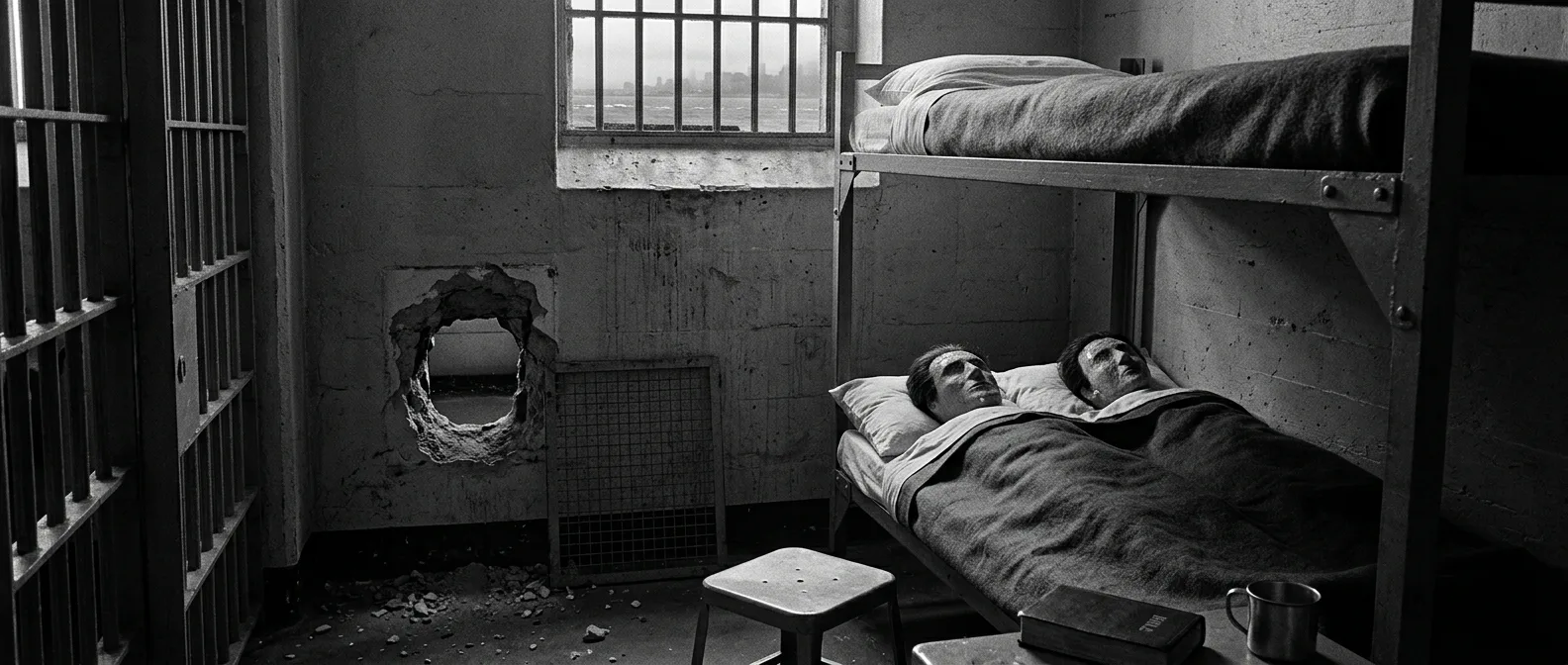
The solution was grotesquely creative. Over several weeks, the men sculpted lifelike dummy heads from a mixture of soap, toilet paper, and concrete dust. They molded crude but recognizable facial features — noses, chins, closed eyelids. They painted them with flesh-toned pigment stolen from the prison art supplies. And in a touch of darkly comic genius, they collected actual human hair from the prison barbershop floor and affixed it to the sculpted scalps, creating wigs that looked disturbingly realistic in the dim light of a cell at two in the morning.
Placed on their pillows beneath their blankets, with the hair peeking out just so, the dummy heads would pass anything but the closest inspection. And the night guards, making their rounds through hundreds of cells, rarely gave any single bunk more than a passing glance.
Phase Three: The Raincoat Raft
The bay was the final barrier — a mile and a half of churning, glacial water with currents strong enough to pull a man out to sea. Swimming it was theoretically possible but desperately dangerous. The men needed a craft.
Working in a hidden workshop they had established in the utility corridor above the cells, Morris and the Anglins assembled an inflatable raft and individual life preservers using over fifty stolen prison-issued raincoats. They vulcanized the seams using heat from the steam pipes that ran through the corridor, creating airtight bonds. The raft, when inflated, was roughly six feet by fourteen feet — large enough to carry three men and their meager provisions across the bay.
They also fashioned a concertina-like device from raincoat material that could be used to inflate the raft quickly once they reached the water's edge. Every component was tested, retested, and hidden away in the maze of pipes above the cellblock, waiting for the night when everything would come together.
The Night of the Escape
The date was not chosen at random. Morris had studied the tides, the weather patterns, the guard rotation schedules. June 11 offered a convergence of favorable conditions — a late-evening high tide that would help carry them away from the island, overcast skies that would reduce visibility, and a guard shift transition that created a brief window of reduced surveillance.
After the 9:30 PM lights-out count, the three men moved with practiced precision. They placed their dummy heads on the pillows, arranged the blankets to suggest sleeping bodies, and slipped through the carved openings at the rear of their cells into the utility corridor. Allen West, the fourth conspirator, struggled with his ventilation grille — the material he had used to conceal the opening had hardened, and he could not break through in time. He was left behind, pounding in silent, desperate fury at the wall that refused to yield.
Morris and the Anglin brothers ascended through the pipe-laced interior of the cellblock, climbing thirty feet up to a ventilation shaft on the roof. They had previously loosened the rivets holding the shaft's protective grate in place, replacing them with rivets made from soap that would crumble under pressure. One firm push, and they were through — out onto the roof of one of the most secure prisons ever built, the cold San Francisco wind whipping against their faces.
They scaled down the building's exterior, traversed a fence topped with barbed wire, and made their way to the northeast shore of the island. There, in the darkness, they inflated the raft, climbed aboard, and pushed off into the black waters of San Francisco Bay. Behind them, the lights of Alcatraz glowed white and indifferent. Ahead of them lay the darkness, the current, and either freedom or death.
The Morning After
The deception held through the night. It was not until the 7:15 AM morning count that a guard, making his routine pass along B-Block, noticed something peculiar about cell B-152. The figure in the bunk was too still. The skin had an odd, waxy quality. He reached down and touched the head on the pillow — and it gave way beneath his fingers like wet clay.
Within minutes, the alarm shattered the morning silence. Guards swarmed the cellblock. Three cells were empty. Three dummy heads grinned from three pillows. And in the utility corridor behind the cells, the carved-out ventilation openings gaped like open mouths, revealing the months of secret labor that had taken place right under the noses of some of the most vigilant guards in the American penal system.
Allen West, still trapped in his cell, was quickly identified as the fourth member of the conspiracy. Under interrogation, he provided a detailed account of the escape plan — the tools, the raft, the dummy heads, the intended route across the bay. He told investigators the plan had been to paddle to Angel Island, rest briefly, then continue to the Marin County headlands, steal a car, and disappear into the vastness of the American interior.
The largest manhunt in San Francisco's history erupted. The FBI, the Coast Guard, the U.S. Marshals, and local police agencies mobilized boats, helicopters, and search teams. They scoured the bay, the surrounding islands, the waterfront communities. They followed leads across the country and beyond.
What the Bay Revealed
In the days following the escape, search teams recovered fragments of evidence from the waters and shores around the island. A deflated life preserver was found near Angel Island. A waterproof bag containing photographs and personal papers belonging to the Anglin brothers washed up on the shore. Pieces of the raft, or what appeared to be pieces, were found scattered along the waterline.
But no bodies were recovered. Not that week. Not that month. Not ever.
The FBI's official investigation, which remained active for seventeen years before the case was transferred to the U.S. Marshals Service in 1979, concluded that the men most likely drowned in the bay. The water temperature, the currents, the distance, and the crude nature of their vessel all pointed, the Bureau argued, to a desperate gamble that had failed. The escapees, they declared with bureaucratic certainty, were dead.
But the absence of bodies nagged at investigators. San Francisco Bay, for all its dangers, is not the open ocean. Drowning victims in the bay are typically recovered. The tidal patterns tend to push objects — and remains — toward shore rather than out to sea. In the history of Alcatraz escapes, bodies had been found before. Why not this time?
Theories, Whispers, and Shadows
Over the decades that followed, the escape from Alcatraz transformed from a criminal incident into an enduring American mystery — one that has generated books, documentaries, feature films, and an endless tide of speculation.
The Drowning Theory
Proponents of the official conclusion point to the raw physics of the situation. The water temperature on June 11, 1962 was approximately fifty-four degrees Fahrenheit — cold enough to induce hypothermia within thirty minutes of immersion. The currents near Alcatraz can reach speeds of four to five knots, strong enough to overpower even experienced swimmers. A crude raft made from glued raincoats, they argue, would not have survived the crossing. The personal effects found near Angel Island suggest the raft broke apart in the water, spilling its occupants into the lethal current.
The Survival Theory
Those who believe the men survived point to an equally compelling body of evidence. The Anglin brothers were exceptional swimmers, trained from childhood in the lakes of rural Georgia. Morris was an extraordinary problem-solver who had planned for the tidal conditions. The high tide at the time of the escape would have pushed them north toward Angel Island — exactly the route Allen West described. And critically, the items found in the bay were peripheral — a life preserver, some papers — not the raft itself, not the men, not any indication of catastrophic failure.
In 2013, the San Francisco office of the FBI received a letter, purportedly from John Anglin. “My name is John Anglin,” it read in part. "I escaped from Alcatraz in June 1962 with my brother Clarence and Frank Morris. I'm 83 years old and in bad shape. I have cancer. Yes, we all made it that night but barely." The letter offered to turn himself in in exchange for medical treatment. The FBI investigated but could neither confirm nor disprove its authenticity.
Members of the Anglin family have long maintained that the brothers survived. Relatives have claimed to have received Christmas cards in the brothers' handwriting for years after the escape. A photograph allegedly showing John and Clarence alive in Brazil in 1975 surfaced in 2015, though its authenticity remains disputed. The family has spoken publicly of their belief that the brothers lived out quiet lives in South America, far from the reach of American law enforcement.
What Science Says
In 2014, a team of Dutch scientists used hydrodynamic modeling to simulate the conditions in San Francisco Bay on the night of the escape. Their conclusion was striking: if the men had launched their raft before midnight and paddled north toward Angel Island, the tidal currents would have worked in their favor. The window was narrow — a departure even thirty minutes too late would have pulled them out toward the open Pacific — but it existed. Success was, according to their models, physically possible.
The Prison That Couldn't Hold Three Men
Alcatraz Federal Penitentiary closed on March 21, 1963 — less than a year after the escape. The official reasons were financial: the salt air had corroded the buildings beyond economical repair, and it cost three times more to house an inmate on the island than at any other federal facility. But the escape had shattered the prison's mythology. The fortress that no one could breach had been breached. The reputation that had been Alcatraz's most powerful weapon was gone.
Today, the island receives more than 1.5 million visitors each year. Tourists walk the crumbling cellblocks, peer into the cells where Morris and the Anglins once slept, and gaze out across the bay toward the distant shore, trying to imagine the crossing. The cell openings are still visible — rough, ragged holes in the concrete, framed by decades of accumulated dust. The dummy heads, remarkably well-preserved, sit in display cases, their painted features and stolen hair still eerily lifelike after more than sixty years.
The case remains officially open. The U.S. Marshals Service continues to investigate leads and maintain active warrants for all three men. If alive today, Frank Morris would be ninety-nine years old. John Anglin would be ninety-five. Clarence would be ninety-four. The Marshals have stated they will continue to pursue the case until the fugitives are confirmed to be either captured or deceased.
Into the Fog
On a cold night in June of 1962, three men crawled through holes they had carved with stolen spoons, climbed through the guts of a prison designed to be inescapable, and pushed a raft made of raincoats into the darkest, coldest water on the American West Coast. They were criminals — bank robbers, escapees, men who had lived outside the law for most of their lives.
But they were also something else. They were ingenious. They were relentless. They refused to accept that any wall, any current, any system built by human hands was truly impenetrable. In a place designed to extinguish hope, they spent months nurturing it in secret — shaping it from soap and hair and stolen cloth, hiding it behind painted cardboard and accordion cases.
Did they survive? Did they reach the far shore, shed their prison identities, and build new lives in the anonymity of the wider world? Or did the bay claim them, pulling them down into the cold darkness beneath the Golden Gate, three more lives swallowed by the same waters that had swallowed so many before?
Nobody knows. Perhaps nobody ever will. And it is precisely that uncertainty — that tantalizing, infuriating, beautiful uncertainty — that keeps the story alive. The great escape from Alcatraz endures not because of what we know, but because of what we don't. It is a mystery wrapped in fog, carried on a tide that never stops moving, vanishing into the same darkness that swallowed three men and a raincoat raft on a cold June night more than sixty years ago.