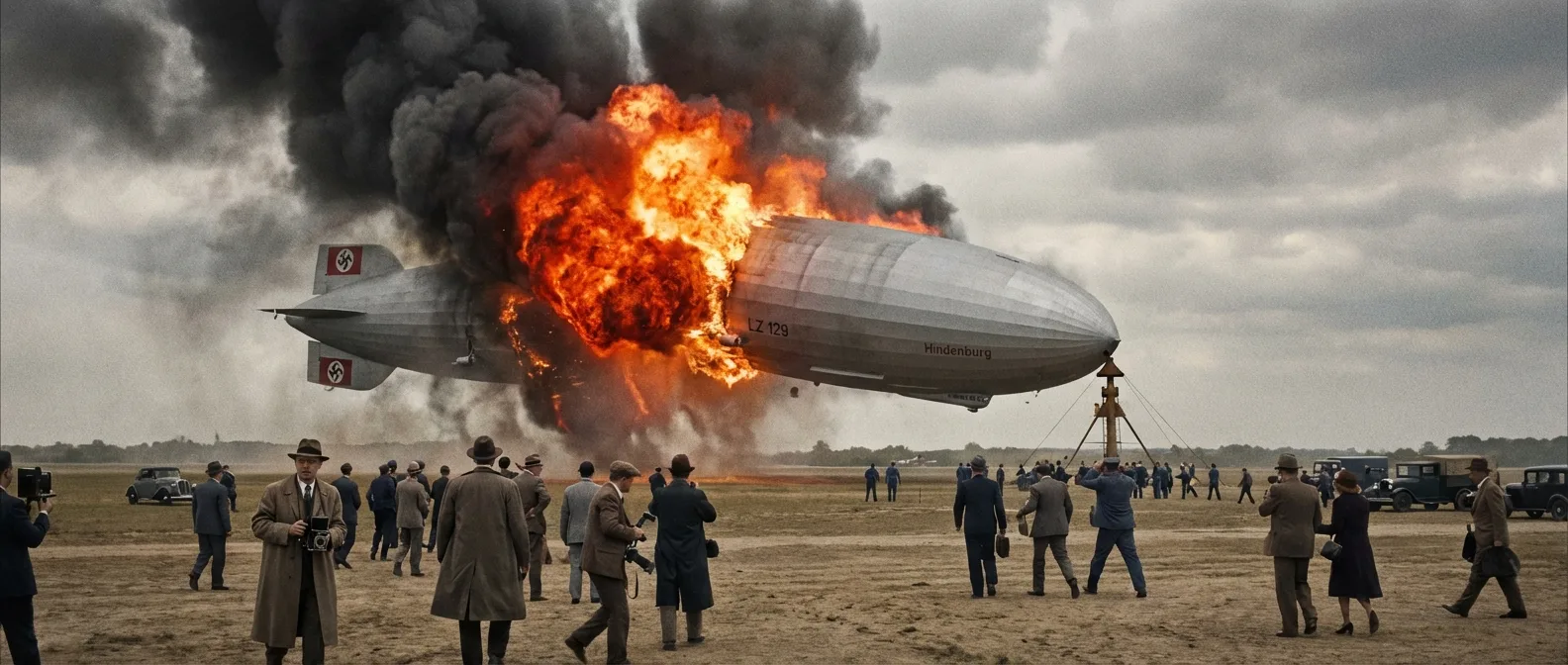
The Hindenburg Disaster: Live on Radio
A True Story
📖 Read more: Woman Survived 10km Fall Without Parachute: Vesna Vulović
The age of the sky giants
In the mid-1930s, zeppelins represented the ultimate dream of aviation. Before pressurized airplanes conquered the skies, these enormous airships — filled with gas, draped in silver fabric — carried passengers across oceans with a luxury no airplane could match. Lounges with grand pianos, dining rooms with crystal glasses, windows overlooking the Atlantic. They were cruises in the air — slow, majestic, aristocratic.
At the center of this era stood the German Zeppelin Company. Their reputation was ironclad. The airship Graf Zeppelin had already circumnavigated the globe. And now, the brand-new LZ 129 Hindenburg — 245 meters long, larger than the Titanic — promised to inaugurate a new age of transatlantic passenger flights between Germany and America.
Instead of helium, however, the Hindenburg was filled with hydrogen — extremely flammable. The United States, the sole holder of significant helium reserves, refused to sell it to Nazi Germany. The danger was well known. But confidence ran higher than caution.
The LZ 129 Hindenburg
The Hindenburg was the largest object ever to fly. At 245 meters in length, it was three times the size of a Boeing 747. Inside, 72 passengers enjoyed suites with panoramic views, a communal lounge with an aluminum piano (for weight reasons), a writing room, a dining hall, and even a smoking room — yes, a smoking room inside a hydrogen-filled airship, equipped with pressurized air locks so that no gas could enter.
📖 Read more: The Disappearance of Amelia Earhart in the Pacific
Beneath the elegance, however, lurked a political symbol. Painted on the airship's tail fins — in enormous scale — were the swastika emblems of the Third Reich. Goebbels used the Hindenburg as a propaganda tool. The airship flew over German cities dropping leaflets on election days. It was simultaneously an engineering marvel and a symbol of a regime.
The last flight
The Hindenburg departed from Frankfurt, Germany, bound for the Naval Air Station at Lakehurst, New Jersey. On board were 36 passengers and 61 crew members. Captain Max Pruss was on the bridge. The transatlantic crossing was smooth — roughly 60 hours through moderate winds. Many passengers were wealthy American and German businesspeople, some experiencing their first airship voyage.
36 seconds of fire
A small flash of light appeared near the tail of the airship, just forward of the upper fin. Several witnesses on the ground reported seeing “something like St. Elmo's fire” — an electrical glow. Many did not immediately understand what was happening. A few seconds later, the glow became a fireball.
No one would remember that day without the voice of Herbert Morrison. The recording he made that evening was not a live broadcast — the technology of the era did not allow it. It was a disc recording, aired the following day by radio stations across the country. But the impact was seismic.
Morrison's voice cracked. That single phrase — “Oh, the humanity!” — became one of the most recognizable expressions in the history of media. It was the first time millions of listeners experienced a disaster in near-real-time through the voice of a man weeping as he described it. Morrison was no longer a reporter — he was a witness to tragedy.
The recording created a new standard in journalism: the power of raw, authentic emotion. Decades later, media historians would place it alongside the live footage of a world reacting to disaster — a phenomenon unprecedented for that decade.
What caused the fire?
The cause of the disaster was never definitively established. Nearly nine decades later, four principal theories remain in contention:
Theory #1 — Static electricityThe most widely accepted theory. As the airship passed through the thunderstorm, it accumulated static electricity on its outer surface. When the wet mooring ropes touched the ground, they created a ground connection — but only to part of the structure. The resulting difference in electrical potential may have caused a spark near a hydrogen gas vent valve. A small leak was all it took.
📖 Read more: The Rugby Team That Survived 72 Days in the Andes
The end of an era
The Hindenburg disaster was not the deadliest airship accident. The American USS Akron had killed 73 people four years earlier. But it was the first disaster to be filmed, photographed, and broadcast by radio in near-real-time. The images were relentless: the fireball, the figures leaping, the aluminum skeleton burning. The image of the Hindenburg in flames became one of the most iconic photographs of the 20th century.
Two weeks later, the Zeppelin Company suspended all passenger flights. No airship ever carried paying passengers on a transatlantic route again. Public confidence was shattered beyond repair. The German zeppelin fleet was retired. The world turned to airplanes — faster, cheaper, and — paradoxically — less spectacular when they failed.
In a way, the Hindenburg was the Titanic of the sky. A technological marvel deemed invincible, destroyed by the combination of physics, design flaws, and bad luck. Its destruction was not merely physical — it was psychological. It showed people that the sky was not as hospitable as they believed.
Morrison after the fire
Herbert Morrison never fully recovered from that evening. His voice became a symbol of a new kind of journalism — rawer, more human, closer to the event. But he himself refused to capitalize on the fame. He continued working quietly in radio, avoiding the spotlight. He died in 1989 in Morgantown, West Virginia, at the age of 83.
📖 Read more: The Story of 'Free': Why Nothing Is Truly Free
His recording, however, lives on. It has been used in documentaries, films, songs, and educational programs. The phrase “Oh, the humanity” has entered everyday English as an expression of absolute horror in the face of human suffering.
The last traces
Today, at the Naval Air Station in Lakehurst, New Jersey, a small memorial marks the spot where the Hindenburg touched the ground for the last time. A metal relief shows the silhouette of the airship in flames. Around it, the base is a ghost field — an airfield that no longer sees zeppelins.
At the Smithsonian National Air and Space Museum in Washington, a piece of the Hindenburg's outer fabric is on display — faded, yellowed, scarred by heat. Beside it, a plaque lists the names of the 36 victims. Among them: passengers, engineers, riggers, and even an aerial photographer who had taken position in the lower observation deck.
EpilogueThe destruction of the Hindenburg lasted just 36 seconds. But its consequences lasted forever. It ended the age of the passenger airship. It created a new standard for disaster journalism. It gave us one of the most powerful audio recordings in history. And it reminded us — as the Titanic had 25 years before — that no human creation is invincible. Herbert Morrison's voice, cracked, tearful, real, still echoes across the decades. An eternal “oh, the humanity” that leaves no one unmoved.