The Man Who Survived Two Atomic Bombs
Tsutomu Yamaguchi — Hiroshima and Nagasaki, 1945
📖 Read more: Nicholas Winton: Saved 669 Children in Secret
There are moments in human history when fate seems to craft a joke so dark, so inconceivable, that no screenwriter would dare put it on paper. On August 6, 1945, at 8:15 in the morning, a Japanese engineer is on a business trip in Hiroshima when the sky is torn in two by a flash of a thousand suns. He gets up, wounded, blind in one eye, burned across half his body. He survives. He returns home, to Nagasaki.
Three days later, on August 9, he describes to his supervisor what he saw in Hiroshima — a single bomb, he says, destroyed an entire city. His supervisor stares at him in disbelief. “You’re crazy,” he says. “How can one bomb destroy an entire city?” At that very moment, the sky over Nagasaki is torn apart again.
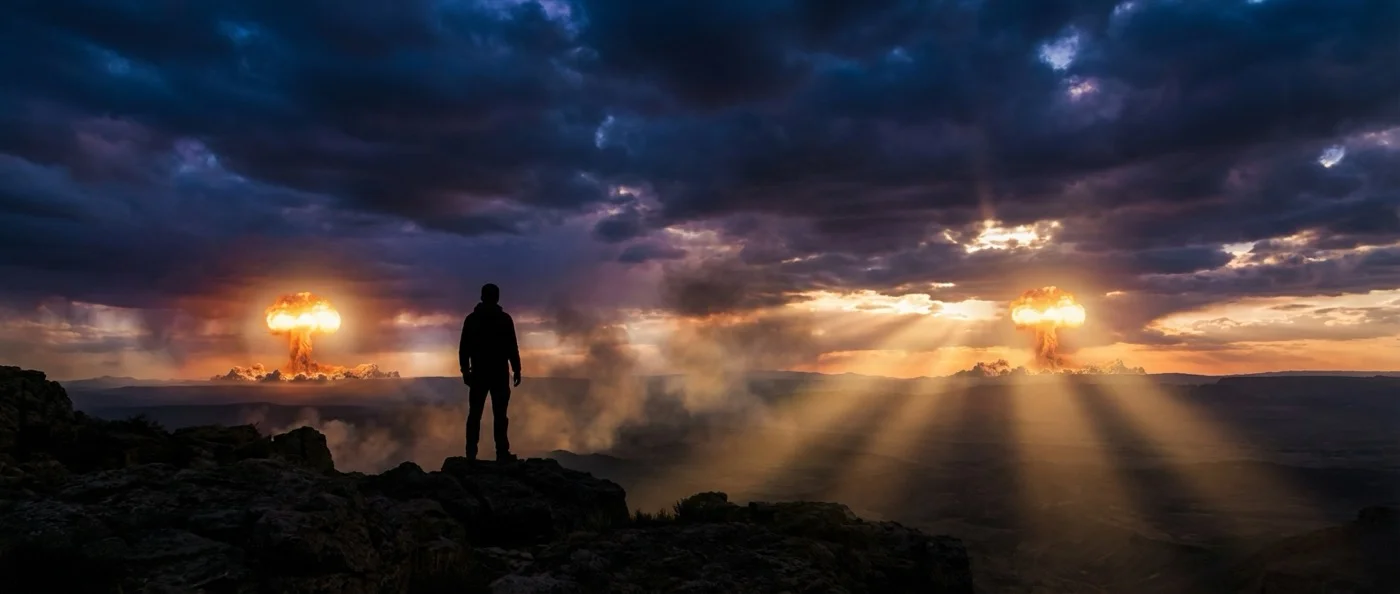
This is not a novel. This is not a movie. This is the life of Tsutomu Yamaguchi — the only person in history officially recognized by the Japanese government as a survivor of both atomic bombings. A man who stared into two atomic suns and refused to close his eyes.
Tsutomu Yamaguchi was born on March 16, 1916, in Nagasaki, a thriving port city on the southwestern tip of the island of Kyushu. Nagasaki had for centuries been Japan’s gateway to the world — the only city that during the country’s political isolation maintained trade relations with the Dutch. A city with history, with a harbor, with life.
The young Yamaguchi was quiet, methodical, precise — qualities that naturally led him to engineering. In the 1930s, he joined Mitsubishi Heavy Industries, the colossus of Japanese heavy industry, as a designer of oil tanker ships. In the design offices of Nagasaki, with ruler and pencil, he drew the lines of ships that would carry oil for an empire hungry for energy.
It was a quiet, academically precise job, at some point so removed from the approaching war that one could forget these ships would serve a war machine. Yamaguchi, for his part, did not want the war. “I never believed Japan should start a war,” he would later declare. But the opinion of a simple designer did not count for much in the imperial Japan of 1940.
As the war intensified, raw materials became scarce, tankers were sunk by American submarines, and the shipbuilding industry groaned under repeated blows. Yamaguchi, like many Japanese of the era, watched in horror as the country marched toward the abyss. At one point, his despair was so deep that he considered giving sleeping pills to his family if Japan lost — a thought so dark it reveals how unbearable the pressure was on ordinary people of that time.
In the summer of 1945, Yamaguchi was on a three-month business trip to Hiroshima, along with two colleagues, Akira Iwanaga and Kuniyoshi Sato. They worked for days, weeks, drafting ship details in offices that smelled of paper and ink. Hiroshima, despite the war, was a city that still breathed — children went to school, housewives shopped at the markets, the rivers flowed calmly beneath the bridges.
On August 6, the three-month assignment was ending. The three engineers were preparing to leave. Yamaguchi was walking toward the station when he suddenly realized he had forgotten something behind: his hanko — the identification seal that every Japanese person uses instead of a signature. Without it, he couldn't certify any official document. He went back to get it.
That moment — the moment he forgot a small wooden seal — would save him and condemn him at the same time. If he hadn't gone back, he would have been at the station, perhaps on the train, perhaps already on his way to Nagasaki. Instead, he found himself on the streets of Hiroshima at 8:15 in the morning, walking toward the docks, just three kilometers from ground zero.
What is a hanko?
A hanko (判子) is a personal seal, usually made of wood or ivory, that Japanese people use instead of a signature on contracts, banking transactions, and official documents. It was — and to some extent still is — an inseparable part of Japanese bureaucracy.
📖 Read more: Shackleton: 2 Years Trapped in Antarctica
At exactly 8:15, Yamaguchi was walking next to a potato field near the docks. He looked up at the sky — a habit of those days, when American bombers flew at high altitude over Japanese cities. He spotted a B-29, the Enola Gay, and two small parachutes falling from it. A second later, a flash of a thousand suns split the horizon.
"There was a tremendous flash in the sky, and I was blown into the air," he would later recall. The shockwave struck him like a wall of invisible iron, hurling him meters away, rolling him through the dirt like a ragdoll. Both eardrums ruptured — the left one permanently. He was temporarily blinded. Severe burns covered the left side of his upper body — face, neck, arm.
He came to in a landscape of apocalypse. Hiroshima no longer existed — or rather, it existed only as rubble. Buildings flattened, fires everywhere, clouds of dust and ash darkening the sky. And a massive, mushroom-shaped cloud rising above what had once been the heart of a city of 340,000 people.
Yamaguchi crawled to an air-raid shelter. There, among the dying and the wounded, he rested. When he had regained enough strength, he set out to find his colleagues. He found them — alive as well, injured but able to walk. Together they spent the night in a shelter, surrounded by corpses and the dying, listening to the screams of a city in its death throes.
"I thought I had died. That what I was seeing was hell. But hell doesn't hurt this much — that's how I knew I was still alive."
— Tsutomu Yamaguchi, in an interview about Hiroshima
The next day, August 7, the three engineers decided to return to Nagasaki. There was no reason to stay — Hiroshima no longer existed, their offices had been destroyed, their mission had lost all meaning. They managed to find a train — a miracle in itself, given that half the city had vanished.
The train traveled through a landscape they didn't recognize. The suburbs of Hiroshima, once full of small wooden houses and gardens, were now a flat, scorched plain. As if someone had stomped the entire city flat with their heel. Yamaguchi, in pain, covered in burns, gazed through the window unable to speak.
Arriving in Nagasaki, Yamaguchi went straight to the hospital. The doctors bandaged him — second and third-degree burns on his face, ear, and arm. His left eardrum had ruptured irreparably. He began treatment, but the burns were so severe they required constant bandage changes. Nevertheless, Yamaguchi decided to go to work.
Such devotion may seem incomprehensible to modern Western eyes, but in 1945 Japan, work ethic was equivalent to patriotic duty. Yamaguchi, wrapped in bandages like a mummy, reported to the Mitsubishi office in Nagasaki on August 9, three days after Hiroshima. What followed could be considered a cosmic farce — if it weren't so tragic.
On August 9, 1945, at 11:00 in the morning, Tsutomu Yamaguchi was sitting in his supervisor's office at the Mitsubishi factory in Nagasaki. With bandages on his face, one ear that couldn't hear, burns feverish beneath the gauze, he was describing what he had experienced in Hiroshima. One bomb, he explained. A single bomb destroyed an entire city.
His supervisor looked at him skeptically. “You're crazy,” he replied. “How is it possible for a single bomb to destroy an entire city?” The reaction was understandable — until that day, no weapon in the world could do such a thing. The war had brought enormous damage to Japanese cities, but always from hundreds of bombs in massive air raids. One bomb? Impossible.
At that exact moment — the moment the word “impossible” was still hanging in the air — a white light flooded the room. We're talking again about three kilometers from ground zero — almost the exact same distance as in Hiroshima. As if fate were following a sardonic script, the B-29 “Bockscar” had just dropped the “Fat Man” bomb on Nagasaki.
📖 Read more: Wojtek: The Bear That Fought in World War 2
"I thought the mushroom cloud from Hiroshima had followed me all the way here."
— Tsutomu Yamaguchi, on the moment of the second bomb
This time, something almost inexplicable happened: Yamaguchi was not seriously injured. The building partially protected him, the shockwaves shook him but didn't knock him down. However, his bandages from Hiroshima were rendered useless, and Yamaguchi was exposed to radiation once again — a double dose that would haunt him for the remaining 65 years of his life.
The fever came immediately. Non-stop vomiting for over a week. His hair began to fall out. The radiation had begun its silent, slow work on his cells. But Yamaguchi was still breathing. He was alive — the only known person in the world who had stood three kilometers from two different atomic suns and lived to tell the tale.
Radiation is the most insidious enemy humanity has ever known. It cannot be seen, smelled, or heard. It simply penetrates cells, breaks chromosomes, mutates DNA, and waits — weeks, months, years, decades — until the damage ripens into disease, into cancer, into death.
Yamaguchi suffered double exposure. In Hiroshima, the “Little Boy” bomb unleashed massive quantities of gamma radiation and neutrons. In Nagasaki, the “Fat Man” bomb — a plutonium bomb of a different type — added a new dose to his already bombarded body. The combined dose was surreal. Under normal circumstances, it would have killed him within weeks.
But Yamaguchi did not die. On the contrary, he recovered — though the word “recovered” is relative. His hair slowly grew back. The burns formed scars he would carry forever. His left ear remained deaf. His daughter recalls that until she was twelve, her father was permanently wrapped in bandages — twelve whole years after the bombs.
And the radiation waited. Silent. Patient. Inside his cells, microscopic damage multiplied, mutations accumulated, biological timers began countdowns that would manifest decades later.
After the war, during the American occupation, Yamaguchi worked as a translator for the occupation forces. His language ability, combined with his methodical thinking, made him valuable. But behind the new job, the shadow of radiation followed his every step.
In the early 1950s, Yamaguchi and his wife Hisako — herself a survivor of the Nagasaki bombing — made a decision that seems as simple as it was heroic: they decided to have children. In an era when no one knew what radiation does to babies, what mutations might be passed to the next generation, Yamaguchi and Hisako chose to trust in life. They had three children: Katsutoshi, Toshiko, and Naoko.
In 1957, the Japanese government officially recognized the survivors of the atomic bombings as “hibakusha” (被爆者) — “explosion-affected persons.” The recognition made Yamaguchi eligible for medical care and a stipend. However, his certification only acknowledged that he was present in Nagasaki — Hiroshima was mentioned nowhere.
Yamaguchi did not protest. He was satisfied that he was relatively healthy, had a family, had a job. He returned to Mitsubishi, designing tankers again — this time for a Japan that was rebuilding, not for an empire self-destructing. And he tried to leave the bombs behind him.
For decades, Yamaguchi remained silent. The culture of postwar Japan did not encourage public discussion of the bombings — shame, guilt, the desire to move forward kept many hibakusha in silence. Some also faced social stigma — the fear of radiation made some Japanese avoid the survivors, fearing “contamination.”
📖 Read more: The Castaway Who Survived 133 Days Alone on a Raft
But as Yamaguchi grew older, something changed inside him. In his eighties, he decided to break the silence. He wrote a book about his experiences, titled “Ikasareteiru Inochi” — “A Life Well Lived.” He published poems. He spoke to journalists, documentary filmmakers, cameras. His voice, weak but steady, carried a message simple and sharp: nuclear weapons must be eliminated.
"The reason I hate the atomic bomb is not what it does to buildings or streets. It's what it does to human dignity."
— Tsutomu Yamaguchi
In 2006, he participated in a documentary titled “Twice Survived: The Doubly Atomic Bombed of Hiroshima and Nagasaki” — which recorded the stories of 165 people who, like him, were present at both bombings. The documentary was screened at the United Nations. There, Yamaguchi spoke live, calling for the abolition of nuclear weapons. His voice, through a telephone (he was by then too weak to travel), echoed in a hall full of diplomats.
"I cannot understand," he said, "why the world cannot comprehend the agony of nuclear bombs. How can they continue to develop these weapons?"
In January 2009, at the age of 92, Yamaguchi submitted an application to the Japanese government for something he had until then considered unnecessary: to be officially recognized as a “nijuu hibakusha” — a double survivor. His existing certification recognized only Nagasaki. Hiroshima, the first bomb, that terrifying flash that hurled him three kilometers away, existed in no official document.
Why now, after 64 years? His answer was remarkably pragmatic: "My double radiation exposure will now become an official government record. It can tell the younger generation the horrific story of the atomic bombings even after my death." He didn't want recognition for himself — he wanted irrefutable proof that this actually happened, that a person can stand twice before the nuclear sun and survive, that these things must never happen again.
In March 2009, his application was accepted. Tsutomu Yamaguchi became the only person officially recognized by a government as a survivor of both atomic bombings. There, at the age of 93, in a hospital in Nagasaki, the man who had been told “you're crazy” half a century earlier was vindicated. He wasn't crazy. He was a witness.
The 165 nijuu hibakusha
Although Yamaguchi is the only “officially recognized” double survivor, at least 165 people are known to have experienced both bombings. Many were workers who, like Yamaguchi, were on a business trip to Hiroshima and returned to Nagasaki — their home — just before the second bomb.
In December 2009, director James Cameron and author Charles Pellegrino visited Yamaguchi at his hospital in Nagasaki. Cameron wanted to make a film about nuclear weapons, and Yamaguchi was enthused by the idea. "I believe it is the destiny of Cameron and Pellegrino to make a film about nuclear weapons," he said — this was one of his last documented statements.
Yamaguchi knew he was dying. His stomach cancer — almost certainly a result of the double radiation exposure — had spread. His wife, Hisako, had already died in 2008, at age 88, from kidney and liver cancer — she too a victim of radiation. Their son, Katsutoshi, had died in 2005 at the age of 59. All three of their children suffered health problems throughout their lives — the radiation didn't just pass through Yamaguchi, it passed on to his heirs.
On January 4, 2010, Tsutomu Yamaguchi died in Nagasaki, at the age of 93. He died in the city that bore him, in the city that was bombed second, in the city he had returned home to — home to the eye of a nuclear hurricane.
📖 Read more: The Soldier Who Hid in the Jungle 30 Years After the War
The news of his death traveled around the world. The media called him “the luckiest man in the world” — or “the unluckiest.” The BBC called him “The Unluckiest Man in the World” on a comedy show, sparking a storm of outrage. His daughter, Toshiko, stated: "I cannot forgive the fact that the atomic bomb experience is being made the subject of laughter in Britain, a country that possesses its own nuclear weapons. I feel sadness rather than anger."
Let us put numbers to this story, because numbers sometimes say what words cannot. The Little Boy bomb in Hiroshima had a yield of 15 kilotons of TNT. It killed 80,000 people instantly, and up to 140,000 in total by the end of 1945. The Fat Man bomb in Nagasaki had a yield of 21 kilotons — larger, but Nagasaki's hilly terrain limited the damage. It killed approximately 40,000 instantly, 70,000 by the end of 1945.
In total: 210,000 dead in three days. From two bombs. That number seems enormous — and it is. But consider this: today's thermonuclear weapons have yields of hundreds or thousands of kilotons. A single modern nuclear warhead can make Hiroshima look like a firecracker. And the world today possesses — by estimates — approximately 12,500 such warheads.
Yamaguchi understood this arithmetic better than any politician, general, or physicist. He understood it with his skin, with his shattered eardrums, with the cells slowly mutating inside him. “Nuclear weapons are not a political issue,” he would say. “They are an issue of pain. And pain needs no translation.”
The question always asked about Yamaguchi is this: was he the luckiest or the unluckiest man in the world? The contrast seems paradoxical but it isn't false. On one hand: he was at ground zero of two atomic bombs and survived. Perhaps the luckiest person who ever walked the earth. On the other hand: he was at ground zero of two atomic bombs. Who would want such “luck”?
Yamaguchi himself gave his own answer to this dilemma, and it was deeper than anyone expected. In an interview, he said: "At first I didn't feel the need to draw attention to my position as a double survivor. But later, I began to see my survival as destiny." It was neither luck nor curse — it was a mission. He survived because he had something to say, because someone had to rise from the ashes and shout: “This must never happen again.”
Yamaguchi's story reveals something chilling about our relationship with nuclear weapons: we've grown accustomed to them. The nuclear warheads curled up in silos, the submarines carrying enough power to annihilate entire countries — these things become, at some point, invisible. It takes a Yamaguchi — a person who walked into the fire twice and emerged alive — to remind us what these numbers, these warheads, these buttons actually mean.
On March 16, 1916, a baby is born in Nagasaki. He will grow up, become an engineer, design ships, love a woman, have children. He will forget a hanko in an office in Hiroshima, go back to get it, see the sky torn apart. He will get up, go home, be called crazy. He will see the sky torn apart again.
He will lose the hearing in one ear. He will lose his wife, his son. He will wrap his burns in bandages for twelve years. He will write poems. He will speak at the United Nations. He will demand the elimination of nuclear weapons. He will be mocked on British comedy shows. He will be called lucky, unlucky, crazy, a hero.
He will die at 93 of stomach cancer — the silent legacy of radiation that found its purpose 65 years after the flash.
But at some point in this life — at some moment between the first flash and the final cancer — Tsutomu Yamaguchi did something few can: he transformed pain into a message. He did not grow bitter, he did not hide, he did not remain silent forever. He took his burns and turned them into words. He took his terror and turned it into poems. He took his fate — this inconceivable, almost blasphemous fate — and turned it into a lesson.
"A Life Well Lived," he titled his book. And that was his final answer to the question of whether he was lucky or unlucky. He was neither. He was something far rarer: he was a man who defied two suns — and instead of being blinded, saw more clearly than ever.