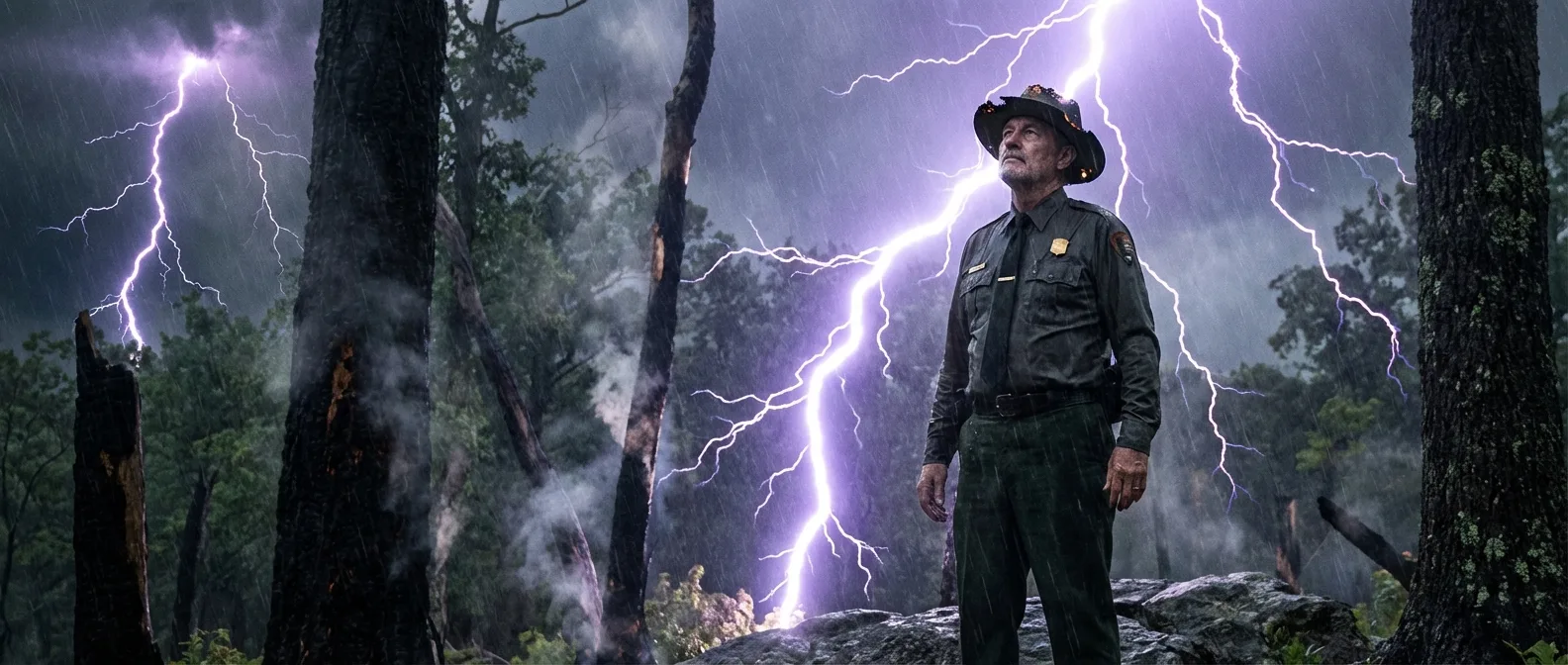
The Human Lightning Rod
The unbelievable story of Roy Sullivan — the man lightning never stopped hunting
📖 Read more: The Lykov Family: Hidden in Siberia for 40 Years
The ranger and the storm
Roy Cleveland Sullivan was born in 1912 in Greene County, Virginia. He was a quiet, simple man — a park ranger in Shenandoah National Park, a vast and beautiful forested expanse in the Appalachian Mountains of Virginia. He worked there for over thirty years, walking trails, overseeing wildlife, monitoring the weather. Born into a modest farming family, he never finished school. The job at the park wasn't just a profession — it was his life. He knew every trail, every ridgeline, every stream.
The weather, however, was monitoring him back.
Roy Sullivan entered the Guinness Book of Records as the person struck by lightning more times than anyone in history: seven times, between 1942 and 1977. He survived every single one. The probability of being struck once in your lifetime is roughly 1 in 15,000. The probability of being struck seven times can't even be properly calculated using conventional mathematics — if you multiply the odds independently, you arrive at a number so small it essentially equals zero. And yet, it happened.
The seven bolts
Each strike was a separate story of terror, pain, and inconceivable luck. Here they are, one by one:
- 1st — 1942: He was in a fire lookout tower high in the Shenandoah peaks. Lightning hit the tower, passed through his leg, and ripped off his big toenail. The tower had no lightning rod and was entirely metal — Sullivan was essentially standing inside a conductor. It was the first time — and he believed it would be the last.
- 2nd — July 1969: He was driving his truck on a forest road. Lightning struck nearby trees, entered through the open window, hit him, and left him unconscious. He lost his eyebrows and eyelashes. His hair was partially burned. When he came to, he was alone on the forest road with his truck stopped.
- 3rd — July 1970: In his own yard — a place he considered safe. Lightning struck a nearby power transformer and the energy passed into his left shoulder, searing it. It was the moment he realized there was no safe place.
- 4th — April 1972: Inside the ranger station. His hair caught fire. He ran to the bathroom and doused it with water. From then on, he always kept a jug of water with him.
- 5th — August 1973: On patrol in the park. He saw the storm approaching and tried to drive away. But he stopped to check if the storm had followed him — and it had. Lightning found him mid-motion — his hair caught fire again, his legs were jolted, his shoes flew off.
- 6th — June 1976: Checking a campsite near a stream. Struck in the ankle. Seriously injured — the wound didn't heal properly for months and forced him to walk with a limp.
- 7th — June 25, 1977: Fishing in a pond. Lightning hit his chest and stomach, causing burns. According to the records, after the strike he had to fight off a bear that came to steal his fish.
What lightning does to the body
A lightning bolt carries approximately 300 million volts of electrical energy. The air temperature around it reaches 30,000°C — five times hotter than the surface of the sun. The strike lasts less than a millisecond, but in that fraction of time, the energy surges through the body like an electric shock beyond all imagination.
📖 Read more: The Woman Who Survived 3 Shipwrecks on 3 Sister Ships
Common effects include cardiac arrest, burns, neurological damage, hearing or vision loss, muscle spasms, and amnesia. About 90% of victims survive — but many are left with permanent nervous system damage, chronic pain, depression, and psychological trauma. In some cases, survivors report personality changes, memory loss, and difficulty concentrating — symptoms that may appear weeks after the strike and persist permanently.
In the United States, approximately 300 people are struck by lightning each year — and on average, 20 die. Sullivan wasn't immune to electricity. Each strike caused injuries — burns, hair loss, wounds on his extremities. But every time, he got back up. Every time, he returned to work. Every time, lightning found him again.
Fear of the sky
After the 4th strike, Sullivan began to believe some force was hunting him. He always carried a jug of water — to douse his hair if it caught fire again. He constantly scanned the sky. Every dark cloud filled him with dread. According to interviews, during nighttime thunderstorms he would get out of bed and hide in closets or in his basement.
His colleagues avoided him during storms — they believed his proximity increased their chances of being struck too. Sullivan knew it all too well. The loneliness he felt wasn't just physical — it was social. Lightning didn't just destroy his skin — it destroyed his relationships. His first wife left him, unable to live under the shadow of constant threat. His second wife was herself struck by lightning while they were together — she was hanging laundry in the yard. She survived, but the marriage didn't last.
"I don't know why God is hunting me. I just know that when I see a storm, I feel my body trembling. Not from cold — from anticipation." — Roy Sullivan
Psychologists later spoke of lightning-strike PTSD — a condition that plagues many survivors. Sullivan's particularity was that he didn't have just one trauma — he had seven. Every storm was a reminder that the sky wasn't done with him yet.
Why him?
The question that tormented Sullivan — “Why me?” — also occupied scientists. The truth is there's no single answer. There is no “lightning magnetism” in humans. There was nothing in Sullivan's body structure that attracted lightning more than anyone else.
📖 Read more: 33 Miners Trapped 69 Days Deep Underground
What does exist, however, is statistical probability. Sullivan worked for decades in a national park — in mountainous, forested terrain with frequent thunderstorms. He was always outdoors, hiking ridgelines, manning lookout towers, crossing open meadows. He was in the places where lightning strikes — and he was there thousands of hours per year, for decades.
This doesn't fully explain seven times. But it shifts the conversation: it's not magic or a curse, but a man who spent his entire life in the places where lightning hits. At any given moment, the probability was minuscule. But over a lifetime of decades in the open, the “impossible” becomes “improbable” — and the “improbable” sometimes happens. Sullivan's case was studied by the National Weather Service and became a symbol of the unpredictable nature of natural phenomena.
Modern meteorologists estimate that roughly 100 lightning bolts strike the Earth every second — that's over 8 million per day. The Shenandoah region experiences an average of 35-45 thunderstorms per year. A park ranger working outdoors 250 days a year faces significantly higher risk than someone working in an office. This doesn't explain everything — but it puts things in perspective.
The end that didn't come from the sky
What killed Roy Sullivan wasn't lightning. Sullivan died in 1983, at age 71, from a self-inflicted wound. According to reports, the reason was an unrequited love. The sky hunted him for thirty-five years — but in the end, loneliness proved more lethal than lightning. He was found on September 28, 1983.
Sullivan's story is fascinating as a record, but behind the numbers hides a man who lived in constant fear. The chronic terror of storms, the social isolation (nobody wanted to be near him during bad weather), the permanent scars on his body, the pain — it all weighed on him.
His ranger hat, scarred by lightning, is displayed today at Shenandoah National Park as an exhibit piece. NASA has referenced his case in studies on atmospheric electrical activity. Today, Roy Sullivan's gravestone in Dooms, Virginia, doesn't mention the lightning. But his story reminds us of something profound: that the most impressive survival stories aren't always happy ones. Sometimes, the hero doesn't want to be a hero. Sometimes, his “luck” wasn't luck — it was a burden. And sometimes, the sky leaves you alive, but the earth won't leave you in peace.
"Roy Sullivan didn't fear death. He feared the storm. And that was worse — because the storm always came."
— The End —