The Night Orson Welles Scared America
A True Story
📖 Read more: The History of Information: Who Controls What We Know
A boy who loved the spotlight
George Orson Welles was born on May 6, 1915, in Kenosha, Wisconsin — a small industrial city between Chicago and Milwaukee. His father, Richard, was an inventor and an alcoholic. His mother, Beatrice, was a pianist who organized cultural events. She died when Orson was nine. His father died three years later.
Orphaned at twelve, Orson was raised by his guardian, Dr. Maurice Bernstein — a man who believed the boy was a genius. He wasn't wrong. At sixteen, Orson traveled to Ireland, walked into the Gate Theatre in Dublin, and convinced the director he was a Broadway star. He wasn't. But his performance was so good that nobody asked again. By twenty, he was already the most talked-about theater director in New York.
In 1937, Welles founded the Mercury Theatre with John Houseman — a theatrical company that wanted to turn everything upside down. They staged Shakespeare's “Julius Caesar” with modern sets, the actors dressed as fascists. The production was electric. Within months, CBS offered them a weekly radio show: “The Mercury Theatre on the Air.” Every Sunday evening at 8 PM, they broadcast radio adaptations of classic literary works.
The show had no sponsor. The ratings were modest. Welles knew he needed something explosive to grab attention. Halloween was approaching. And he had an idea.
"The War of the Worlds"
H.G. Wells' novel “The War of the Worlds,” published in 1898, described a Martian invasion of England. It was a masterpiece of science fiction — but it was written as narrative prose. Welles (Orson, this time) wanted something radically different. He asked screenwriter Howard Koch to rewrite the entire story — not as a narrative, but as a radio news broadcast.
The idea was simple and diabolical: listeners would think they were hearing regular programming — music, commercials — until it was suddenly interrupted by “breaking news bulletins” about strange explosions on Mars. Then “correspondents” would report live from a field in New Jersey, where a mysterious object had crashed. And things would get worse quickly.
September 1938Howard Koch writes the first script. Welles rejects it — it isn't realistic enough. He demands real place names, real streets, real institution names. The action is moved to Grover's Mill, a small village in New Jersey that Koch chose randomly by pointing at a map with his eyes closed.
Sunday, October 30, 1938 — 8:00 PM
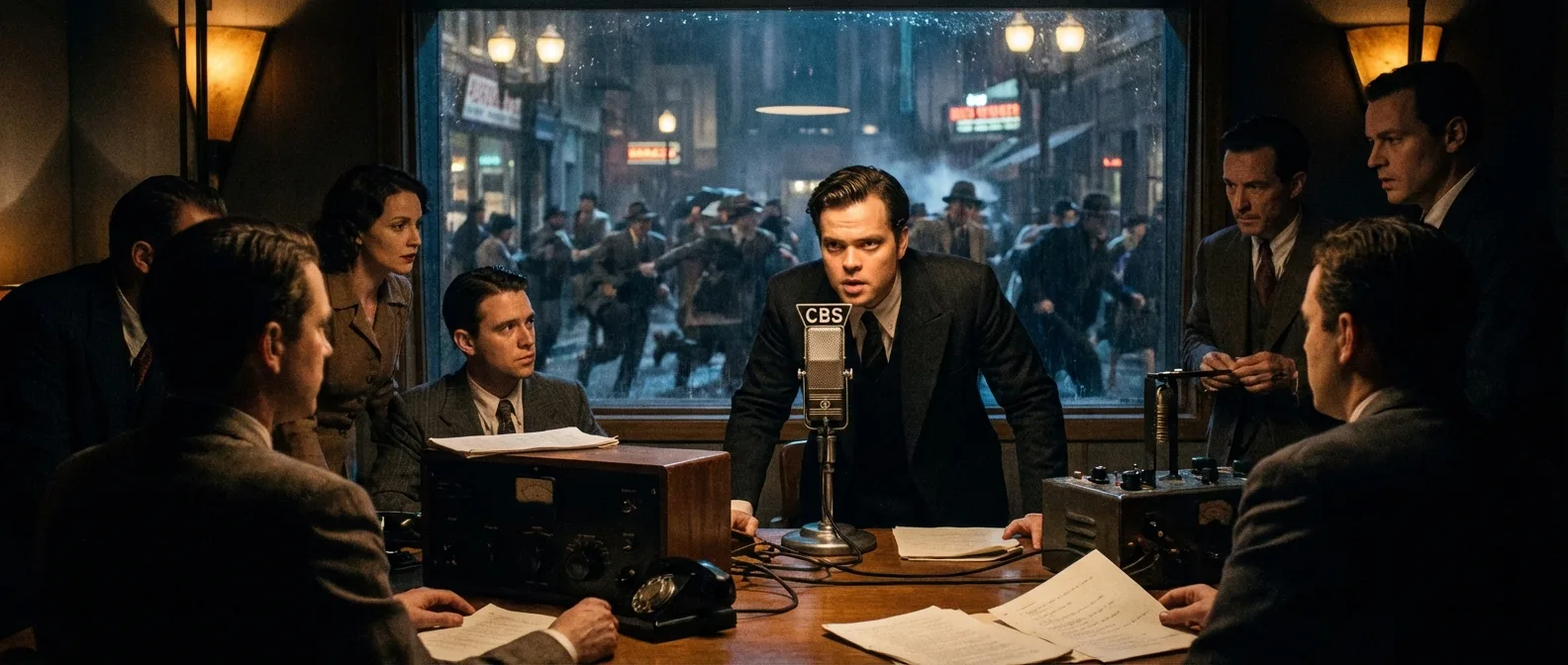
It was the eve of Halloween. A cool autumn night. Across America, millions of families sat in their living rooms, gathered around their radios — the wooden boxes with glowing frequency dials that were the center of every home. In Studio 1 of the Columbia Broadcasting System, on the 20th floor of a building on Madison Avenue in New York, a twenty-three-year-old with a striking bass voice stood before the microphone.
The show opened with a brief introduction: "The Columbia Broadcasting System and its affiliated stations present Orson Welles and the Mercury Theatre on the Air in The War of the Worlds by H.G. Wells." A short narration by Welles followed — and then, immediately, the format changed. What listeners now heard was a “regular” radio broadcast: orchestra music from a fictional hotel in New York. Sweet, unremarkable music.
That was the first “bulletin.” Brief, clinical, almost boring. The music returned. Listeners who had been following from the start knew it was a dramatization — the opening announcement had been clear. But those who turned the dial at 8:12, bored by the singer on NBC, heard no announcement. They heard the “news bulletins” directly.
The invasion begins
The bulletins grew increasingly urgent. An object “like a meteorite” had fallen in a field near Grover's Mill, New Jersey. A “correspondent,” Carl Phillips (played by actor Frank Readick), was reporting live. He described crowds gathering around a crater. Something was moving inside. A metallic lid was slowly unscrewing.
📖 Read more: The Night an Entire City Stayed Awake for No Reason
8:18 PMThe “correspondent” describes a creature emerging from the object — “gray like a snake, large as a bear, with eyes that gleam like light.” His voice trembles. Screams can be heard in the background.
The panic
What followed became the greatest urban legend in American broadcasting history — though the truth, as always, is more complicated than the myth. Telephone switchboards collapsed. Tens of thousands of calls flooded police stations, newspapers, and radio stations across the country. People called asking whether the invasion was real, whether they should evacuate, whether New York had been destroyed.
Grover's Mill, New JerseyResidents took to the streets with hunting rifles. Some shot at a water tower, believing it was the Martian cylinder. Police struggled to convince them there was no danger.
The morning after
When the show ended at 9 PM, Welles had no idea what had happened. He went through the commercial break, made the standard announcement that it had been a dramatization, and went home. He was awakened by reporters' phone calls. The New York Daily News ran the headline: “Fake Radio War Stirs Terror Through U.S.” It filled the entire front page. The New York Times: “Radio Listeners in Panic, Taking War Drama as Fact.”
October 31, 1938Welles holds a press conference. He appears innocent, awkward, nearly tearful. He apologizes. He says he never intended to frighten anyone. But photographs show him with a half-hidden smile — a smile that knew exactly what it had accomplished.
Why it fooled them
The question that haunted sociologists for decades: why did so many people believe something so implausible? The answer wasn't gullibility — it was fear. In October 1938, Europe stood on the brink of war. Just weeks earlier, the Munich Agreement had averted — temporarily — a conflict with Germany. Radios broadcast breaking news bulletins constantly. Americans had grown accustomed to hearing bad news.
Hadley Cantril, a psychology professor at Princeton, published “The Invasion from Mars” in 1940 — an analysis of the panic. His findings were revealing: the listeners who panicked were no less intelligent than the rest. They were, however, more isolated, more insecure, more dependent on the radio as their sole source of information. Many lived in rural areas, with no access to a second source. They couldn't simply walk outside and see that everything was normal.
Welles understood this instinctively. He had studied how real news bulletins structured events — in the Rhineland, in Austria, in the Sudetenland. He had copied the rhythmic escalation, the dramatic pauses, the announcer's voice breaking mid-sentence. He had constructed a sonic landscape so convincing that even today, listening to the recording, you feel a slight shiver run down your spine.
The legacy of one night
The evening of October 30, 1938, changed the world in ways nobody had foreseen. It revealed the dark power of mass media — their ability to manufacture reality, manipulate emotions, and create panic with a few well-placed words. Before Welles, the media were considered mere “carriers” of information. After Welles, the world understood that the carrier could be more powerful than the message.
1940Welles directs “Citizen Kane” — a film about the power of mass media. It is no coincidence. The experience of Halloween 1938 marked his thinking forever.