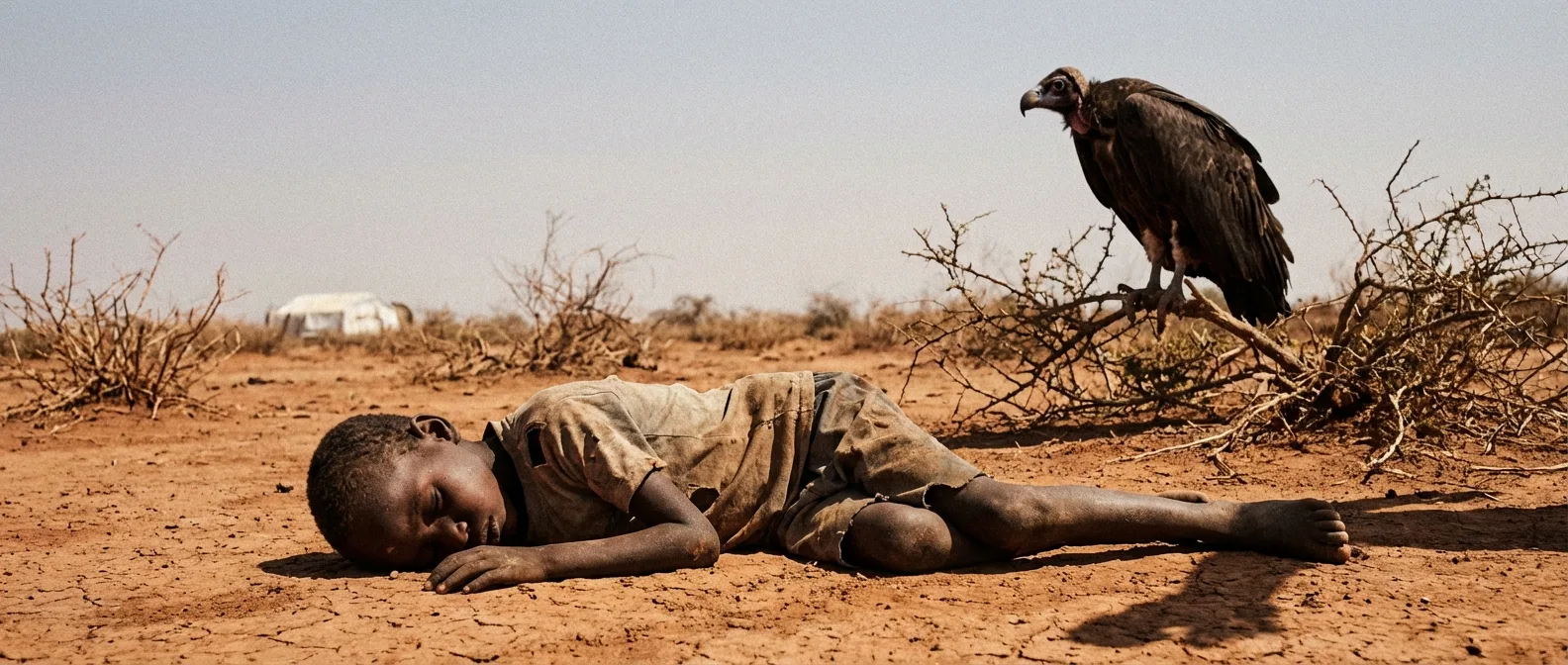
The Photographer, the Vulture, and the Child
In March 1993, a photographer from South Africa captured the horror of famine in Sudan in a single image: a skeletal chi...
📖 Read more: Pompeii: The City Frozen in Time
The “Bang-Bang Club”
Kevin Carter was born on September 13, 1960, in Johannesburg, into a white middle-class Catholic family of British descent. He grew up in the shadow of apartheid. As a child, he watched police raids to arrest black people living illegally in his neighborhood. He later wondered how his parents — kind, educated, liberal — could remain so complacent about the system.
After high school, Carter started studying pharmacy but dropped out. He was drafted into the army and, to escape the infantry, enlisted in the Air Force, serving four years. In 1980, in a military mess hall, a white serviceman insulted a black waiter. Carter defended the man — and was severely beaten by his fellow soldiers. He went AWOL, tried to become a radio DJ under the name “David,” failed, and returned to complete his service.
In 1983, after witnessing the Church Street bombing in Pretoria, he decided to become a photojournalist. He got a job at a photographic supply store, met local journalists, and earned his first commissions. He was the first to photograph a public “necklacing” — an execution using a burning tire around the victim's neck — in the mid-1980s. “I was appalled at what they were doing,” he said later. "But then people started talking about those pictures... and I felt that maybe my actions hadn't been all that bad."
In the late 1980s and early 1990s, Carter, Greg Marinovich, João Silva, and Ken Oosterbroek formed the “Bang-Bang Club” — four photographers who covered the violence in the townships. Every day, bullets, tear gas, bodies. Carter was talented but sensitive. The violence consumed him — every night, the images returned. He turned to cocaine and mandrax to sleep, to forget, to survive one more day. Even before Sudan, he was a broken man. His friends worried, but no one could stop someone who believed his work was worth the pain.
Sudan, March 1993
In March 1993, Robert Hadley of the UN's Operation Lifeline Sudan offered João Silva the chance to travel to Sudan and document the famine. Silva told Carter, who saw it as an opportunity to build his freelance career. Lifeline Sudan was facing funding difficulties — the UN believed that publicizing the famine would help sustain donor support.
They flew first to Nairobi, but new fighting in Sudan forced them to wait. Carter made a day trip with the UN to Juba to photograph a food barge. Soon after, the UN received permission from a rebel group to fly food aid to Ayod — and Hadley invited both photographers along. In Ayod, Carter gave a cheap wristwatch to a soldier who didn't speak English — and the soldier became their bodyguard.
📖 Read more: Rana Plaza: The Truth Behind Cheap Clothes
In Ayod, they separated to photograph famine victims on their own. They talked to each other about the shocking scenes they were witnessing — skeletal adults, children with bellies swollen from malnutrition, bodies waiting in line for a handful of flour. Near the feeding center, Carter wandered away alone. There, in the dirt, he saw the scene: a small child — skeletal, naked, hunched on the ground — trying to drag its body toward the center. And a few feet behind, a vulture.
I sat under a tree and waited 20 minutes, hoping the vulture would spread its wings. It didn't. I took the photograph. Then I chased the vulture away.
Carter did not touch the child. UN rules prohibited physical contact with famine victims due to infection risk. A few minutes later, Carter and Silva boarded a small UN plane and left Ayod for Kongor. But the decision to photograph instead of help would condemn him in the eyes of the world.
The photograph that shook the planet
The image was published in The New York Times on March 26, 1993. Within days, it was reprinted in every major newspaper in the world. The impact was seismic — TIME later named it one of the 100 most influential photographs of all time.
Hundreds of readers called the Times asking: “What happened to the child?” On March 30, the newspaper published an editors' note: according to Carter, “she recovered enough to resume her trek after the vulture was chased away,” but it was unknown whether she reached the UN feeding center.
The truth was revealed only in 2011: the child's father disclosed that the child was actually a boy — named Kong Nyong — and had made it to the UN food aid station. According to his family, Nyong died of fevers in 2007. Not that day.
In March 1994, Carter photographed three Afrikaner Weerstandsbeweging members being shot during their abortive invasion of Bophuthatswana — just before the South African elections. Eamonn McCabe of The Guardian called it “a picture that made nearly every front page in the world.” Carter ran out of film halfway through the incident.
In April 1994, Carter won the Pulitzer Prize for the photograph. Instead of joy, he felt horror. The public reaction was brutal: “Why didn't he help? Why did he sit and photograph?” The St. Petersburg Times wrote: "The man who adjusts his lens to get the right shot of suffering — isn't he a predator too?"
The question was devastating: is the photographer a second vulture? Carter never found an answer that satisfied him.
Ken's death and the end
On April 18, 1994 — just days after the Pulitzer — Ken Oosterbroek, Carter's closest friend in the “Bang-Bang Club,” was killed by a bullet in a township. Greg Marinovich was seriously wounded in the same incident. Carter couldn't take it.
The depression deepened. The drugs no longer helped. His relationship with his daughter had crumbled. There was no money — not for rent, not for child support, not for debts. Awards don't pay bills.
On July 27, 1994 — three and a half months after the award — Kevin Carter drove his red pick-up truck to a creek in Parkmore, Johannesburg. He connected a hose to the exhaust, fed it into the cab, and died. He was 33 years old.
I'm really, really sorry. The pain of life overrides the joy to the point that joy does not exist. ...depressed ...without phone ...money for rent ...money for child support ...money for debts ...money!!! ...I am haunted by the vivid memories of killings & corpses & anger & pain ...of starving or wounded children, of trigger-happy madmen, often police, of killer executioners... I have gone to join Ken if I am that lucky.
📖 Read more: The Boston Molasses Flood: Sweet Death
The price of the lens
Carter's story poses a question without an easy answer: what is the duty of a war photographer? To photograph or to help? Archbishop Desmond Tutu, Nobel Peace laureate, wrote: "We know a little about the cost of being traumatized that drove some to suicide — yes, these people were human beings operating under the most demanding of conditions."
If Carter had not taken that photograph, the world might never have seen the horror of famine in Sudan. That image pushed governments to send aid, raised the famine to an international issue, pressured donations. It saved lives — but destroyed his own.
Carter's legacy lives on in unexpected places. In 1996, the Manic Street Preachers dedicated a song to his memory: “Kevin Carter.” In 2001, Savatage released an entire album inspired by his life. In 2010, Taylor Kitsch portrayed him in the film “The Bang Bang Club.” And in every journalism school in the world, his photograph is still used as a starting point for the debate on ethics in photojournalism.
The second vulture
Kevin Carter did not die from the famine in Sudan. He did not die from a bullet in a township. He died from something that doesn't show in a photograph: the memories. The pain that accumulated click after click, image after image, body after body.
His photograph of the vulture still lives — in books, museums, photography halls around the world. It is one of the most recognizable images of the 20th century. It reminds us that journalism saves lives — but sometimes, the price is paid by those who hold the lens. Kevin Carter was not a vulture. He was a human being — and that is exactly what killed him.