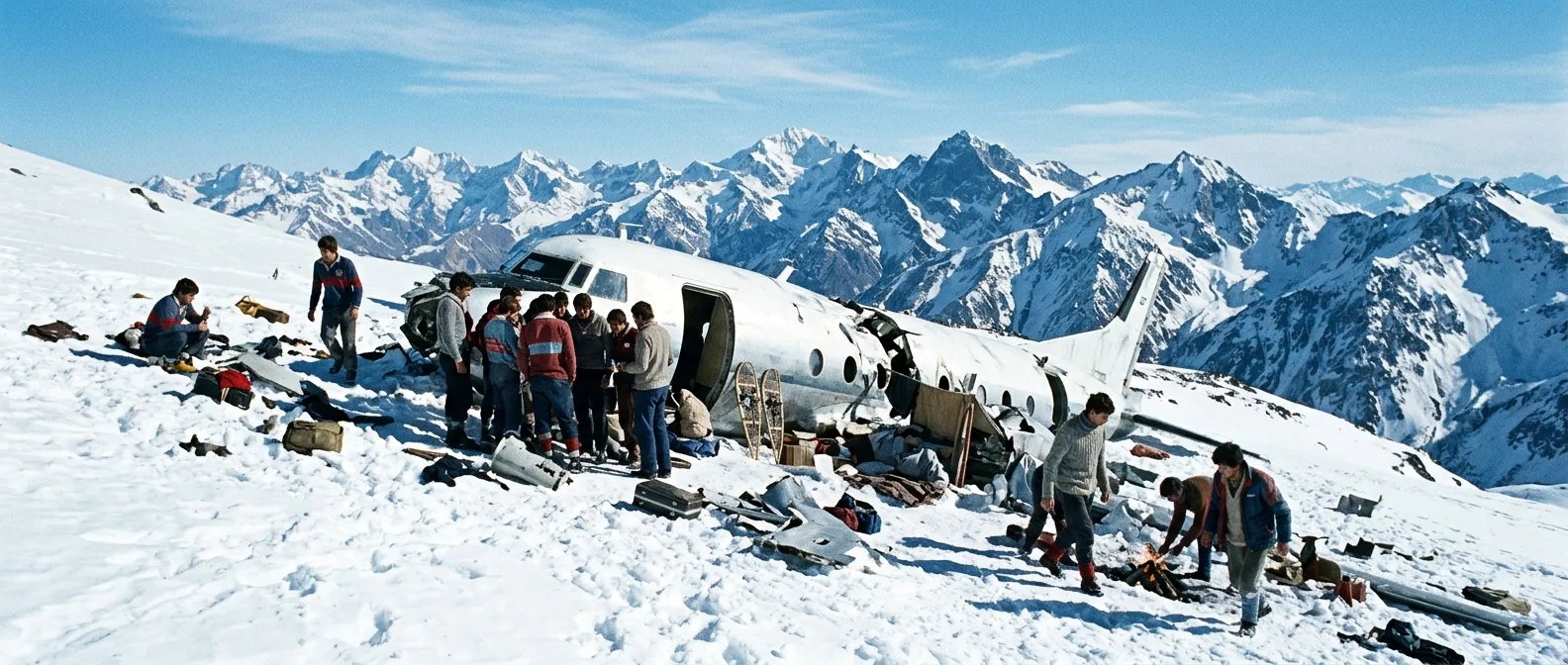
72 Days in the Andes
The story of a rugby team that defied the mountains,
death, and the limits of human endurance
📖 Read more: Donner Party: The Settlers Who Resorted to Cannibalism
All Nando Parrado remembers is darkness. A thick, impenetrable black — as though floating inside nothingness. One thought kept repeating: “I'm dead. I'm dead. This is death. It's so black that this is death.” Hours passed. Maybe days. Then a new thought crept in: “I'm thirsty. If I'm dead, how can I be thirsty?”
Parrado opened his eyes. Friends' faces stared down at him. “Nando, are you OK?” they asked. He wasn't. He was lying inside the mangled carcass of an airplane, surrounded by twisted cables, shattered plastic, and crumpled metal. Three days earlier, Uruguayan Air Force Flight 571 had slammed into a mountain in the Andes. Parrado had suffered a skull fracture. They'd left him in the snow — they thought he was dead.
It would take 72 days to get off that mountain alive. Sixteen out of forty-five. What survival demanded of these young rugby players goes beyond anything most people can imagine.
In October 1972, Nando Parrado was twenty-two — an ordinary young Uruguayan who helped out at his father's hardware store, chased girls, and played rugby for the Old Christians Club in Montevideo. When a trip to Chile was announced for a rugby match, he didn't think twice. Team captain Marcelo Perez had chartered a military aircraft. Players, friends, and families boarded — Parrado even brought his mother and younger sister, Susy.
On October 12, the Fairchild FH-227D took off from Montevideo. Bad weather forced an overnight stop in Mendoza, Argentina. The next day — Friday the 13th — the players joked about the ominous date. The pilots delayed departure, but the aircraft belonged to the Air Force and regulations prohibited it from staying on Argentine soil for more than 24 hours. They took off around 2 PM — the worst time to fly over the Andes.
The plane's maximum ceiling was roughly 22,500 feet — barely clearing the mountain range. Aconcagua, the tallest peak, stands at 22,837 feet. The pilots plotted a U-shaped course: south to Planchón Pass, where the ridges are lower, then north to Santiago.
An hour into the flight, the co-pilot made a fatal error. He misjudged their position — likely due to cloud cover or miscalculated headwinds. He turned north too early, deeper into the Andes. He radioed air traffic control that they had passed Curicó in Chile. They hadn't.
"Today, I would never go near that airplane. A Fairchild FH-227D, very underpowered engines, full of people, flying over the highest mountains in South America, in bad weather. No way."
— Nando Parrado, The Guardian, 2023At roughly 3:30 PM, the plane struck a mountain. Both wings sheared off. The left propeller slashed through the fuselage. The tail snapped away. What remained toboganned down the slope at terrifying speed until it came to rest in a valley at 11,500 feet.
Twelve people died on impact. The other thirty-three were alive — temporarily.
The atmosphere up there kills you slowly. Temperatures plunge to -35°C. The air is so thin you can be left gasping just from standing still. Sunlight bounces off endless white snow, blistering and blinding. One wrong step and the ice swallows you to the waist. Nobody had winter clothes, blankets, or mountaineering gear of any kind.
What surprised Parrado most was the thirst. “You dehydrate five times faster at that altitude,” he later explained. “And there's no water, so you have to eat snow.” The snow was so cold it burned their throats and cracked their lips.
Nights were worse. Makeshift barriers of suitcases and wreckage fragments couldn't stop the freezing wind. Their clothes froze solid on their bodies. They punched each other's arms to improve circulation. Their teeth chattered so violently they couldn't speak. They huddled together, seeking warmth in each other's breath.
📖 Read more: The Cat That Traveled 3,000 km to Get Home
Captain Perez took charge. Roberto Canessa, a medical student, bandaged broken bones with strips of cloth and cooled them in snow. They found the pilot trapped in the crumpled cockpit. Before dying, he told them they'd passed Curicó — a piece of misinformation that would mislead them for weeks.
Parrado's mother, Eugenia, had died in the crash. His sister Susy was badly hurt — she couldn't move, couldn't speak. Only her eyes moved. Parrado crawled to her, held her on the floor, melted snow in his mouth and fed her water. She died in his arms on the eighth day. “I couldn't cry,” he remembers. “My brain wouldn't react to anything outside survival.”
Food ran out within a week. Chocolate bars, crackers, a few bottles of wine — that was everything. One square of chocolate per person per day. Parrado took three days to eat a single chocolate-covered peanut. Some tried chewing leather from broken luggage. It didn't go well.
On day ten, Roy Harley managed to get a transistor radio working. The news hit like a second crash: search operations had been called off. After eight days of looking, authorities assumed nobody had survived.
That night, Parrado turned to his friend Carlitos and told him he was ready to eat the flesh of the dead lying outside in the snow. The conversation opened to the whole group. It lasted hours. Some refused. But hunger — that merciless, all-consuming hunger — doesn't leave much room for philosophy.
"I had no doubts. I had reached the conclusion very clearly. This is the only way out. Not knowing when you're going to eat again is the worst fear of a human being. The most primal fear."
— Nando Parrado, The Guardian, 2023They shook hands. They told each other: "If I die, use my body. At least get out alive. And tell my family how much I love them." A small group went outside with a shard of glass. After the search was called off, slowly, everyone began eating.
Canessa described it years later: "It's a deeply humiliating thing. But I thought of my mother — that I had a unique chance to tell her to stop crying, that I was alive. And to do that, I had to buy time."
On October 29 — two weeks after the crash — the mountain attacked. An avalanche roared down the slope and buried the fuselage with everyone inside. “You can't see, you can't hear, you can't move, and you're dying,” Canessa recalled. Eight more people were killed — among them team captain Marcelo Perez.
The nineteen who remained were trapped in a tiny space between the snow and the fuselage wall. It could comfortably fit four. Darkness. No room to stand. Parrado punched a hole in the roof with a metal cargo pole, drawing in fresh air. They stayed like that — pressed against the bodies of dead friends — for four days.
A second avalanche came that night but rolled over the already buried plane. "Hell would have been a comfortable place, compared to those four days under the avalanche," Parrado said. When the blizzard stopped, they dug their way out through the cockpit in fifteen-minute shifts. It took hours.
Of the 45 people on board: 12 died in the crash, 6 in the following days, 8 in the avalanche, 3 later. Sixteen survived — roughly a third of the original count. Their average age was just 22.
After the avalanche, Parrado knew the only way off the mountain was on foot. The following weeks were spent preparing: stitching a sleeping bag from seat cushions, crafting a sled from a suitcase, layering clothes. The rest of the group made sure the “expeditionaries” ate larger portions — building their strength for the trek ahead.
On December 12 — day sixty-one — Parrado, Canessa, and Antonio “Tintin” Vizintín set out. Parrado wore three pairs of jeans, three sweaters, four pairs of socks wrapped in plastic bags, and rugby boots. He carried an aluminum pole as a walking stick and a backpack with three days' worth of meat rations.
📖 Read more: The Challenger Explosion: 73 Seconds of Horror
Before leaving, he told those staying behind they could use the bodies of his family if food ran out. That single offer says everything.
"I knew that when I took the first step away from the fuselage, I was not coming back. This was a kamikaze mission."
— Nando Parrado, The Guardian, 2023Experts say you shouldn't climb more than 300 meters a day at such altitudes. The three of them doubled that in a single morning. The ascent they expected to take 14 hours lasted three days. Altitude sickness hit hard — heart rates soaring, hyperventilation, dehydration. On the first night, the temperature dropped so low that their water bottle shattered.
Parrado reached the peak first. They had started at 11,700 feet — the summit stood at 15,000. Any joy he felt evaporated with a single glance around. There was nothing. No green valleys, no signs of civilization. Just snow-capped ridges stretching to the horizon, row after row after row.
The dying pilot had told them they'd passed Curicó — that they were on the western edge of the Andes. “We thought we were five kilometers away. We were eighty.” The information had been wrong from the start.
At that moment, Parrado made the second biggest decision of his life — after the decision to leave. He turned to Canessa: "Come on, Roberto. I can't do it alone. Let's go. If we go back, what for? I'll die looking into your eyes, and who dies first?"
Before heading down, Parrado christened the mountain. He wrote “Mt Seler” in lipstick on a bag and tucked it under a rock. Seler was his father's name — the man he wanted to live for.
They sent Vizintín back to the fuselage — he made it down in one hour using the makeshift sled. They took his food rations. Parrado and Canessa continued west, alone.
Day by day, the landscape softened. They found a river and followed its flow. Signs of life kept them moving: traces of camping, dung, cattle. Parrado's shoes were falling apart. Canessa was spent — “He gave everything he had,” Parrado remembers. “He was the best companion I could have had on that expedition.”
On the eighth day, Canessa spotted a man on horseback across the river. Parrado started running downhill. Sergio Catalán, a Chilean farmer, approached but they couldn't hear each other — the river roared between them. Parrado caught one word: “Mañana.” Tomorrow.
"That 'tomorrow' we had always dreamed of was real now."
— Roberto Canessa, ABC News, 2023The next morning, Catalán returned with his sons. He threw a rock wrapped in paper across the river, with a pencil. Parrado, hands trembling, wrote a note that would change sixteen lives:
"I come from a plane that crashed in the mountains. I am Uruguayan. We have been walking for 10 days. I have 14 friends wounded at the crash site. We need help. We don't have any food. Please come and get us."
Catalán rode ten hours on horseback to the nearest police station. Parrado and Canessa had walked over 60 kilometers in ten days. Parrado believes they could have lasted one more day. Just one.
📖 Read more: The Child Who Grew Up in the Jungle: Marina Chapman Story
On December 22 — day seventy-one — two helicopters appeared in the sky above the wreckage. Carlos Páez Rodríguez, one of the survivors, remembers: "I saw them as two giant birds, bearers of freedom. I can't explain the happiness of that moment."
Parrado guided the pilots to the site. The rescue crew didn't believe him at first — he was pointing to locations deep inside Argentina on their maps. “No, no, that's Argentina, that's 60 to 80 kilometers away,” they told him. Parrado insisted. He looked at Canessa lying on the floor while a nurse tended to him. Adrenaline surged. He climbed into the helicopter behind the pilot.
He recognized the mountains. Then the ridge. Then the fuselage. The boys ran out as the helicopter circled. It landed. Parrado opened the door. Three friends leaped on top of him like dogs, kissing him, shouting. Six were rescued that day. The remaining eight the next.
Half an hour later, the helicopter landed at a hospital in San Fernando, Chile. Nurses rushed toward Parrado with a gurney. He refused. "The distance from the helicopter to the hospital entrance was about 50 meters. And I said: No. Stop. I crossed the entire Andes on foot. I am not getting on a gurney." He walked into the hospital.
Alipio Vera, a reporter for Chilean national television, saw them up close: "They were very weak, their voices barely audible. It was incredible — people who had been strong rugby players, now they were almost skeletons." Parrado had lost 45 kilograms — down from 100. The nurses removed his clothes — some he'd been wearing for 72 days straight. He looked at himself in the mirror. “I didn't recognize myself.”
The 147 Who Wouldn't Exist
The news that survivors had eaten the dead caused a firestorm. They responded as a team — something they never stopped doing. Canessa answered: “They have no right to judge us.” The backlash faded quickly. Even the Pope expressed sympathy. The Church absolved them of any sin.
Parrado was reunited with his father and older sister Graciela at the hospital. His father had been sleeping in Nando's bedroom — sometimes on the floor, holding the dog. On the mantelpiece stood a photograph: Nando with his mother and Susy. The two of them never came back.
Parrado's father made the pilgrimage to the crash site 18 times — two and a half days on horseback, 70 kilometers of hiking — to lay flowers on his wife and daughter's grave. "I asked him: Dad, why do you go every year? He answered: People go to cemeteries to visit their loved ones. My cemetery just happens to be very far away." He died in 2008, aged 92. His ashes were carried to the Andes — beside his wife and daughter, in the shadow of Mount Seler.
Every year on December 22, the survivors gather. They call it their “shared birthday” — the year they were reborn. Parrado has never missed one. For the fiftieth anniversary, they came with their families. Someone took a photograph: 147 people. The children and grandchildren of those who returned. 147 lives that would not exist if those 22-year-old boys hadn't walked.
"We are dead men walking. But we are still walking."
— Nando Parrado, ABC News, 2023Their story inspired books, films — “Alive” (1993), “Society of the Snow” (2023 / Netflix) — and countless conversations about what humans can endure. Parrado doesn't see it as a miracle. "It was the effort of a group of young people who trusted each other beyond anything you can imagine. This is a rugby story. Rugby saved my life."
In memory of the 29 who never returned
Flight 571, Andes — October 13, 1972