The Teacher Who Divided a Class by Eye Color
On April 5, 1968, the day after Martin Luther King Jr.
📖 Read more: The Teacher Who Created a Dictatorship in a School
The town of Riceville
Riceville in 1968 was a small farming town of about 900 residents in the heart of Iowa. The population was almost entirely white, Christian, and of Anglo-Saxon descent. The children had never seen a Black person in real life — the nearest Black family lived more than fifty miles away. The word “racism” was something abstract — a story from faraway cities, from television news broadcasts showing protests in places unimaginably distant.
Jane Elliott had been teaching at Riceville Elementary since the late 1950s. She was known to parents as strict but fair. She knew her students well — her classroom was like a family within a family community. But she had traveled enough. She had seen how Black Americans were treated in the South. She had read about Jim Crow laws. The gap between what she knew and what her students knew was a chasm.
When April 5, 1968 dawned, the news of Martin Luther King's assassination still echoed on the radios. The children arrived at school asking “why did they kill the king?” — confusing the surname “King” with a royal title. Elliott realized at that moment: she couldn't explain racism with words. She had to show it.
Day one — “Blue eyes are superior”
Elliott began the lesson that morning with a question: “Does anyone know what discrimination means?” The children gave vague answers. Then the teacher announced calmly: "Today you'll learn how it feels. Children with blue eyes are smarter, cleaner, more capable. Children with brown eyes are slow, dirty, stupid."
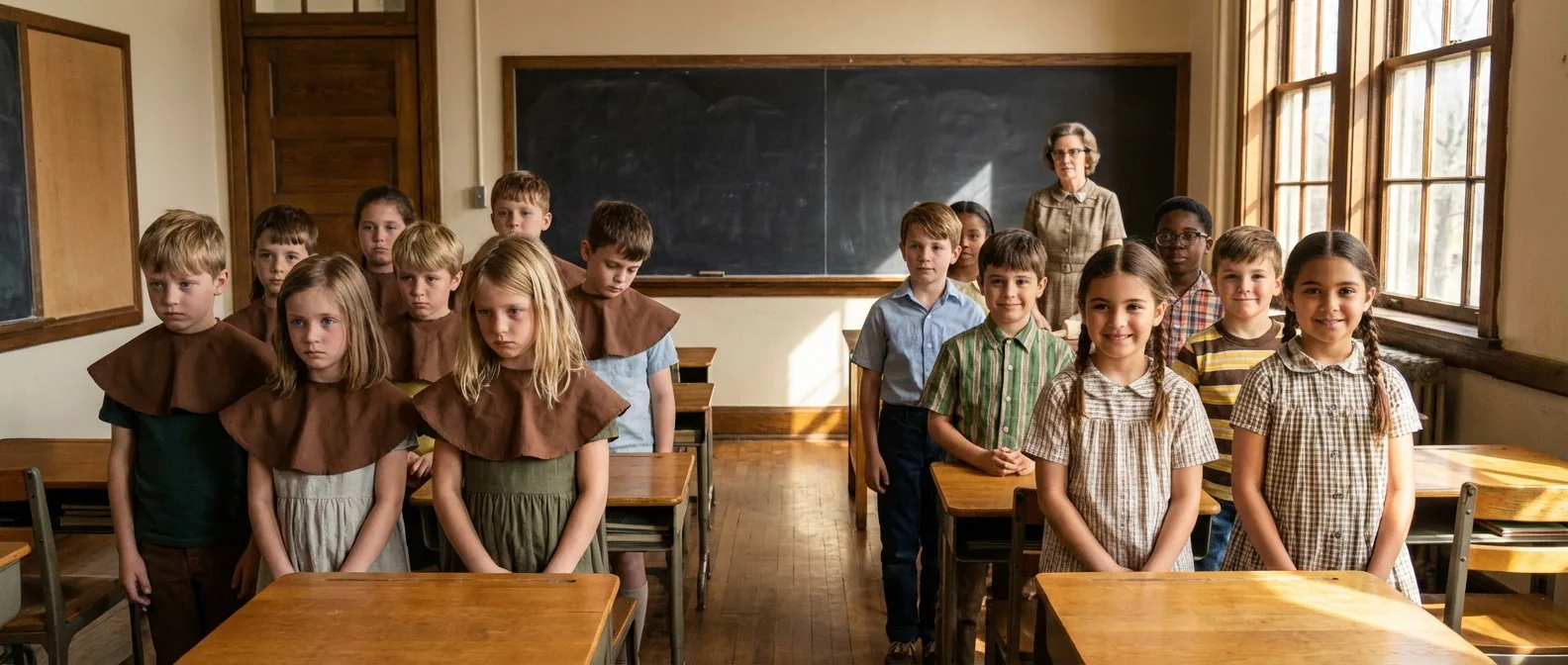
At first the children laughed. They thought she was joking. But Elliott was relentlessly serious. She gave the blue-eyed children special fabric collars to place around the necks of brown-eyed children so they could be immediately identified as the “inferior” group. Blue eyes received privileges: they sat at the front of the class, went first at recess, received second helpings at lunch, and got five minutes of extra break time.
Elliott didn't shout, didn't threaten, didn't use force. She simply stated — with the authority of a teacher — that blue eyes were superior. The power of the role was enough.
Within fifteen minutes, the classroom transformed. Blue-eyed children began looking at the others with arrogance. They refused to play with them at recess. They called them “dirty” and “stupid.” One child punched a brown-eyed classmate in the stomach because “he called me a racist — but I'm not a racist, blue eyes just ARE better.”
The brown-eyed children collapsed. Children who minutes earlier had been lively and cheerful now stared at the floor, spoke quietly, made mistakes on exercises they had previously solved easily. Math scores among the “inferior” children dropped noticeably within hours. The psychological weight of an arbitrary label was immediately measurable.
Within the day, I had created little racists. Eight-year-old children who didn't know what racism meant were suddenly behaving exactly like racists.
The next day, Elliott reversed the roles. She announced that she had been wrong: BROWN eyes were actually superior. The collars went onto the blue-eyed children. The privileges were reversed.
The reaction was instantaneous. The brown-eyed children, who had been humiliated the day before, now walked with confidence. They smiled broadly. They raised their hands in class. Their scores improved. The blue-eyed children moved into the disadvantaged position — and their behavior changed immediately. They withered, became silent, and their mistakes multiplied.
There was, however, an important difference: the brown-eyed children, who had already experienced treatment as “inferiors,” were less cruel toward the blue-eyed children compared to what they themselves had endured. The experience of exclusion had made them more empathetic. This was perhaps the most significant finding of the entire experiment.
Some students asked if they could stop — because they now understood how it felt. The children embraced each other at the end. Many were crying.
The community reacts
Elliott's lesson didn't stay inside the classroom. The children went home and told their parents what had happened. The reactions were mixed — several parents were furious. “Who gave you the right to make our children cry?” they demanded. Some fathers went to the school and insisted the “nonsense” stop.
The town split in two. A portion of residents supported Elliott — mainly those who understood what she was trying to teach. But the majority was against her. She received threatening phone calls. Her siblings stopped speaking to her. Her youngest daughter was bullied at school. The social punishment was merciless.
Yet the experiment immediately attracted media attention. The Riceville Recorder journalist wrote a short piece that was reprinted in major city newspapers. The story began to travel.
If you can behave like a racist in 15 minutes, then racism isn't natural — it's learned. And anything that's learned can be unlearned.
The broadcast that changed everything
In 1970, “The Tonight Show” with Johnny Carson invited Elliott. It was the first time the story reached a national audience. The response was explosive. Thousands of letters flooded the studio — both supportive and venomous. Some called her a hero. Others demanded she be fired, imprisoned, or worse.
That same year, director William Peters released the documentary “Eye of the Storm” for ABC News. The film captured real footage from the classroom: the faces of children transforming, voices hesitating, tears flowing. It was one of the most powerful television documentaries of the decade. It won a Peabody Award and was shown in schools across the country.
📖 Read more: Rosenhan Experiment: Fake Patients in Psychiatric Hospitals
In 1985, PBS Frontline released “A Class Divided,” a follow-up documentary that reunited the former students 15 years later. The results were striking: nearly all remembered the day vividly and stated it had changed them. Many wept on camera remembering how they felt as “inferiors.”
The legacy
Jane Elliott didn't stop after 1968. Over the following decades, she conducted the same experiment with adults — in corporations, universities, military bases, and correctional facilities. The results were always the same: in less than half an hour, adults began behaving exactly like the eight-year-old children. The “superior” group became arrogant and cruel. The “inferior” group withered.
The experiment has been incorporated into anti-discrimination training programs in more than 30 countries. Elliott herself traveled to Australia, the Netherlands, Germany, South Africa, and dozens of other places to present her method. Every time, regardless of cultural background, the reaction was identical: authority automatically creates division. Several researchers drew comparisons with the Stanford Prison Experiment — which demonstrated how even arbitrarily assigned roles of power can radically alter human behavior within hours.
In 1992, Elliott appeared on “The Oprah Winfrey Show,” conducting a condensed version of the exercise with studio audience members. The episode became one of the most-watched segments in the show's history, introducing the experiment to millions of new viewers worldwide.
Critics of the experiment argue the method was harsh — especially for eight-year-old children. Some psychologists believe the exercise causes psychological trauma and would not approve such a procedure in a school today. Elliott has always responded the same way: "If you think this was harsh, imagine how those who live it every day of their lives feel."
In a survey conducted among former students, none reported regretting their participation. Instead, the majority stated it was “the most important day of my school life.”
Eyes wide open
Jane Elliott, now over 90 years old, remains active. She still gives lectures, appears in documentaries, and responds to critics. The “blue eyes / brown eyes” experiment has entered social psychology textbooks worldwide. The method is still used in anti-discrimination educational seminars.
What Elliott proved in a classroom of small children in 1968 wasn't merely a truth about racism. It was a truth about the human brain: that we need only seconds to divide people into “us” and “them,” that authority automatically creates inequality, that a label becomes reality.
If fifteen minutes are enough to destroy a friendship between eight-year-olds, imagine what decades of institutionalized racism can do to an entire society. That was the essence of Jane Elliott's lesson — and it remains just as relevant today as it was on April 5, 1968.