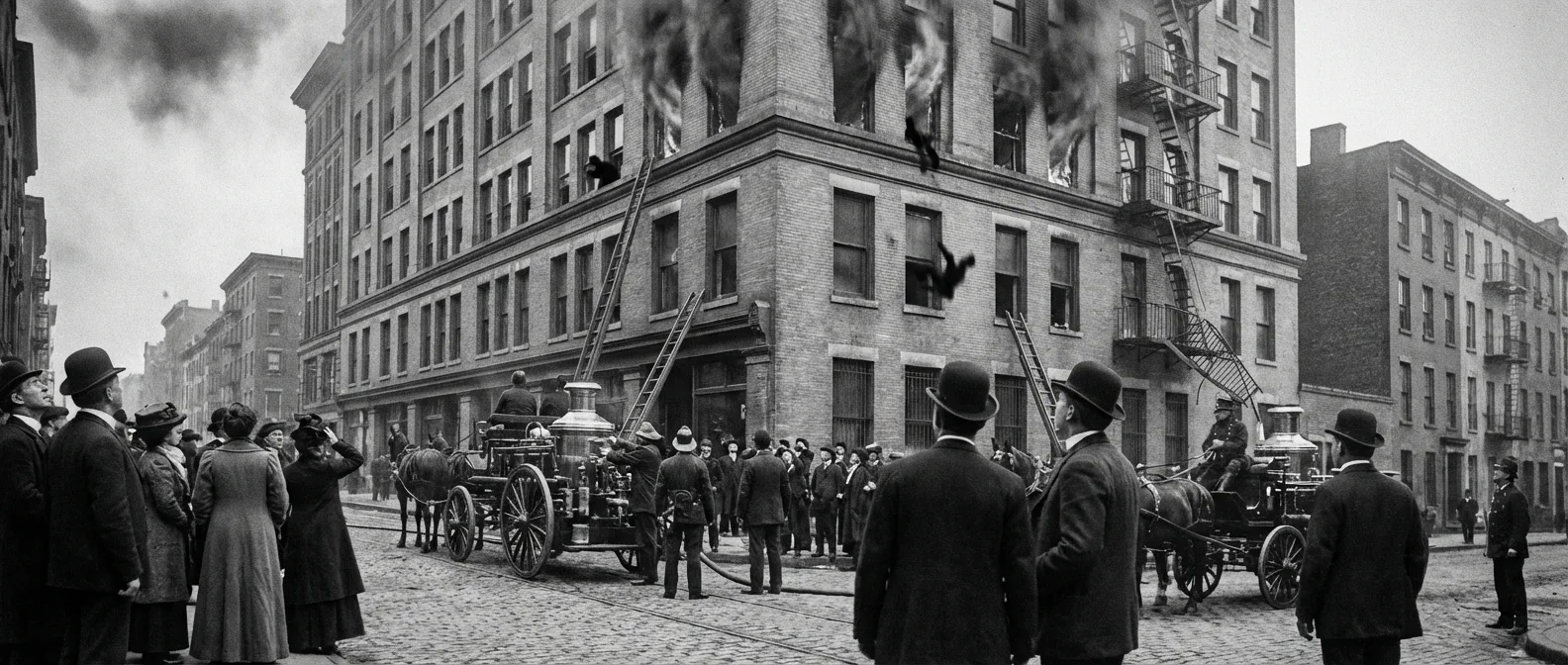
The Triangle Fire: The Tragedy That Changed Labor Rights
A True Story
📖 Read more: Bhopal Tragedy: The Worst Industrial Disaster
The sweat industry
In the early 20th century, New York's garment industry relied on thousands of immigrant women — mainly Italian and Jewish from Eastern Europe. They worked 52 hours a week: nine hours a day on weekdays, seven on Saturdays. Pay: $7 to $12 per week. The owners preferred hiring immigrant women — they worked for less and were less likely to unionize.
The factories — known as “sweatshops” — were death traps. Overcrowded, unventilated, with no fire extinguishers, filled with fabric scraps, machine oils, and paper patterns. The doors were locked — officially to prevent theft — but also to keep union organizers out. Owners searched workers' bags at the exit.
The Triangle Shirtwaist Company occupied floors 8, 9, and 10 of the ten-story Asch Building, near Washington Square in Greenwich Village. It employed roughly 500 workers. The owners, Max Blanck and Isaac Harris, already had four suspicious fire insurance claims on their record. Smoking was banned, but cutters snuck cigarettes, exhaling through their lapels to avoid detection. No fire drill had ever been conducted in the building. There were no automatic sprinklers, no audible alarm, no water buckets on the upper floors. The floor was soaked in machine oil and littered with paper patterns — perfect fuel.
The "Uprising of the 20,000″
In November 1909, 20,000 garment workers in New York went on strike — the largest women's strike in U.S. history at that time. Clara Lemlich, a 23-year-old immigrant from Ukraine, stood up at a mass meeting in Cooper Union and called for a general strike. The hall erupted.
Triangle Shirtwaist was a key target. Blanck and Harris refused every concession. They hired strikebreakers. They paid police to beat the picketers. The strike lasted 11 weeks but ended without meaningful changes for Triangle's workers.
I would be a traitor to these poor burned bodies if I came here to talk good fellowship. We have tried you good people of the public and we have found you wanting.
The fire breaks out
Saturday afternoon, March 25. The workers were getting ready to leave. Owners Blanck and Harris were on the 10th floor — along with their children, whom they had invited to the factory that afternoon. Around 4:40pm, a fire flared up at the northeast corner of the 8th floor — likely from a match or cigarette dropped into a scrap bin containing two months' worth of fabric cuttings. Hundreds of pounds of scraps, hanging fabrics all around — only the steel trim wasn't highly flammable.
A bookkeeper on the 8th floor called the 10th by telephone — where the offices were. The owners climbed to the roof and were rescued. There was no audible alarm. There was no way to contact the 9th floor. Survivor Yetta Lubitz would later testify: “The first warning on the 9th floor arrived at the same time as the fire itself.”
📖 Read more: The Boston Molasses Flood: Sweet Death
On the 9th floor, 300 workers were trapped. The door to the Washington Place stairway was locked — it was locked every day so management could check workers' bags at the exit. The foreman who held the key had already escaped by another route.
18 minutes of terror
Within three minutes, the Greene Street stairway was unusable in both directions. Dozens of workers crowded onto the single exterior fire escape — a flimsy, poorly anchored iron structure that the city had allowed instead of a required third staircase. It twisted and collapsed from the heat and overload. About 20 workers fell nearly 100 feet to the concrete pavement below.
Elevator operators Joseph Zito and Gaspar Mortillaro made three trips up to the 9th floor, saving dozens. Mortillaro was forced to stop when the elevator rails buckled from the heat. Some workers pried the elevator doors open and jumped into the empty shaft, trying to grab the cables. The weight and impact warped the elevator car, making further rescue impossible.
The fire department arrived quickly — but their horse-drawn ladders reached only the 7th floor. Life nets were torn by the impact of bodies falling from 100 feet. 62 workers jumped or fell from the windows. Some held each other in embrace. A man was seen kissing a young woman at a window before both jumped together. Eyewitness Louis Waldman described the scene: "Girl after girl appeared at the reddened windows, paused for a terrified moment, and then leaped to the pavement below."
The bodies were taken to Charities Pier at 26th Street — known as “Misery Lane.” Thousands of residents waited in line, in the rain, to identify their loved ones. Some collapsed on the floor. The makeshift morgue was overwhelmed.
I learned a new sound that day, a sound more horrible than description can picture — the thud of a speeding living body on a stone sidewalk.
The trial and the acquittal
Blanck and Harris were charged with manslaughter. The trial began on December 4, 1911. Defense lawyer Max Steuer destroyed the credibility of key witness Kate Alterman by asking her to repeat her testimony multiple times — it came out identically each time. Steuer argued the witnesses had memorized their statements. The jury acquitted both men.
Two years later, civil lawsuits resulted in compensation of just $75 per victim. The insurance company paid Blanck and Harris $64,925 more than their reported losses — roughly $445 in profit per death. Three years after the fire, Blanck was arrested again — this time for locking doors at his new factory. The fine: $20. The minimum possible.
The laws that changed everything
The public outrage was unprecedented. New York State created the Factory Investigating Commission, chaired by Robert F. Wagner and co-chaired by Al Smith — two politicians who would later play central roles in labor rights. The Commission interviewed 222 witnesses, compiled 3,500 pages of testimony, and sent field agents to inspect hundreds of factories. Fire Chief John Kenlon reported that over 200 factories in New York had conditions identical to Triangle's.
📖 Read more: The Explosion That Leveled a City Without Any Bombs
By 1913, 60 of the 64 new laws recommended by the Commission had been enacted: mandatory fire extinguishers, automatic sprinkler systems, safety doors opening outward, maximum workers per floor, mandatory fire drills, prohibition on locked exits, and improved eating and toilet facilities for workers.
Frances Perkins — a social worker who witnessed the fire with her own eyes — later became the first woman cabinet member in the U.S. (Secretary of Labor under Roosevelt). She later said the day of the fire was “the day the New Deal was born.” In October 1911, the American Society of Safety Professionals was founded — the first national organization for worker safety.
The memory that won't fade
The last living survivor, Rose Freedman, died on February 15, 2001, at the age of 107. She had been two days short of her 18th birthday at the time of the fire — she survived by following the executives and being rescued from the roof. She remained a lifelong supporter of unions.
Since 2004, every year on March 25, volunteers write the names of the victims in chalk outside their former homes in New York — 146 names, 146 ages. On October 11, 2023, a permanent memorial was unveiled at the building — a steel ribbon rising to the 9th floor, with the names and ages of all 146 victims formed as holes in the steel. The names are written in English, Italian, and Yiddish — the languages the victims spoke.
The legacy doesn't stop in New York. In April 2013, the Rana Plaza collapse in Bangladesh killed 1,134 garment workers — under conditions almost identical to those of 1911. More than a century after the Triangle fire, locked doors were still killing garment workers.
The names we must not forget
The youngest was Kate Leone, 14. The oldest was Providenza Panno, 43. Most were 16 to 23 — girls who had crossed an ocean for a better tomorrow. Some didn't even speak English. Six victims remained unidentified until 2011, when historian Michael Hirsch was able to trace their names after four years of research.
The Triangle fire lasted 18 minutes. But the laws it gave birth to protect millions of workers to this day. 146 lives were lost behind locked doors in a building near Washington Square. From their ashes, the labor rights the modern world takes for granted were born. Every fire door that opens outward, every sprinkler system in an office building, every fire escape built to hold actual weight — exists because of those 18 minutes.