The Wrong Button That Nearly Started a Nuclear War
The true story of the man who refused to press the button — and saved the world without anyone ever knowing
📖 Read more: The Astronaut Who Was Stranded in Space
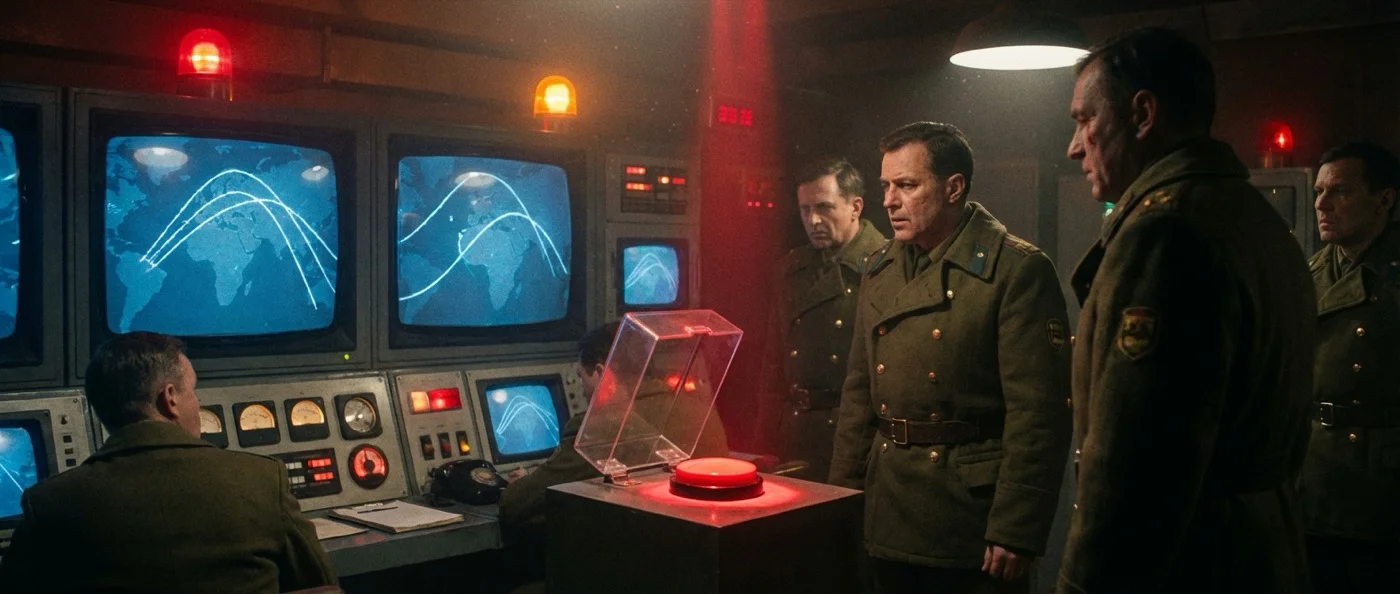
Shortly after midnight on September 26, 1983, in an underground bunker built beneath Russian soil, a forty-seven-year-old officer stares at the screens before him. There is nothing unusual. The same green lines flicker across the monitors, the same hum of electronic equipment fills the air, the same cold fluorescent glow illuminates faces worn by the night shift. It is a night like any other at Serpukhov-15, the most classified military command center of the Soviet Union — the place where satellites orbiting hundreds of kilometers above the Earth transmit their signals, ceaselessly reporting whether somewhere, beyond the Atlantic, a missile has lifted off from the ground.
Lieutenant Colonel Stanislav Yevgrafovich Petrov has no idea that within the next few minutes he will be called upon to make a decision that will determine the fate of all humanity. He does not know that in less than an hour, he will stand between the world as we know it and total nuclear annihilation. He does not suspect that history, on this night, will literally hang on a nod of his head.
Because in a few minutes, the siren will scream.
And Petrov will have to decide: do I press the button, or not?
This is the story of that night. A night when the world did not know it stood on the edge of oblivion — and of a man who held it back, without anyone ever thanking him.
To fully understand what happened that night at Serpukhov-15, one must first grasp the world in which Stanislav Petrov operated. It was a world living under the shadow of nuclear holocaust — and 1983 was no ordinary year in the Cold War. It was, according to many historians, the most dangerous year since the Cuban Missile Crisis of 1962.
In Washington, Ronald Reagan governed with rhetoric that made the Soviets shudder. He had called the Soviet Union an “evil empire” in a speech in March 1983, and just weeks later announced the Strategic Defense Initiative — the notorious “Star Wars” program that promised to create an invisible shield against nuclear missiles. For Moscow, this was not merely a policy shift. It was a signal that America was preparing for a nuclear first strike.
Yuri Andropov, the Soviet leader, was a deeply suspicious man. A former head of the KGB, he saw the world through the lens of espionage and paranoia. Under his orders, the KGB and the military intelligence service GRU had launched Operation RYaN in 1981 — the largest peacetime intelligence-gathering operation in Soviet history. RYaN was an acronym for “Raketno-Yadernoe Napadenie” — Nuclear Missile Attack. Agents in every corner of the Western world had been ordered to monitor any sign that America was preparing to strike.
And as if that weren't enough, just three weeks before Petrov's night, the Soviet Union had shot down a South Korean passenger aircraft, Korean Air Lines Flight 007, which had accidentally entered Soviet airspace over Sakhalin. All 269 people on board were killed, including a U.S. congressman. Washington's reaction was fierce. Reagan accused the Soviet Union of “mass murder.” Relations between the two superpowers had sunk to their lowest point in decades.
Meanwhile, the United States was conducting a series of psychological operations that infuriated Moscow. Bomber aircraft flew directly toward Soviet airspace, causing Russian radar to “light up” in alarm, and turned back just seconds before crossing the border. Fleets of fifty and sixty ships quietly approached the Kola Peninsula. Dr. William Schneider, then Under Secretary of State, would later recall: "It really got to them. They didn't know what it all meant. A squadron would fly straight at Soviet airspace, radars would light up, units would go on alert. And at the last moment the squadron would turn and head home."
Bruce Blair, a Cold War nuclear strategy expert, would describe it years later in chilling terms: "Relations had reached a point where the Soviet Union as a system — not just the Kremlin, not just Andropov, not just the KGB, but as a system — was primed to expect an attack and react with terrifying speed. It was on maximum alert. It was extremely nervous and prone to mistakes and accidents."
It was into precisely this world — a world consumed by paranoia, armed to the teeth, with its finger on the trigger — that Stanislav Petrov went on duty that evening. And this world was holding its breath, waiting for something no one dared to name.
Stanislav Yevgrafovich Petrov was born on September 7, 1939, in a small village near Vladivostok, at the far edge of Russia, where the land gazes out over the Pacific Ocean. His father was a fighter pilot in World War II — one of those men who knew all too well what war means, and even better what survival means. His mother was a nurse. Growing up in a home scarred by the shadow of war, the young Stanislav did not immediately follow in his father's footsteps. Instead of military academy, he studied engineering — a technician, a man of logic and numbers.
This choice would prove crucial. Because Petrov was not the typical Soviet officer trained to obey orders without thinking. He was an engineer, and engineers doubt. Engineers ask “why” before pressing a button. Engineers know that machines make mistakes.
He joined the Soviet Air Defense Forces in 1972 and gradually took on duties at the most sensitive point of the Soviet defense system: the satellite early-warning control center. This was a complex deep underground, near Moscow, known by the codename Serpukhov-15. It was there that data arrived from the satellites of the “Oko” system — a word meaning “eye” in Russian. Oko was the Soviet Union's eyes in the sky, designed to detect intercontinental ballistic missile launches from United States territory.
Petrov's job was, on the face of it, simple: to sit before the screens and monitor the satellite data. If a missile launch appeared, he was to immediately notify his superiors. And his superiors would notify the military leadership. And the military leadership would inform the General Secretary. And the General Secretary would decide whether to press his own button — the one that would unleash hundreds of Soviet nuclear missiles against American cities.
The chain was clear, the procedure established, the reaction time minimal. According to Soviet military doctrine, the response to a nuclear attack was mandatory and immediate — “launch on warning,” the so-called launch-on-warning policy. There was no room for philosophy. If someone reported missiles, the response came within minutes. And the world would end before the night was over.
This is what Petrov knew. This is what he had been taught. But he had something else inside him — something they never taught at the Soviet military academy. He had the doubt of an engineer. And that doubt would prevent World War III.
It was shortly after midnight, Moscow time, on September 26, 1983. Petrov was at his station inside the underground bunker, surrounded by the machines that formed the brain of the Soviet nuclear defense system. The shift was routine. He had sat there dozens of times before. The same hum, the same cold atmosphere, the same monotony.
And suddenly, the world exploded.
The siren screamed inside the bunker with a blood-curdling sound. The main screen, the enormous screen everyone was watching, blazed red. And on it appeared the word no one ever wants to see in that position — the word “LAUNCH.” An intercontinental ballistic missile, according to the Oko satellites, had just been launched from United States territory, heading for the Soviet Union.
"The siren was screaming, but I just sat there for a few seconds, staring at the big red illuminated screen."
— Stanislav PetrovPetrov would remember that moment for the rest of his life. He later said he felt as if he were sitting on a hot frying pan. His mind froze. But it was no longer his problem alone — inside the bunker were twelve other people, their eyes fixed on him, waiting for the order. They stared at him in terror. Some were young soldiers who had never experienced anything so terrifying. They knew the procedure: the duty officer notifies the chain of command, the chain of command decides, the missiles are launched. No doubt, no hesitation.
But Petrov hesitated.
Something was wrong. An instinct, deep and inexplicable, told him this was not real. One missile? Just one? If the Americans decided to strike first, they would not send one missile. They would send hundreds. A first strike would be massive — designed to eliminate any capacity for retaliation. A single missile made no sense.
He picked up the phone — the line connecting him directly to the military leadership — and reported a false alarm. System malfunction, he said. Not a launch.
Minutes passed.
And then the siren screamed again. At the same moment, the screen displayed a second launch. Petrov felt his stomach churn. Two missiles now. But still — two were not enough. The logic still held. A country intent on destroying another does not send two missiles.
A third launch. Fourth. Fifth.
Within minutes, the Oko satellites reported five American intercontinental ballistic missiles on course for the Soviet Union. The main screen now read “LAUNCH” with double confirmation — the highest reliability level the system could provide. The word in Russian was unmistakable: “ПУСК” — launch.
And Petrov did not press the button.
"I was terrified," he would say years later. “But something inside me could not believe it was real.”
The minutes that followed were the longest in Stanislav Petrov's life — and perhaps in the history of humanity. Five missiles on the screen. The siren wailing without pause. Twelve pairs of eyes fixed on him. And a telephone in his hand, connecting him to people capable of unleashing Armageddon.
Let us take a moment to analyze exactly what went through this man's mind during those minutes — because the decision he made was not the result of courage or heroism. It was the result of logic. A cold, mechanical logic that he applied while the entire system around him screamed at him to react.
First, the number. Five missiles made no sense as a nuclear first strike. American nuclear strategy, as Petrov and every Soviet officer knew it, was based on massive retaliation. A first strike would involve hundreds — perhaps thousands — of nuclear warheads simultaneously, designed to eliminate Soviet missile silos, command centers, air bases, and submarines. Five missiles would accomplish nothing except triggering a counterattack. No rational strategist would target a superpower with five missiles.
Second, the system. Oko was new. It had been put into operation recently, and Petrov, as an engineer, knew its weaknesses better than most. He knew that every new system suffers from teething problems, that software code can produce false reports, that the satellites were not infallible. One thing that concerned him was that the report had passed “far too quickly” through the system's approximately thirty layers of verification. A genuine launch would have taken more time to confirm at each level.
Third, the ground radar. Soviet ground radar stations, which scanned the horizon for incoming missiles, were detecting nothing. Of course, ground radar could not see beyond the horizon — a missile would only become visible to them in the final minutes before impact. But as time passed and the radar still showed nothing, Petrov's conviction grew stronger: there was nothing up there.
Five minutes passed. Ten. Fifteen. Every second was agony. If the missiles were real, they would soon enter the range of ground radar. If they were not, the intensity of his inaction would prove either salvational — or fatal.
"I felt like I was sitting on a hot frying pan. I didn't know whether the minutes would end with relief or with a flash above Moscow."
— Stanislav PetrovTwenty-three minutes. That is how long it took from the moment the siren screamed until Petrov knew with certainty he had been right. Twenty-three minutes during which no missile arrived, no radar detected anything, no explosion lit up the sky. The false alarm was confirmed. The data had been fake. The world kept turning.
Later, an investigation would reveal exactly what had gone wrong. The false alarm was caused by a rare alignment of sunlight on high-altitude clouds, combined with the Molniya orbits of the Soviet satellites. The sunlight, reflected at a very specific angle off the clouds, created a thermal signature that the sensors interpreted as a missile launch. It was, in a sense, a cosmic accident — nature playing a malicious trick on a system designed to protect millions of lives.
But that night, Petrov knew none of this. He made his decision based on three things: logic, experience, and an instinct that refused to believe the world would end on that dark, cold, mundane night in the depths of a Soviet bunker.
To fully appreciate what Petrov prevented that night, it is worth examining what would have happened if he had made the “correct” decision — if he had followed protocol, if he had reported the missiles as real, if the chain of retaliation had been set in motion.
📖 Read more: The Lykov Family: Hidden in Siberia for 40 Years
Soviet doctrine was clear: “launch on warning.” This meant they would not wait to see if the missiles would actually strike. From the moment a launch was confirmed, the Soviet Union would immediately launch its own missiles — before the incoming missiles could destroy the launch silos. The goal was mutually assured destruction: if we die, you die too.
Had Petrov reported the launches as real, his report would have reached General Yuri Votintsev, then commander of the Missile Defense Units of the Air Defense Forces, within seconds. From there, the information would have climbed to the Politburo, the General Staff, to Andropov himself — a dying leader, bedridden in a hospital, with no personal experience of the Western world, paranoid that America was planning a nuclear attack.
Oleg Kalugin, former head of the KGB's foreign counterintelligence, who knew Andropov well, explained it later: "The danger lay in the fact that the Soviet leadership was thinking: 'The Americans might strike, so let's strike first.'"
In such an atmosphere, a report of five incoming missiles could have been interpreted as the beginning of a massive strike. Andropov could have — no one can say for certain — ordered a retaliatory launch. Hundreds of Soviet missiles would have risen from their silos, heading for New York, Washington, Chicago, Los Angeles. The Americans, seeing the Soviet launches, would have launched everything in return. And in less than an hour, the planet would have been unrecognizable.
Estimates of the era spoke of hundreds of millions dead within the first twenty-four hours of a nuclear war. But the death would not have stopped there. Nuclear winter — the blanketing of the atmosphere with clouds of ash and dust that would block sunlight — would have killed agriculture, destroyed ecosystems, and driven billions of people to famine. All of modern civilization would have collapsed.
This is what Petrov held in his hands that night. This is what he decided not to let happen. And he decided it alone, in an underground bunker, without a single advisor, without any certainty, with the siren screaming in his ears and twelve pairs of eyes staring at him, full of fear.
One would expect that the man who prevented nuclear war would be treated as a hero. That he would be decorated with medals, that his story would be written in school textbooks, that the country's leader himself would welcome him. None of that happened. Instead, the Soviet Union reacted the way only a bureaucratic system that feels shame can react: it covered its tracks.
Initially, Petrov was praised. General Yuri Votintsev, the first to learn of the incident, acknowledged Petrov's “correct actions” and promised him a commendation. But very quickly, the atmosphere changed. Because if Petrov was right that the alarm was false, it meant the Oko system — a system that had cost billions of rubles and had been designed by powerful Soviet scientists and generals — had failed. And if Petrov was commended, then those scientists and generals would have to be punished.
That was not acceptable.
Instead of a medal, Petrov received a reprimand — for “incomplete maintenance of the military logbook.” He had not properly recorded the events in the official activity log, they told him. A routine bureaucratic violation, used as a pretext. Petrov understood immediately: they were not punishing him, but making sure no one would honor him. Silence was the only acceptable outcome.
"If they had commended me, they would have had to admit the system had failed. And that would have meant that some powerful people would be punished. They preferred to bury it."
— Stanislav PetrovHe was transferred to a less sensitive position. He retired early — although he always emphasized that he was not “expelled,” as some Western sources claimed. He simply realized that his career had effectively ended. A nervous breakdown followed. The man who had held the fate of humanity in his hands found himself alone, forgotten, psychologically broken, in a small apartment in a Russian city.
And the world learned nothing. For fifteen years, the story of the false alarm at Serpukhov-15 remained buried in Soviet archives, hidden behind layers of secrecy and bureaucratic indifference. Petrov lived as a retired military officer with nothing remarkable about him, and no one in his apartment building suspected that their neighbor had once prevented World War III.
In 1998, a full fifteen years after the night of the false alarm, General Yuri Votintsev — the same officer who had first received Petrov's report — decided to speak. In an interview with a Russian publication, he publicly revealed for the first time what had happened that night at Serpukhov-15. The story traveled fast. Western journalists discovered it, and soon the account spread to newspapers and television networks around the world.
Petrov, now nearly sixty, suddenly found himself face to face with journalists, cameras, and questions. They called him “the man who saved the world” — a title he always met with awkwardness. “I was just doing my job,” he would repeat. “I was lucky it was me on shift that night.”
That phrase, which sounds almost humble to the point of exaggeration, hides a deep truth. Petrov knew that if a typical military officer had been in his place that night — someone trained to carry out orders without doubt, to trust the machines, to follow procedure — things could have turned out very differently. “They were lucky it was me there that night,” he once remarked, without a trace of arrogance — simply acknowledging a statistical reality. The engineer doubted. The soldier would have obeyed.
The revelation set off a wave of recognition that Petrov had never sought. At the dawn of the new millennium, the world discovered him. He looked back at it with that simple, almost bewildered gaze of a man who never understood why they were asking him to attend ceremonies and accept awards.
The awards came late, but they came. In 2004, the Association of World Citizens honored him with the World Citizen Award in a special ceremony at the United Nations in New York. Petrov went, accepted the award, shook hands, smiled awkwardly. And returned home. In 2006, he traveled to the United States for a second time, where he was received like a celebrity in a country that he himself had once refused to bomb.
In 2013, the city of Dresden — a city that knew all too well what destruction by bombing meant — awarded him the Dresden Peace Prize. Petrov, now elderly and visibly exhausted, accepted the award with the same quiet dignity. He didn't utter grand phrases, didn't call himself a hero. “I know the title doesn't belong to me,” his body language seemed to say. “I know I was simply in the right place at the right time.”
But perhaps that is exactly what heroism is: being in the right place, at the right time, and doing the right thing — even if no one sees you, even if no one will ever thank you, even if your reward is a reprimand for poor record-keeping.
What makes Petrov's story even more chilling is that just a few weeks later, in November 1983, the world would come close to nuclear war again. Exercise Able Archer 83, an annual NATO military exercise, that year included elements so realistic — new communication protocols, participation of heads of state, simulation of Pershing II missile launches — that Moscow believed a real attack was being concealed. The Soviet 4th Air Army loaded nuclear warheads onto bombers. ICBM silos were placed on thirty-minute standby.
And there, it was again the composure of one person — Lieutenant General Leonard Perroots, chief of staff of the U.S. Air Forces in Europe — that prevented the Western side from reciprocating the Soviet mobilization. “Let's wait for the exercise to end,” he suggested to his superior, as if speaking about something routine. Later, a Presidential Intelligence Board analysis would characterize this stance as “fortuitous” — noting that “he acted correctly from instinct, not from informed guidance.” If he had reacted to what he was seeing, if he had placed NATO forces on alert, the mutual escalation could have led to the unthinkable.
1983 was a year in which the world came to the brink twice within six weeks. The first time was Petrov. The second, Perroots. Both times, what saved the planet was not technology, nor strategy, nor political wisdom. It was human judgment — the ability of one person to think, to doubt, and to refuse to blindly follow a system.
In his final years, Stanislav Petrov lived in Fryazino, a small city on the outskirts of Moscow, in an apartment no different from the millions of Soviet-era apartments across Russia. His wife had died. His children were living their own lives. Petrov was an elderly retiree, nearly invisible in the world he had once saved.
Occasionally, a journalist or a television crew would appear at his door. He would welcome them with courtesy, speak calmly, recount the story without drama, as if describing an ordinary day at work. He never asked for anything. He never complained about his treatment. He never blamed his superiors. He simply narrated the facts, with the steady voice of an engineer describing how a machine had functioned.
"I am not a hero," he said nearly every time. "I was just in the right place at the right time. Any rational person would have done the same." But history proves this is not true. Not just anyone would have done the same. Soviet military training did not encourage hesitation or questioning. The correct response, according to protocol, was to report the alarm as real. The “right” thing, by the rules, would have been wrong. And the “wrong” thing Petrov did — the disobedience, the hesitation, the doubt — was what saved the world.
Documentary filmmaker Peter Anthony traveled to Fryazino to find him in the 2010s. He found him in a nearly empty apartment, with minimal furniture, no luxuries. Petrov welcomed him with tea, they sat, they talked. Anthony would later describe an unforgettable scene: the elderly Russian, sitting in an old armchair, looks at his hands and says quietly: “They were lucky it was me on shift that night.”
A phrase without arrogance, without boasting. A simple acknowledgment of chance — that an entire planet was saved or not saved depending on who happened to be on duty one night in September.
Stanislav Petrov died on May 19, 2017, at the age of seventy-seven, from pneumonia. His death was not reported immediately — in fact, the world didn't learn of it until September of that year, four months later, when a German activist tried to contact him and discovered he had passed away. Even in death, Petrov went unnoticed.
One year later, in 2018, he was posthumously awarded the Future of Life Award — an award honoring individuals who, through their actions, radically reduced the existential risk to all of humanity. His son accepted the award on his behalf. In Warsaw, a memorial stone was placed for Petrov, recognizing his courage during the 1983 incident.
Petrov's story is not merely the story of a brave individual. It is the story of a system — a system designed to react automatically, without thought, without doubt, without human judgment. A system in which the human element is considered a weakness, not a strength. And yet, it was precisely this human element — the ability to question, to think, to say “no” — that proved to be salvation.
Today, in an era of artificial intelligence, automated decision-making systems, and algorithms that act in fractions of a second, Petrov's story takes on new weight. What will happen if the next critical decision is no longer in the hands of a person who can doubt? What will happen if the “duty officer” is an algorithm, designed to react according to statistical probabilities, without instinct, without doubt, without that inexplicable “something is wrong” that Petrov felt that night?
Doubt, that thing automated systems can never feel, was what kept the world alive on a frozen night in 1983. This, perhaps, is the most important legacy of Stanislav Petrov.
Petrov's story doesn't end with his death. On the contrary, the years that followed revealed how close the world had truly come to destruction — and how little we knew at that moment. In 2021, declassified documents revealed that during Exercise Able Archer 83, just weeks after Petrov's night, the Soviet Union had indeed loaded nuclear warheads onto bombers — and that the world had come even closer to war than historians had believed.
Reagan himself, after Able Archer, wrote in his memoirs a thought that haunted him: "Three years had taught me something astonishing about the Russians: many at the top of the Soviet hierarchy genuinely feared America and Americans. Perhaps it shouldn't have seemed astonishing to me, but it did." This realization — that the adversary was not a cold calculator but a terrified system — led to a gradual policy shift. Reagan, from a hardline hawk, transformed into a negotiator. He met Gorbachev in Geneva in 1985, and that relationship led to the Intermediate-Range Nuclear Forces Treaty of 1987.
No one can say with certainty what would have happened if Petrov hadn't been there that night. History has no parallel universes for us to examine. But we can say that his decision balanced on a razor's edge — a moment in which the fate of the entire planet depended on the logic of a single human being.
And there is something even deeper in this story. Petrov didn't defeat an enemy. He didn't win a battle. He didn't capture territory. What he did was refuse. He refused to react. He refused to follow. He refused to push the button. His heroism was a heroism of inaction — a deliberate, conscious, terrifying inaction.
In a world that celebrates action, power, speed, and dynamic response, Petrov's story reminds us that sometimes, the most heroic act is to do nothing. To stop. To think. To doubt. To let time reveal whether what you see before you is real or false.
There are sounds that mark history. The thunder of cannons at Waterloo. The whistle in the trenches of the Somme. The echo of the atomic bomb at Hiroshima. But there is also a sound that no one ever heard — the sound of a button that was never pressed. The sound of a nuclear war that never happened. The sound of hundreds of millions of people who continued to wake up every morning without knowing that someone, one night, held their world back from the abyss.
That sound — the sound of silence, of inaction, of doubt — belongs to Stanislav Petrov. No monument can honor him enough. No award can balance what he did. Because he didn't save a city, or a country, or a single department. He saved everything. Every morning we wake up, every child born, every book written, every song heard — all of these owe a little to that night, to that bunker, to that engineer who refused to believe a screen.
The world is not safe. Nuclear warheads still exist — thousands of them, in silos, in submarines, in bombers. Early warning systems continue to scan the sky. And every night, somewhere in the world, a duty officer sits before screens, waiting for a flash he hopes will never come.
Let us hope that, when needed, he too will do what Petrov did: stop, think, and refuse to push the button.
Stanislav Yevgrafovich Petrov was born on September 7, 1939, near Vladivostok, and died on May 19, 2017, in Fryazino, near Moscow. Among the awards he received are the World Citizen Award (2004), the Dresden Peace Prize (2013), and the posthumous Future of Life Award (2018). His story became publicly known only in 1998, fifteen years after the incident. September 26, the day of the false alarm, is honored internationally today as the International Day for the Total Elimination of Nuclear Weapons.