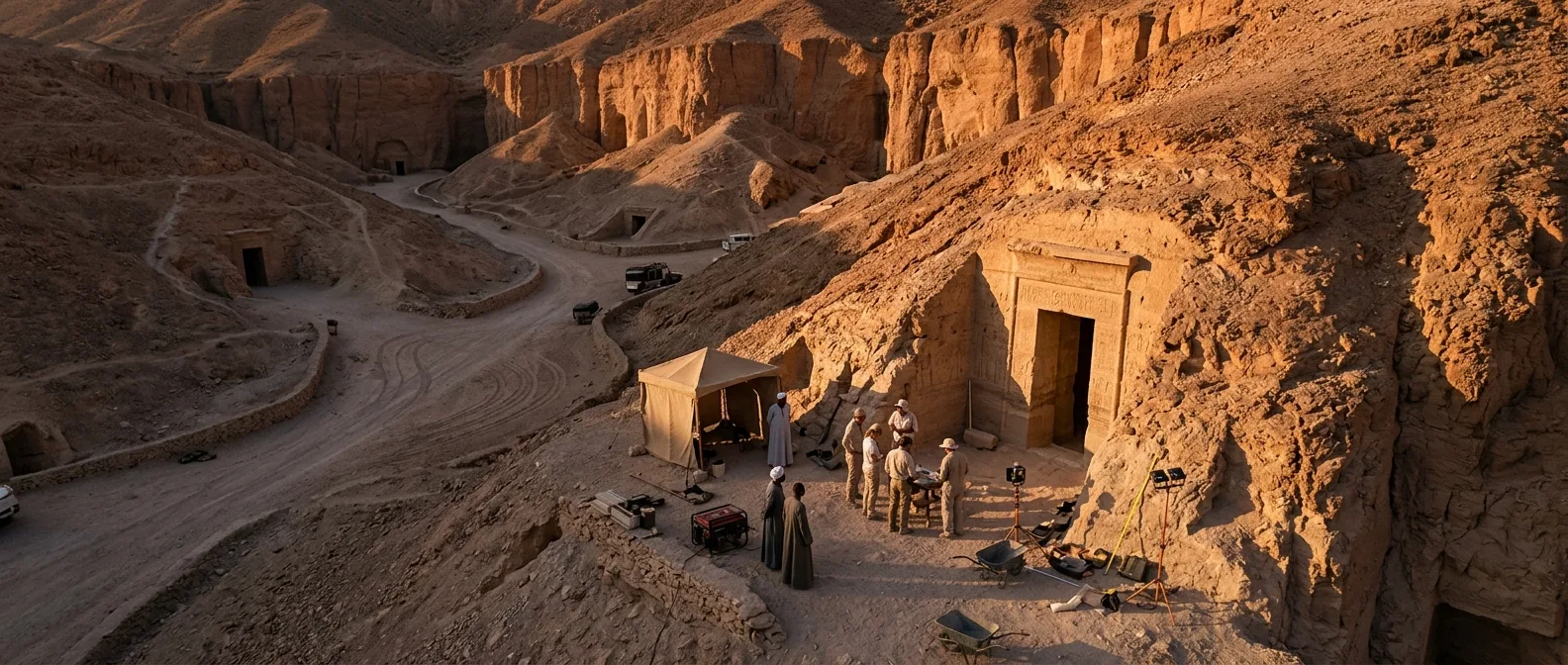
February 2025 — Piers Litherland steps into the tomb for the first time. Above his head, yellow stars dance across a blue ceiling. Only pharaohs got this treatment. "That was the moment we knew we'd found a pharaoh," the British archaeologist tells the BBC. Outside the tomb entrance, his wife waits. "When I came out, I was crying like a child."
After more than a century of searching in the Valley of the Kings, archaeologists have uncovered the last "lost" royal tomb of Egypt's 18th Dynasty. The burial chamber of Pharaoh Thutmose II, who ruled from 1493 to 1479 BC, was revealed by a British-Egyptian team in the Western Valleys of the Theban Necropolis near Luxor. It's the first such discovery since Tutankhamun's tomb in 1922.
🏺 The Mystery Location That Changed Everything
For decades, archaeologists searched in the wrong place. They were certain that 18th Dynasty pharaoh tombs lay in the famous Valley of the Kings, about two kilometers east. Wrong. Wadi Gabbanat el-Qurud — a remote valley associated with queens and court women — held the key.
Dr. Piers Litherland's team from Cambridge University's New Kingdom Research Foundation, working with Egypt's Ministry of Tourism and Antiquities, began excavations in 2013. In October 2022, they spotted the entrance to tomb C4. Initially, they thought it belonged to a queen.
The Ceiling That Revealed the Secret
The tomb didn't look royal at first. Location, size, even access suggested a high-ranking court burial. But when the team reached the burial chamber through a narrow corridor with just 40 centimeters of clearance, they saw something that changed everything.
"The ceiling was painted blue with yellow stars. This color scheme is found only in royal tombs."
— Dr. Piers Litherland, head of the British mission
💧 The Waterfall That Destroyed History
The biggest surprise waited inside the tomb. It was completely empty. Not from ancient looters — that would leave traces. The tomb had been emptied systematically and deliberately. The cause? Water.
The ancient Egyptians made a critical mistake. They built Thutmose II's tomb directly beneath a waterfall. Years after burial, floods swamped the chambers. Priests were forced to relocate everything — including the pharaoh's mummy — to safer ground.
The Fragments That Saved History
Though the tomb was empty, something remained behind. Tons of limestone rubble covered the floor — debris from roof collapses caused by flooding. Within these ruins, the team found fragments of alabaster vessels.
Carved hieroglyphs on the fragments bore the name "Thutmose II" and his wife "Hatshepsut." This was the first time objects directly connected to the pharaoh's burial had been found. "Luckily they broke a few things during the move," Litherland jokes. "Otherwise we'd never have known whose tomb it was."
The Book of Amduat
Among the blue plaster fragments were sections from the "Book of Amduat" — a sacred text describing the sun god's journey through the underworld. This text was exclusive to pharaohs. Only royal tombs contain such references.
👑 The Unknown Pharaoh in Hatshepsut's Shadow
Thutmose II was son of Thutmose I by a secondary wife, Mutnofret. He married his half-sister Hatshepsut — a practice that ensured royal bloodline legitimacy. But his reign lasted just 14 years.
After his death, Hatshepsut served as regent to the underage heir Thutmose III. Gradually, she seized full power and declared herself pharaoh. One of the few women to rule Egypt with the title of "king." Here's where things get weird.
The Attempt to Erase Him from History
Hatshepsut didn't stop at seizing power. She deliberately "erased" her husband's memory from monuments. She replaced his name with her own. The strategy worked so well that for centuries, historians didn't even know when or how Thutmose II died.
In the 19th century, his mummy was discovered in the Royal Cache (TT320) near Deir el-Bahari — alongside other pharaohs from the 18th and 19th Dynasties who had been moved there for protection from looters. The mummy existed. The tomb didn't. Until now.
🔍 The Technology That Revealed the Past
The 2025 discovery wasn't accidental. It combined traditional excavation techniques with modern technology. Drones for aerial photography of the area, ground-penetrating radar scans, 3D modeling of the chambers.
Most crucial? The team had already excavated 54 tombs on the western side of the Theban mountain. They had identified more than 30 royal wives and court women. This experience gave them the knowledge to recognize signs of a royal tomb when they saw them.
New Mapping
The discovery proves that early 18th Dynasty pharaohs were buried in a different area than experts believed.
Architectural Template
The tomb's simple design — corridor and burial chamber 1.4 meters higher — became the model for later pharaohs.
The Second Mystery
But where were the original tomb's contents moved? Litherland says his team has an idea about the second tomb's location. And it might be intact. With treasures.
"We hope to find the authentic burial objects of Thutmose II there," he explains. "Something that hasn't been found in any museum worldwide until now."
⚡ Why This Discovery Changes Everything
It's not just the first royal tomb since Tutankhamun. The discovery reshapes our understanding of ancient Thebes' geography. The priests' emergency relocation reveals how the 18th Dynasty protected royal burials from natural disasters. And it reveals how natural disasters played a role in shaping ancient Egyptian history.
Dr. Mohamed Ismail Khaled, Secretary-General of the Supreme Council of Antiquities, states: "This discovery is one of the most significant archaeological finds of recent years." We can't argue with that.
"It's an exceptional moment for Egyptology and our broader understanding of shared human history."
— Sherif Fathy, Egypt's Minister of Tourism and Antiquities
The Continuing Puzzle
The discovery raises new questions. How exactly was the mummy and treasure transfer organized? How many people knew the second tomb's location? And if the second tomb is found intact, what will it tell us about 18th Dynasty rituals and beliefs?
The answers might lie just meters below — in the soil of a valley that for decades was considered secondary. The western valleys may hold more royal burials from the dynasty that produced Hatshepsut, Thutmose III, and Tutankhamun.