Titanic: What Really Happened That Night
On April 14, 1912, just before midnight, the largest ship ever built struck an iceberg in the North Atlantic.
📖 Read more: Molly Brown: The Unsinkable Woman of the Titanic
An “Unsinkable” Ship
The Titanic was built at the Harland and Wolff shipyard in Belfast for the White Star Line. She was the second of three Olympic-class ocean liners — alongside the Olympic and the Britannic. Construction began on March 31, 1909, and for three years more than 15,000 workers labored in shifts to complete the colossal vessel.
At 269 meters long and displacing 52,310 tons, the Titanic was the largest moving object ever made by human hands. Her construction was groundbreaking. She had a double bottom and 16 watertight compartments that could be sealed automatically. According to her engineers, the ship could stay afloat even if four of those compartments flooded. That calculation gave rise to the phrase that haunted everything that followed: “practically unsinkable.”
The ship's interior matched its ambition. First class featured carved oak staircases, a saltwater swimming pool, Turkish baths, a gymnasium, Ritz-style restaurants, and suites costing $4,350 — equivalent to more than $130,000 today. Among the passengers were John Jacob Astor IV, the wealthiest man aboard, Isidor and Ida Straus, owners of Macy's, and Benjamin Guggenheim.
Third class, however, was a different world. More than 700 immigrants — Irish, Scandinavian, Italian, Syrian — traveled in shared cabins deep within the ship, with minimal access to the upper decks. This architecture was no accident — and it would prove fatal.
The Maiden Voyage
On April 10, 1912, the Titanic set sail from Southampton, England. She called at Cherbourg, France, and Queenstown, Ireland, picking up passengers and mail. In total, 2,224 people were aboard — 1,317 passengers and 907 crew members.
Captain Edward John Smith, 62 years old, was on the final voyage of his career before retirement. He was the most experienced captain in the White Star Line fleet, beloved by passengers and respected by crew. But experience would not be enough for that night.
The first days were idyllic. The weather was fair, the sea calm, and passengers reveled in the luxury. In the first-class lounges, evenings were filled with champagne and live music. In the wireless room, the two operators — Jack Phillips and Harold Bride — were swamped with personal messages from wealthy passengers. That situation would prove fatal.
The Warnings That Were Ignored
On the day of the collision, April 14, at least six iceberg warnings had been received from nearby ships. The Caronia, the Baltic, the Amerika, the Californian — all reported that the area ahead was packed with ice. Some of those warnings never reached the bridge. Jack Phillips, exhausted and under pressure, was busy clearing a backlog of passenger telegrams for the Cape Race relay station in Newfoundland.
At 9:40 PM, Phillips received a message from the Mesaba: “Ice and icebergs in multiple locations.” That message was never delivered to Captain Smith. At 11:00 PM, the Californian — which was very close — transmitted: “We are stopped, surrounded by ice.” Phillips snapped back: “Shut up! Shut up! I am working Cape Race.” It was the last warning.
There was another problem, seemingly trivial but catastrophic: the binoculars. Second Officer David Blair had been replaced just before departure and took with him the key to the cabinet where the bridge binoculars were stored. The lookouts in the crow's nest — Frederick Fleet and Reginald Lee — scanned the darkness with the naked eye. No moon. No binoculars. No waves breaking at the base of the icebergs.
11:40 PM — Collision
At 11:40 PM, Frederick Fleet saw the shadow ahead. He struck the bell three times and telephoned the bridge: “Iceberg right ahead!” First Officer William Murdoch immediately ordered “hard a-starboard” and “full speed astern.” It was too late.
The Titanic did not hit the iceberg head-on — that might actually have saved her. Instead, the iceberg scraped along the starboard side below the waterline, opening gashes across a span of 90 meters. Five of the sixteen watertight compartments flooded almost instantly. Thomas Andrews, the ship's designer, who was traveling aboard, went below to assess the damage. His diagnosis was brief and merciless: the ship would sink in an hour and a half to two hours. There was no way to save her.
Most passengers did not immediately grasp the severity. The collision was nearly silent — many thought it was just a slight vibration. Some went out on deck, saw chunks of ice, and returned inside laughing. One passenger used ice from the deck for his whiskey.
Evacuation Into Chaos
At midnight, Captain Smith ordered the evacuation. But there was no plan. No general lifeboat drill had ever been held — the one scheduled for that morning had been canceled. Many crew members did not know how many people each lifeboat could hold.
The order was “women and children first.” But its implementation was chaotic. On the starboard side, First Officer Murdoch interpreted the rule as “women and children first, but men too if there is room.” On the port side, Second Officer Lightoller was strict: “women and children only” — and he turned men away even when the boat was half empty.
And half empty they were. Lifeboat No. 1 was lowered with just 12 people — though it held 40. No. 6 with 28 instead of 65. In total, the Titanic's 20 lifeboats could carry 1,178 people — enough for barely one-third of those aboard. But even that number was not reached: only 710 people were ultimately saved.
📖 Read more: The Book That Predicted the Titanic 14 Years Before
Third-class passengers were the biggest losers. Many found the gates to the upper decks locked — a practice enforced for immigration regulations that, on that night, meant death. Of the 709 women and children in first and second class, 97% survived. Of the women in third class, only 46%. Of the men in third class, just 16%.
The Band Plays On
Amid the chaos, the ship's orchestra — eight musicians led by Wallace Hartley — continued to play. At first they chose upbeat tunes to keep passengers calm. Later, according to testimony, they shifted to more melancholy pieces. There is debate over whether the final piece was the hymn “Nearer, My God, to Thee” or a waltz. What no one disputes: all eight musicians died that night. Not one entered a lifeboat.
Meanwhile, Thomas Andrews roamed the decks helping passengers put on life jackets. Benjamin Guggenheim, after helping his companion into a boat, returned to his cabin, dressed in evening attire, and declared: “We've dressed in our best and are prepared to go down like gentlemen.” Isidor Straus refused to board a lifeboat without his wife. Ida Straus followed him. They died together.
The Ship Breaks in Two
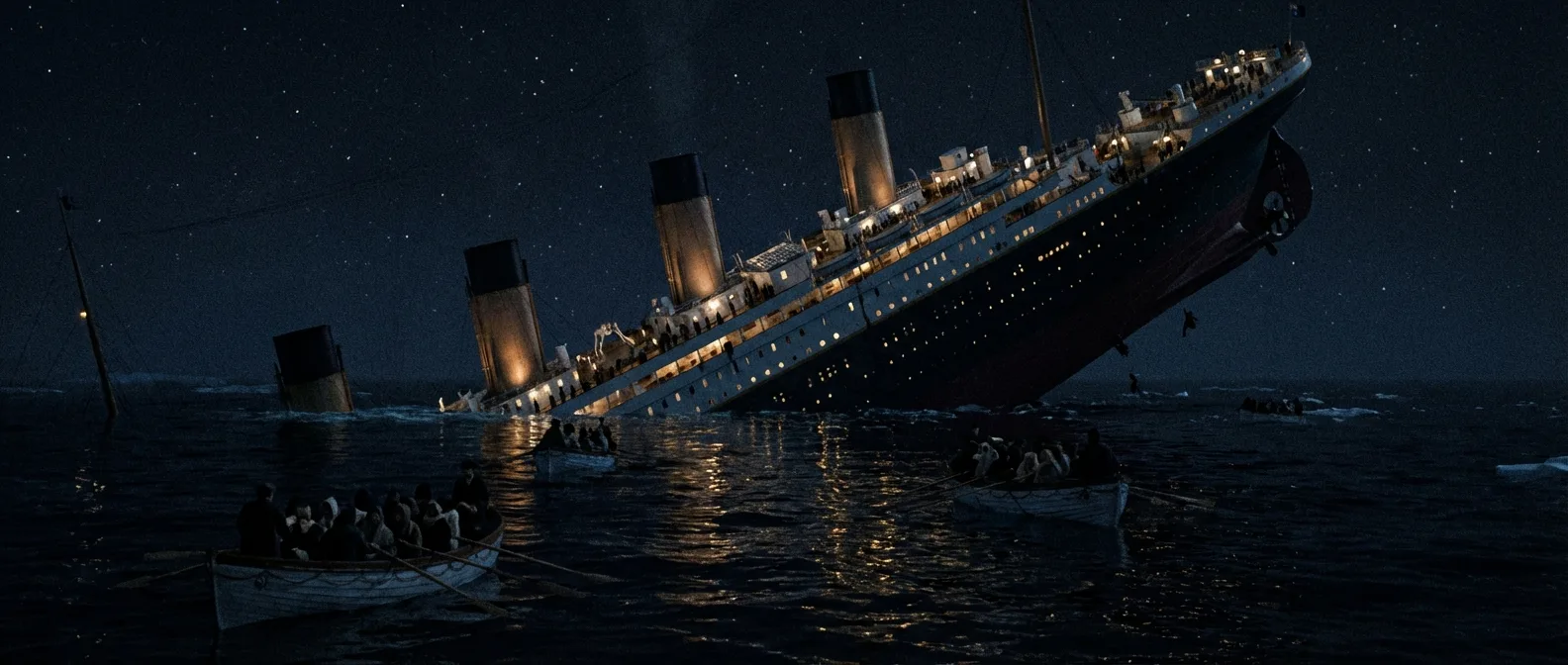
At 2:10 AM, the bow had sunk so deep that the stern rose nearly vertical — at a 45-degree angle above the sea. Hundreds of people clung to railings or slid down the deck. Then came a terrifying crack — the ship split in two between the third and fourth funnels.
The bow sank first. The stern floated for a few minutes, tilting vertical once more, before plunging beneath the surface at 2:20 AM exactly. The water temperature was just 2°C. In such conditions, the human body loses consciousness in 15 minutes and death follows within 30 to 40 minutes.
More than 1,500 people were in the freezing water. Many wore life jackets — but those offer no protection against hypothermia. The screams lasted about half an hour. Then, gradually, they stopped. Of all the lifeboats, only one — No. 14, under Fifth Officer Harold Lowe — went back to pick up survivors. He found four alive. The rest of the boats did not return, for fear that the panicked would capsize them.
The Rescue — and Those Who Never Came
At 12:25 AM, wireless operator Jack Phillips began transmitting distress signals — first CQD, then the newer SOS. Several ships received the call but were too far away. The Carpathia, under Captain Arthur Rostron, was 58 miles away. Rostron pushed to a record speed — 17.5 knots instead of the usual 14 — slaloming between icebergs in the dark.
The Carpathia arrived at 4:10 AM and began pulling survivors from the lifeboats. The last boat was collected at 8:30 AM. In total, 710 people were saved. 1,517 perished.
But there was a ship that never came. The Californian, under Captain Stanley Lord, was just 5 to 12 miles away — and had stopped because of ice. Her crew saw the Titanic's distress rockets, but Lord did not act. The ship's wireless operator had switched off his set and gone to sleep. Had the Californian responded, hundreds of lives could have been saved. That inaction remains one of the most controversial chapters in maritime history.
Captain Smith — The Final Moments
No one knows with certainty what Captain Edward Smith did in the last minutes. Testimonies conflict. Some saw him dive into the water holding a child and hand it to a lifeboat. Others saw him enter the bridge and close the door behind him. A third account places him in the wireless room, saying to Phillips and Bride: “Men, you have done your full duty. I can ask no more of you. Abandon your cabin.”
Captain Smith did not survive. His body was never recovered.
A Shipwreck That Changed the World
The Titanic was not merely a maritime tragedy. It was a turning point in history. In the wake of the disaster, the International Convention for the Safety of Life at Sea (SOLAS) was enacted in 1914, mandating enough lifeboats for every person aboard, round-the-clock wireless communication, and regular evacuation drills. The International Ice Patrol was established and continues to monitor icebergs in the North Atlantic to this day.
The discovery of the wreck on September 1, 1985, at a depth of 3,800 meters by Robert Ballard confirmed what many had suspected: the ship had broken in two. The bow lay 600 meters from the stern, resting upright in the mud. The stern was a mangled ruin.
Today, the Titanic is slowly being consumed by iron-eating bacteria. Experts estimate that by 2030 the structure will have collapsed entirely. The sea will reclaim what man once believed he could conquer.
EpilogueThe night of April 14, 1912, was not simply the night a ship sank. It was the night an entire illusion sank with it — the belief that technology could defeat nature, that wealth guaranteed safety, that humanity had conquered the sea. The Titanic proved that none of that was true. And 1,517 people paid for that lesson with their lives — in the freezing, dark waters of an ocean that never forgets.