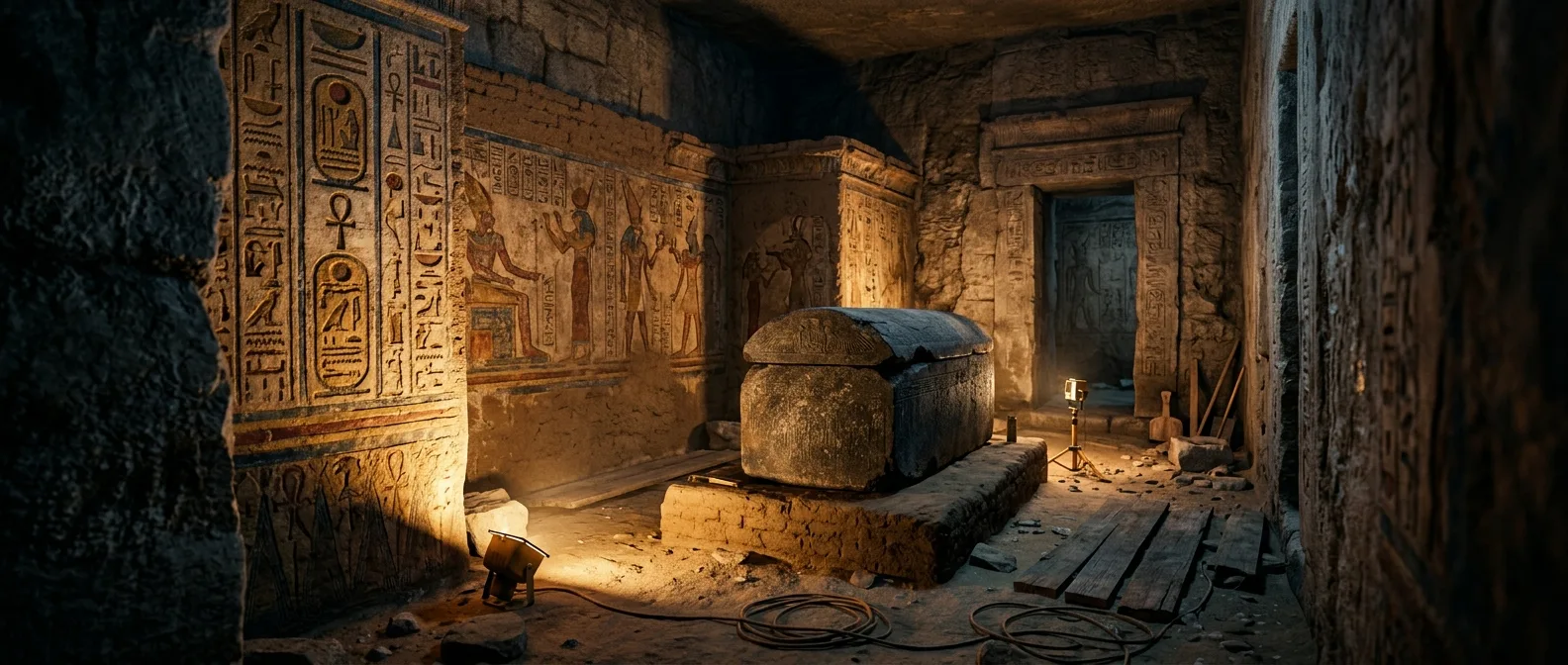
Twenty-three feet down. That's how deep archaeologists had to dig through Abydos sand before hitting the limestone burial chamber of a pharaoh whose name vanished 3,600 years ago. The tomb belongs to Egypt's mysterious Abydos Dynasty — a lost period that rewrites our understanding of ancient Egyptian power struggles. But here's the kicker: ancient tomb robbers did their job so well that we may never know who this king actually was.
📖 Read more: Thutmose II Tomb Found After 100-Year Hunt in Valley of Kings
🏛️ The Dynasty That Shouldn't Exist
The Abydos Dynasty was academic theory until 2014. Historians knew something weird happened during Egypt's Second Intermediate Period (1640-1540 BCE). The kingdom had fractured. Hyksos rulers controlled the north. Someone else held the south. Then Dr. Josef Wegner from Penn Museum found King Seneb-Kay's tomb in the same Mount Anubis necropolis. breakthrough. Suddenly the Abydos Dynasty became fact, not fiction. But that was just the opening act. This new pharaoh tomb dwarfs Seneb-Kay's burial. The scale difference suggests this unknown king ranked higher in the dynasty's power structure. Two candidates emerge from historical records: Kings Senaiib and Paentjeni, known from Abydos monuments but with missing tombs. Which one? Nobody knows yet.The newly discovered tomb is significantly larger than Seneb-Kay's burial — indicating this unknown pharaoh held greater authority within the Abydos Dynasty hierarchy.
The Identity Erased by Time
Here's where the story gets frustrating. Yellow-painted hieroglyphic bands once recorded the pharaoh's name across the tomb entrance. Ancient looters systematically destroyed every inscription. They stole the mummy, the sarcophagus, even the canopic jars. Professional work. "The king's name was originally recorded in painted scenes on plastered mud bricks that decorated the entrance to the limestone burial chamber," explains Dr. Wegner. Those paintings show Isis and Nephthys — goddesses linked to death rituals. But the hieroglyphs? Obliterated beyond repair. This wasn't random vandalism. Someone wanted this pharaoh forgotten. The question is why. Political enemies? Religious purges? Or just thorough thieves covering their tracks? We'll probably never know.📖 Read more: The Gardner Museum Art Heist: $500 Million Mystery
⚰️ Architecture That Impresses
Strip away the mystery and you're left with impressive engineering. The tomb burrows 23 feet underground, featuring a limestone burial chamber topped by mud-brick vaults that originally reached 16 feet high. Multiple rooms, decorated entrances, royal-grade construction throughout.23 feet deep (7 meters)
16 feet vault height (5 meters)
3,600 years old
Ancient Robbery, Professional Grade
The tomb robbery wasn't recent. Archaeologists estimate looters struck during the Roman period, possibly earlier. They weren't just grabbing gold and gems. These thieves harvested building materials — limestone, granite, quartzite — that had market value. This practice was common across Abydos. Many tombs suffered similar treatment over centuries. The result? Priceless historical information lost forever. But not everything vanished. Isis and Nephthys paintings survived on the entrance walls. These goddesses traditionally appear together in funeral contexts, symbolizing protection for the deceased's afterlife journey. Their presence confirms this tomb's royal nature, even without the pharaoh's name.📖 Read more: Chernobyl: The Night of the Worst Nuclear Disaster
🔍 What the Architecture Reveals
Despite the looting, the tomb structure tells stories. The architectural style connects to Seneb-Kay's burial but with crucial differences. Larger scale, more complexity, greater ambition. This points to higher status within the Abydos Dynasty hierarchy. The Isis and Nephthys depictions follow period funeral traditions. These goddesses frequently appear together in death rituals, representing afterlife protection. Their presence here confirms royal burial practices, even with the name destroyed.But what does this mean for understanding the period? The Second Intermediate Period was Egypt's dark age — political instability, economic upheaval, competing kingdoms fighting for control. Every new royal tomb adds puzzle pieces. This one's a big piece. The tomb's proximity to Neferhotep I's complex isn't coincidental. The Abydos Dynasty kings positioned themselves as legitimate successors to earlier pharaohs. Smart politics during unstable times."While the precise identity of the tomb's owner remains uncertain, ongoing analysis aims to establish a clearer chronological framework."
— Dr. Joseph Wegner, Expedition Leader
Parallel Discoveries
Meanwhile, in a nearby village, archaeologists uncovered a Roman-era pottery and glass workshop. They found kilns, storage areas, and 32 ostraca — pottery shards with Greek and Demotic inscriptions recording commercial transactions. This workshop later became a cemetery. Excavators discovered mud-brick tombs containing mummies and skeletons, including a child wearing a woven cap and a 30-year-old woman's skull. These finds paint a picture of continuous occupation. Abydos remained important long after the pharaohs disappeared. People lived, worked, and died here across millennia.📖 Read more: Deaf Beethoven: Masterpieces Without Sound
🏺 Significance for 2026 Archaeology
In today's archaeological landscape, discoveries like this carry double meaning. They add historical puzzle pieces while highlighting how many mysteries remain buried in Egyptian sand. Penn Museum plans continued excavations across 10,000 square meters around Mount Anubis. They're deploying cutting-edge technology: remote sensing, magnetometry, photogrammetry for 3D modeling.Remote Sensing
Satellite detection of buried structures
Magnetometry
Magnetic field mapping for artifact detection
Photogrammetry
3D modeling of tombs and findings
Questions That Remain
This discovery raises more questions than answers. How many other Abydos Dynasty kings remain buried in the area? What other secrets does the Second Intermediate Period hide? Most importantly: will archaeologists ever find an intact tomb that reveals this lost dynasty's full story? Dr. Wegner thinks it's possible. "The team plans to excavate deeper with hopes of discovering additional tombs — perhaps even one that remains intact." That hope drives continued excavation. Every shovel strike in the sand might reveal new puzzle pieces. In an era where technology enables increasingly precise and detailed excavations, the chances for major discoveries keep growing. The unknown pharaoh represents something bigger than one missing name. He symbolizes how much ancient history remains hidden, waiting for the right combination of technology, funding, and archaeological skill to bring it back to light.📖 Read more: Donner Party: The Settlers Who Resorted to Cannibalism