Voynich Code: The Book Nobody Can Read
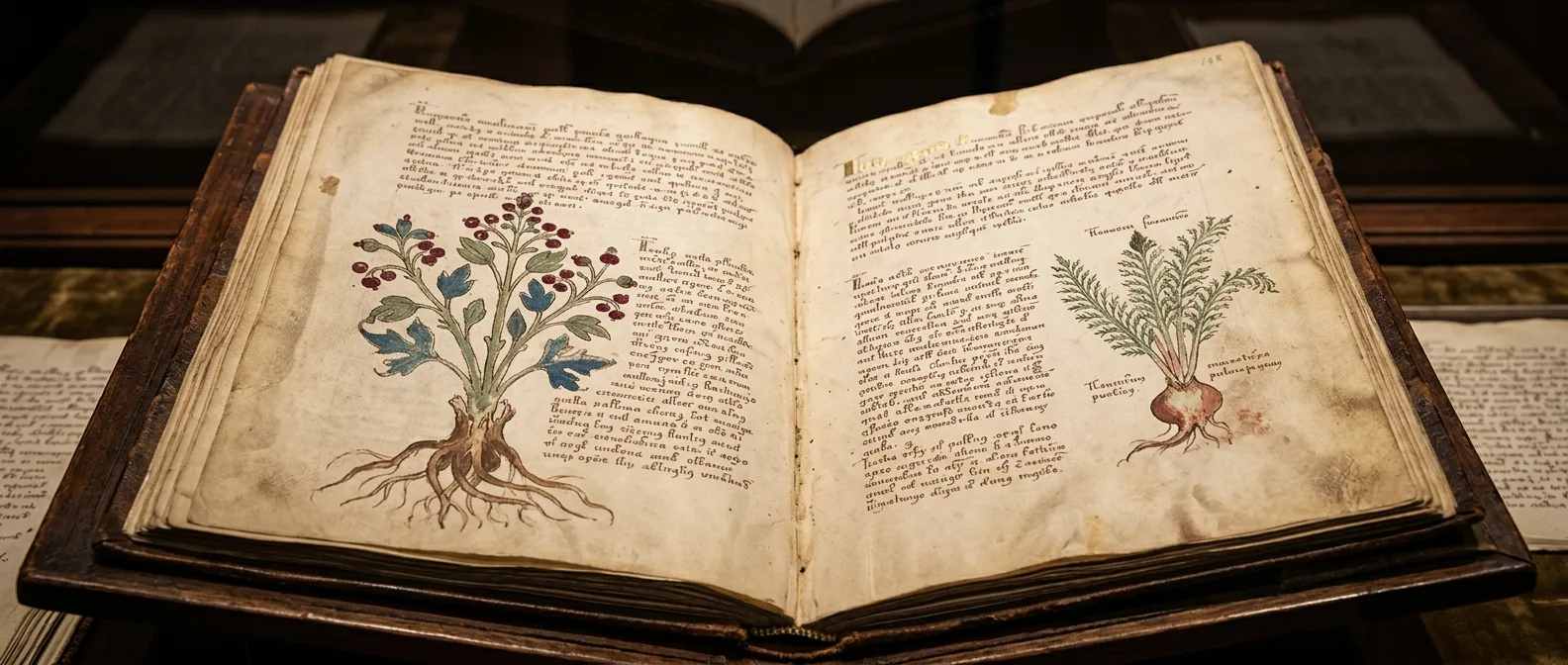
In the basement of Yale University's Beinecke Library, inside an armored case with controlled temperature and humidity, lies a 240-page book that no one has read in 600 years.
📖 Read more: Tutankhamun's Curse: Coincidence or Truth?
A book without a language
The Voynich manuscript — catalogued as MS 408 — consists of 240 pages of vellum, written with quill pen and colored with plant-based pigments. Radiocarbon dating performed at the University of Arizona in 2009 places its creation between 1404 and 1438 — before the invention of the printing press in Europe. Protein analysis in 2014 confirmed the parchment was calfskin.
The text runs from left to right in continuous lines, without corrections, without erasures, without hesitation. The ductus — the way the pen flows — suggests someone writing with confidence, not someone encoding. Whoever wrote it knew what they were writing, or at least appeared to. The alphabet contains roughly 20–25 distinct symbols. Some resemble Latin letters, others look Arabic, and some are unlike anything known in human history. A Yale paleographer, Lisa Fagin Davis, identified five different scribes — evidence that behind this book lies a community, not a solitary mind.
The images that induce vertigo
The manuscript is divided into six sections, each stranger than the last. The first — the herbal section — contains images of plants: over 100 detailed botanical illustrations. None of these plants match any known species. They resemble flora from a world that does not exist. The roots of one plant appear grafted onto the leaves of a second, with the flowers of a third — composite constructions, like botanical collage.
📖 Read more: Moai Statues: Who Built Them on Easter Island?
The second section, astronomical, contains circular diagrams: circles with stars and suns, zodiac symbols, rows of naked female figures arranged in concentric bands, each holding a star. The third, the balneological section, is the most unsettling: naked women bathing in green liquid flowing through elaborate networks of tubes. No one knows what they depict. Perhaps medical practices. Perhaps alchemical rituals. Perhaps something for which we do not even have a word.
The fourth section contains recipes — or at least what appears to be: short paragraphs with drawn vials and plant roots. The fifth consists purely of text with small stars in the margin, like a list of instructions. And there is a massive foldout page — the “rosettes folio” — spanning six pages, showing a kind of map with nine “islands” connected by causeways, castles, and what looks like a volcano.
The odyssey of the manuscript
The first confirmed owner was Georg Baresch, a 17th-century alchemist from Prague — not Danish, as earlier researchers believed. Baresch was frustrated with this “Sphinx” that had been “taking up space uselessly in his library” for years. He sent copies of pages to Athanasius Kircher, a German Jesuit polymath in Rome who claimed to have deciphered Egyptian hieroglyphics. Kircher accomplished nothing with it.
After Baresch's death, the manuscript passed to Jan Marek Marci, rector of Charles University in Prague, who sent it to Kircher with a letter dated 1665 or 1666. In the letter, he mentions that Emperor Rudolf II had once purchased the manuscript for 600 ducats — roughly 2.1 kilograms of gold. Rudolf apparently believed it was written by Roger Bacon, the 13th-century Franciscan polymath.
📖 Read more: Pompeii: The City Frozen in Time
The manuscript vanished for 200 years. It was likely stored in the library of the Collegio Romano. In 1912, Polish book dealer Wilfrid Voynich purchased 30 manuscripts from a monastery in Frascati, Italy — among them the one that would bear his name. He was convinced that decoding it would bring fame and fortune. He died in 1930 without succeeding. His widow, Ethel — daughter of mathematician George Boole — inherited it. It eventually passed through dealers' hands, and Hans Peter Kraus, unable to find a buyer, donated it to Yale in 1969.
The cryptographers who failed
During World War II, William Friedman — the man who broke the Japanese PURPLE code — devoted years to the Voynich alongside a team from the NSA. They transcribed every line onto IBM punch cards for machine analysis. They accomplished nothing. Friedman concluded it was an “artificial language” — a language invented from scratch, with no basis in any existing one. His wife, Elizebeth Friedman, herself a cryptographer, described every statistical approach as “doomed to utter frustration.”
In 1967, John Tiltman, a leading British cryptographer, published a study in the NSA Technical Journal. He declared the Voynich “the most mysterious manuscript in the world.” That statement still stands.
In the following decades, dozens of researchers tried. Some claimed to have identified Latin, Hebrew, early Ukrainian, Old Turkic, even Nahuatl — the language of the Aztecs. No decryption survived academic scrutiny. Every year, someone publishes a new “I've cracked the Voynich Code” — and every time, it proves premature. The most recent, Gerard Cheshire of Bristol, claimed in 2019 the language was “proto-Romance.” The university withdrew the claim within two days.
📖 Read more: 6 Months in a Cave with No Clock: The Siffre Experiment
Could it be a hoax?
The most provocative theory is the hoax hypothesis. What if the Voynich means nothing? What if it is simply an elaborate fake text, designed to deceive a wealthy collector — perhaps Emperor Rudolf himself?
Gordon Rugg, a professor at Keele University, demonstrated in 2003 that he could reproduce text that statistically resembles the Voynich using a 16th-century tool known as a “Cardan grille” — a perforated card placed over a table of syllables. The result: text that appears organized but means nothing. Austrian researcher Andreas Schinner argued in 2007 that the statistical properties matched quasi-stochastic models better than natural language.
But the counterargument is powerful. The Voynich text follows Zipf's law — a word frequency distribution found in every known language but not in random texts. It has internal coherence, recurring patterns, a consistent three-part word structure (prefix, root, suffix). Physicist Marcelo Montemurro found semantic networks — words clustering by topic, exactly as in a normal book. Yale linguist Claire Bowern concluded it is most likely an encoded natural language. If it is a hoax, it is the most ingenious hoax ever devised.
📖 Read more: Chernobyl: The Night of the Worst Nuclear Disaster
Artificial intelligence tries
In the twenty-first century, algorithms took over. Teams from MIT, Stanford, and the University of Alberta used neural networks, machine learning, and natural language processing. Greg Kondrak proposed Hebrew encoded as alphabetically ordered anagrams. Ahmet Ardıç argued for Old Turkic with phonetic orthography. Neither convinced the scientific community.
AI did reveal something important: the second-order conditional entropy (h2) of the text is around 2 — lower than natural languages (3-4), meaning character sequences are unusually predictable. If it conceals a message, its encryption is simple. If it is simple, why can it not be broken? In 2025, a new study proposed a historically plausible verbose cipher ("Naibbe") that could encode Latin as Voynich-like ciphertext — but the researcher himself stressed it remains a proof of concept, not a solution.
What does the Voynich mean?
Perhaps the most interesting question is not “what does it say?” but “why does it bother us so much that we cannot understand it?” We live in an age where everything seems accessible — every language, every code, every puzzle appears temporary. The Voynich is the exception. It is the one thing that for 600 years has refused to cooperate.
The manuscript is now available digitized on the Beinecke Library website — high-resolution scans, freely accessible. In September 2024, new multispectral scans of ten pages revealed details invisible under normal light: hidden symbols beneath the ink, color shifts in the parchment, traces of erased letters. Anyone can download the manuscript, study it, try to solve it. And thousands do — amateur cryptographers, retired mathematicians, students, programmers, even artists. Dedicated forums exist solely for Voynich analysis, subreddits with thousands of members, annual conferences. The Voynich has become an ecosystem — an entire subculture built around a book that no one can read.
EpilogueThe Voynich manuscript is the only book in the world that is simultaneously famous and unreadable. Historians, linguists, cryptographers, algorithms — all have failed. Not Friedman with his punch cards, nor the NSA with its supercomputers, nor the neural networks of the twenty-first century. Someone, somewhere, 600 years ago, sat down with ink and parchment and created something we still cannot explain. That alone is remarkable. The book waits in the basement of Yale, patient, indifferent, impenetrable. It awaits someone who will learn how to listen to it — or definitively prove that it has nothing to say.