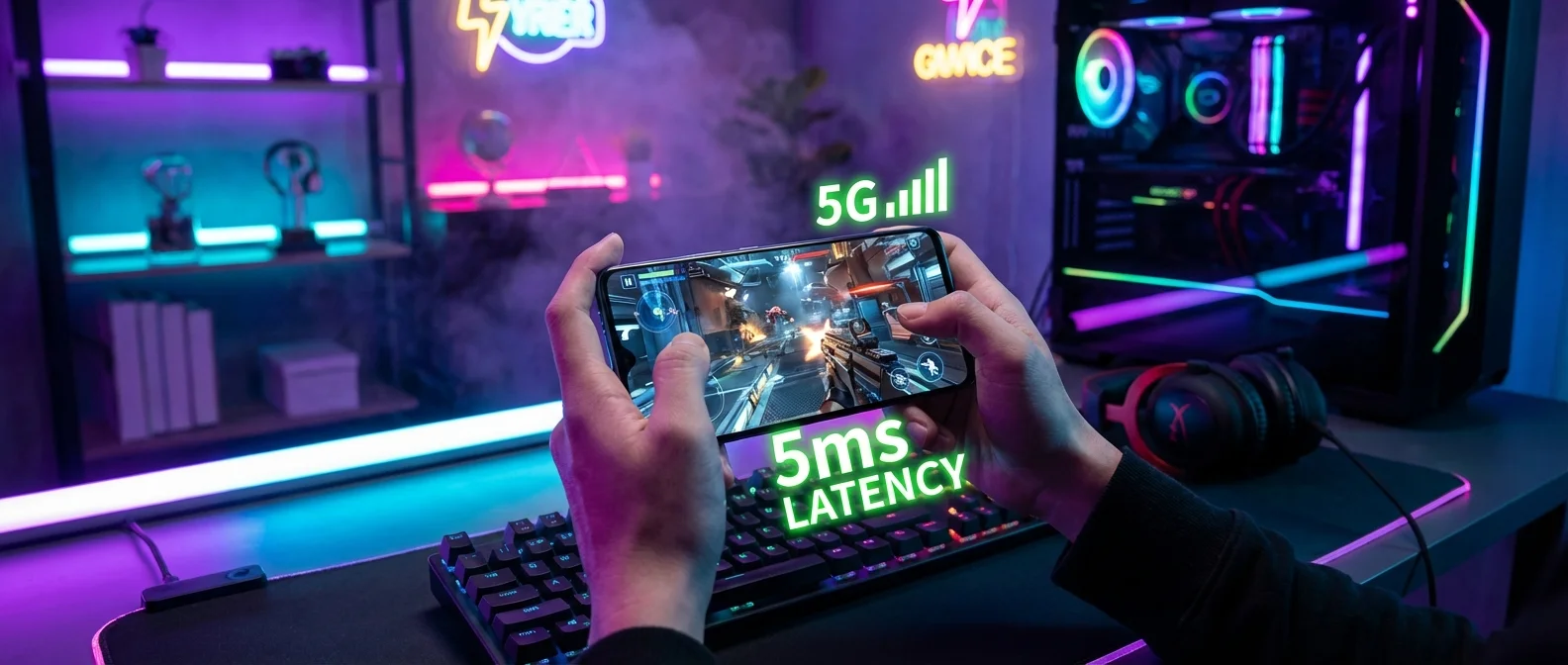
You're deep in a ranked match, your team is pushing for the final objective — and your ping spikes. Lag. Game over. If you play online, you know milliseconds matter. With 5G promising latency under 10ms, is it time to ditch WiFi for good? Or is the reality more nuanced? Let's break down the numbers.
5G vs WiFi — The Numbers That Matter
Before we dive into “which one is better” arguments, let's lay out the real data. Latency, speed, and stability are what make or break your gaming experience.
Comparison: 5G vs WiFi vs Ethernet
| Parameter | 5G (NSA) | 5G SA + Edge | WiFi 6/7 | Ethernet |
|---|---|---|---|---|
| Latency (typical) | 8-12ms air | 1-5ms air | 2-10ms | 0.5-2ms |
| Round-trip to server | 20-40ms | ~14ms | 10-25ms | 5-15ms |
| Download speed | 100-900 Mbps | 200-1500 Mbps | 500-2400 Mbps | 1000-2500 Mbps |
| Stability | Moderate | Good | Varies* | Excellent |
| Mobility | Full | Full | Indoor only | Fixed point |
| Jitter | 3-15ms | 1-5ms | 1-20ms* | <1ms |
*WiFi performance heavily depends on the number of connected devices and in-home interference.
The table doesn't tell the whole story. In practice, 4G delivered 30-50ms latency — fine for casual gaming, but a problem for competitive play. 5G NSA (what's currently deployed in Greece) brings that down to 8-12ms air latency. However, by the time you reach a game server, you're looking at 20-40ms round-trip — depending on server location.
The real revolution comes with 5G SA (Standalone) networks combined with edge servers. There, total round-trip can drop to around 14ms — a number that rivals a solid wired connection.
"Competitive gaming ideally requires under 20ms latency — under 50ms is acceptable. 5G SA with edge servers is finally entering that window."
Cloud Gaming Over 5G
Cloud gaming is where 5G can truly rewrite the rules. You don't need expensive hardware — a smartphone or tablet will do, as long as your connection holds up.
Xbox Cloud Gaming (xCloud)
Stream AAA titles from Microsoft's servers. Requires a steady 10-20 Mbps and latency under 40ms. Works on mobile, tablet, and browser. On 5G in a city, the experience is impressively playable.
NVIDIA GeForce NOW
Stream PC games at up to 4K 120fps (Ultimate tier). European servers mean better latency for Greece. On 5G, it runs smoothly at 1080p. Pricing starts at €5.49/month.
PlayStation Portal Remote Play
Stream from your PS5 via WiFi or 5G. Great for gaming away from home. Keep in mind it also depends on your home connection's upload speed for remote play.
Real-World Scenario
Testing GeForce NOW on 5G in central Athens: 350 Mbps download, ~25ms latency to an EU server. Playing Cyberpunk 2077 at 1080p/60fps — slight input lag, but entirely playable. On the metro? Connection drops to 4G, latency climbs to 45-60ms — still works, but you feel the difference.
The real edge 5G has for cloud gaming isn't just speed — it's the ability to play AAA titles anywhere. At a café, on the bus, in a waiting room. That's something WiFi simply can't do.
When 5G Wins
There are scenarios where 5G isn't just an alternative — it's the only sensible choice:
Gaming on the Go
Train, bus, airport lounge. With 5G and cloud gaming, you have access to AAA titles using nothing but your phone. No console, no gaming laptop required.
Outdoors
Park, café, vacation house with no internet. 5G gives you a gaming-ready connection wherever there's coverage — no hunting for WiFi passwords.
Congested WiFi
A household with 5+ devices, everyone streaming simultaneously? WiFi can spike with lag. A 5G hotspot gives you a dedicated connection free from other devices' interference.
Mobile Gaming
Genshin Impact, PUBG Mobile, Fortnite Mobile — mobile is the #1 gaming platform globally. On 5G, downloads take seconds and matchmaking runs lag-free.
When WiFi Wins
Let's be honest — for many scenarios, WiFi (and especially wired ethernet) remains the undisputed king:
Competitive / eSports
CS2, Valorant, League of Legends in ranked? You need <10ms latency and zero jitter. Ethernet, every time. Even WiFi 6 might not cut it — let alone 5G.
Large Downloads
A modern AAA game weighs 80-150 GB. Even at 500 Mbps on 5G, data caps will stop you. A fixed connection with WiFi means unlimited downloads without anxiety.
Home Setup
A home network with a WiFi 6/7 router, mesh system, and ethernet to your gaming PC/console. Stable, reliable, no data caps. For home gaming, WiFi + ethernet remains the optimal setup.
Cost
5G data plans in Greece remain expensive for heavy gaming use. Unlimited WiFi via fiber costs around €30/month. 5G plans with enough data for gaming cost significantly more.
"WiFi 7 brings 46 Gbps theoretical speeds, Multi-Link Operation (MLO), and 4096-QAM. For home gaming, next-gen WiFi leaves 5G no room to compete."
5G FWA — The Third Option
There's a scenario many overlook: 5G FWA (Fixed Wireless Access). Instead of using 5G on your phone, you install a 5G router at home as a replacement for fiber or DSL.
What Is 5G FWA?
- Fixed 5G router at home — like a DSL modem but without a phone line
- Speeds of 100-500+ Mbps — depending on coverage in your area
- Latency of 15-30ms typically — better than DSL, close to fiber
- Ideal for areas without fiber coverage — rural areas, suburbs, islands
- Unlimited data on select plans — suitable for gaming
For gamers in areas without fiber, 5G FWA is a game changer (literally). Instead of DSL at 30 Mbps with 20-40ms latency, you get a connection that can actually handle cloud gaming and online multiplayer. In Greece, Cosmote, Vodafone, and Nova already offer 5G FWA plans in an expanding number of areas.
The Situation in Greece
How does Greece fare in the 5G gaming landscape? The picture is steadily improving:
5G Gaming in Greece — Current State
- Coverage: Cosmote offers 5G in 68+ cities. Vodafone and Nova are expanding coverage steadily
- Speeds: 200-700 Mbps in cities — enough for cloud gaming at 1080p and often 4K
- Data plans: Unlimited 5G plans are still pricey (~€50-70/month). Most plans cap at 30-100 GB
- FWA: Available in many areas, with unlimited data plans from ~€35-50/month
- Gaming community: The eSports scene is growing — Greek Legends (LoL), CS2 tournaments — and demand for low-latency gaming is on the rise
The biggest challenge in Greece remains pricing. If you're a heavy gamer downloading 200+ GB per month, mobile 5G data caps are a real problem. Unless you opt for FWA or an unlimited plan — if one's available in your area.
On the latency front, Greek 5G networks still run in NSA (Non-Standalone) mode. That means the transition to 5G SA — which promises 1-5ms air latency — will deliver even better results over the next 1-2 years.
The Verdict
So, does 5G replace WiFi for gaming? The short answer: not yet, but it doesn't need to. Each technology shines in different scenarios.
When to Use What
| Scenario | Best Choice | Why |
|---|---|---|
| Competitive/Ranked gaming | Ethernet | Minimal latency, zero jitter |
| Casual gaming at home | WiFi 6/7 | Stable, unlimited, low cost |
| Gaming away from home | 5G | The only option with gaming-ready latency |
| Cloud gaming (mobile) | 5G | AAA titles anywhere without hardware |
| Area without fiber | 5G FWA | Fixed-connection alternative with solid latency |
| Downloading large games | Fiber + WiFi | Unlimited data, consistent speed |
| VR/AR gaming (future) | 5G mmWave | Multi-gigabit speeds, but still early days |
The real answer isn't “5G or WiFi” — it's “5G and WiFi.” Use ethernet/WiFi at home for competitive gaming and large downloads. Use 5G when you're out and about or want cloud gaming on the go. And if fiber isn't available in your area, take a serious look at 5G FWA.
5G didn't come to replace WiFi — it came to complement your gaming arsenal. And honestly? That's even better. GG. 🎮