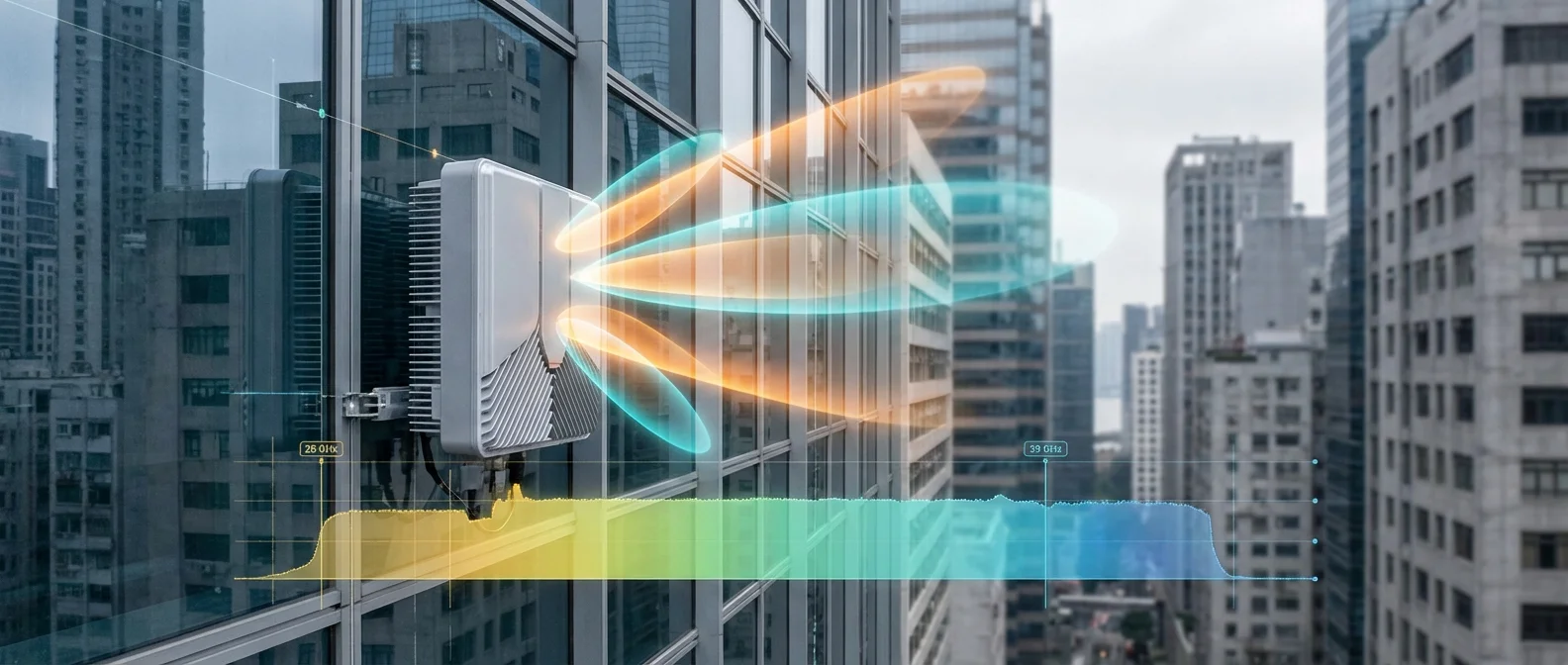
The 5G most people use today runs on frequencies below 6 GHz — fast enough, but nowhere near the technology's full potential. There's a second tier: mmWave (millimeter wave), operating at 24-71 GHz and promising multi-gigabit speeds. It's the technology making a real difference in stadiums, airports, and dense urban cores. Here's what it is, where it's already deployed, and what it means for Greece.
What Is mmWave?
The term mmWave (millimeter wave) refers to radio frequencies in the 24-71 GHz range. They're named after their wavelength, which falls between 1 and 10 millimeters. In 5G terminology, the 3GPP classifies these as FR2 (Frequency Range 2), as opposed to FR1 (410 MHz - 7.125 GHz) used by most 5G networks today.
FR1 vs FR2: The Two 5G Frequency Ranges
| Characteristic | FR1 (Sub-6 GHz) | FR2 (mmWave) |
|---|---|---|
| Frequency range | 410 MHz - 7.125 GHz | 24.25 - 71 GHz |
| Channel bandwidth | Up to 100 MHz | Up to 400 MHz |
| Typical speed | 300-900 Mbps | 2-5+ Gbps |
| Range | Several kilometers | 50-500 meters |
| Wall penetration | Good | Very limited |
| Deployment cost | Moderate | High |
The core principle is straightforward: higher frequencies carry more bandwidth but travel shorter distances. mmWave supports channels up to 400 MHz per carrier, enabling theoretical speeds above 10 Gbps and real-world speeds of 2-5+ Gbps. The record? 5.9 Gbps, achieved by Faroese Telecom using Ericsson equipment in 2023.
Advantages of mmWave
Why do carriers bother deploying mmWave when the range is so limited? The answer lies in several characteristics that no other wireless technology can match:
Multi-Gigabit Speeds
With 400 MHz channels, mmWave delivers real-world speeds of 2-5 Gbps. Download a 4K movie in seconds, stream 8K video without a single buffer.
Massive Capacity
In a stadium with 50,000 people, sub-6 GHz networks buckle. mmWave serves thousands of concurrent users at consistent quality — built for dense deployments.
Ultra-Low Latency
Sub-1 ms latency under ideal conditions. Critical for VR/AR streaming, cloud gaming, industrial automation, and autonomous vehicles.
Vast Spectrum Availability
The 24-71 GHz range offers gigahertz of available spectrum — far more than the congested lower bands that carriers have fought over for decades.
"mmWave doesn't replace traditional 5G bands — it supplements them where demand exceeds sub-6 GHz capacity."
Disadvantages & Limitations
Despite the impressive speeds, mmWave has significant drawbacks that explain why it will never become the primary access technology for every use case:
Key Limitations
- Very short range: mmWave signals travel only 50-500 meters depending on cell type (femtocell ~50m, picocell ~100m, microcell 200-500m)
- Poor penetration: Walls, windows, trees, and even rain can block or severely weaken the signal
- Line-of-sight requirement: Near-direct line-of-sight between antenna and device is usually needed
- Infrastructure cost: Hundreds of small cells are needed instead of a few large towers — each requiring installation, power, and backhaul
- Interference concerns: Potential issues with aviation radar altimeters (4.2-4.4 GHz) and weather satellites (23.8 GHz)
Small Cell Range for mmWave
| Cell Type | Range | Use Case |
|---|---|---|
| Femtocell | ~50 meters | Indoor spaces, homes |
| Picocell | ~100 meters | Shopping malls, offices |
| Microcell | 200-500 meters | Urban areas, stadiums |
In Europe, the risk of interference with aviation altimeters is lower than in the US, since European carriers use the 3.4-3.8 GHz band for mid-band 5G — well separated from critical aviation frequencies.
Where mmWave Is Used Today
mmWave isn't theoretical — it's already live in several countries, primarily in high-traffic hotspots:
Stadiums & Arenas
NFL stadiums in the US, the O2 Arena in London, venues across Japan. Thousands of fans simultaneously streaming, live betting, and using AR overlays during events.
Airports & Transit Hubs
Heathrow, Incheon, JFK — major airports are rolling out mmWave for high-speed connectivity at departure gates, lounges, and terminals.
Dense Urban Centers
Manhattan, Seoul, Tokyo — densely populated city cores where the value per square meter justifies the investment in small cells every 200 meters.
Fixed Wireless Access (FWA)
Verizon in the US uses mmWave FWA as a fiber alternative, offering gigabit home internet without running cables. European pilots are underway.
Beamforming & Massive MIMO
Two technologies make mmWave viable in practice: beamforming and Massive MIMO. Without them, signals at these frequencies would dissipate within meters.
Beamforming
Instead of broadcasting signal in every direction (like a traditional 4G cell), beamforming focuses radio energy directly toward individual users. Think of the difference between a floodlight illuminating an entire room and a laser pointer — that's the concept. The result: extended range, reduced interference, and far better energy efficiency.
Massive MIMO
Massive MIMO (Multiple Input, Multiple Output) means dozens or hundreds of antennas in a single unit. An mmWave base station can have 64, 128, or even 256 antenna elements. Each element forms independent beams, serving multiple users simultaneously without cross-interference. Spectral efficiency increases dramatically.
The combination of beamforming and Massive MIMO transforms mmWave's high frequencies from a theoretical impossibility into a practical solution. Without these technologies, an outdoor mmWave signal would be essentially useless.
"Massive MIMO and beamforming aren't optional extras — they're the reason mmWave works at all. Every mmWave antenna is effectively a miniature supercomputer of antenna elements."
mmWave in Greece
Greece is just getting started with mmWave. In the 5G spectrum auction, Vodafone Greece acquired 2 blocks in the 26 GHz band, gaining first access to mmWave spectrum in the country. This licensing follows EU directives that include the 26 GHz band in the 5G deployment roadmap.
Likely Deployment Scenarios in Greece
- OAKA & AEK Arena (Athens): High spectator density, ideal candidates for mmWave coverage
- Athens International Airport (El. Venizelos): Millions of passengers annually, need for gigabit speeds at gates and lounges
- Thessaloniki Airport (Macedonia): Growing traffic after recent upgrades
- Athens & Thessaloniki city centers: Syntagma, Tsimiski — high-traffic pedestrian zones
- Industrial zones: Smart factories requiring ultra-reliable, low-latency connectivity
Cosmote and Vodafone are the most likely carriers to deploy mmWave in Greece. However, commercial rollout is expected to be gradual — starting with pilots in stadiums and airports, then expanding to urban centers. Don't expect mmWave on the Greek islands — basic coverage remains the challenge there.
For a complete picture of 5G coverage in Greece, check our 5G Greece 2026 guide.
The Future: 5G-Advanced & Beyond
mmWave isn't standing still. Development continues on multiple fronts:
5G-Advanced (Release 18+)
Improved beamforming, better handover between mmWave and sub-6 GHz, and AI-driven network optimization. Commercial deployment expected between 2025-2027.
Wireless Power Transfer
Research projects are exploring mmWave for wirelessly powering small IoT devices — imagine sensors that never need a battery replacement.
Metaverse & XR
Real-time VR/AR streaming demands a steady 1+ Gbps. mmWave is the only 5G technology that can guarantee this in high-density areas.
6G & THz Bands
6G is expected to push into even higher frequencies — terahertz (100+ GHz) — targeting speeds of 100+ Gbps. The lessons learned from mmWave are paving the way.
The Bottom Line
mmWave won't replace “regular” 5G — it will supercharge it where it's needed most. Stadiums, airports, factories, dense urban cores. In Greece, with Vodafone already holding 26 GHz spectrum, the first deployments are a matter of when, not if. In the meantime, 5G Standalone and small cells are building the foundation on which mmWave will thrive.