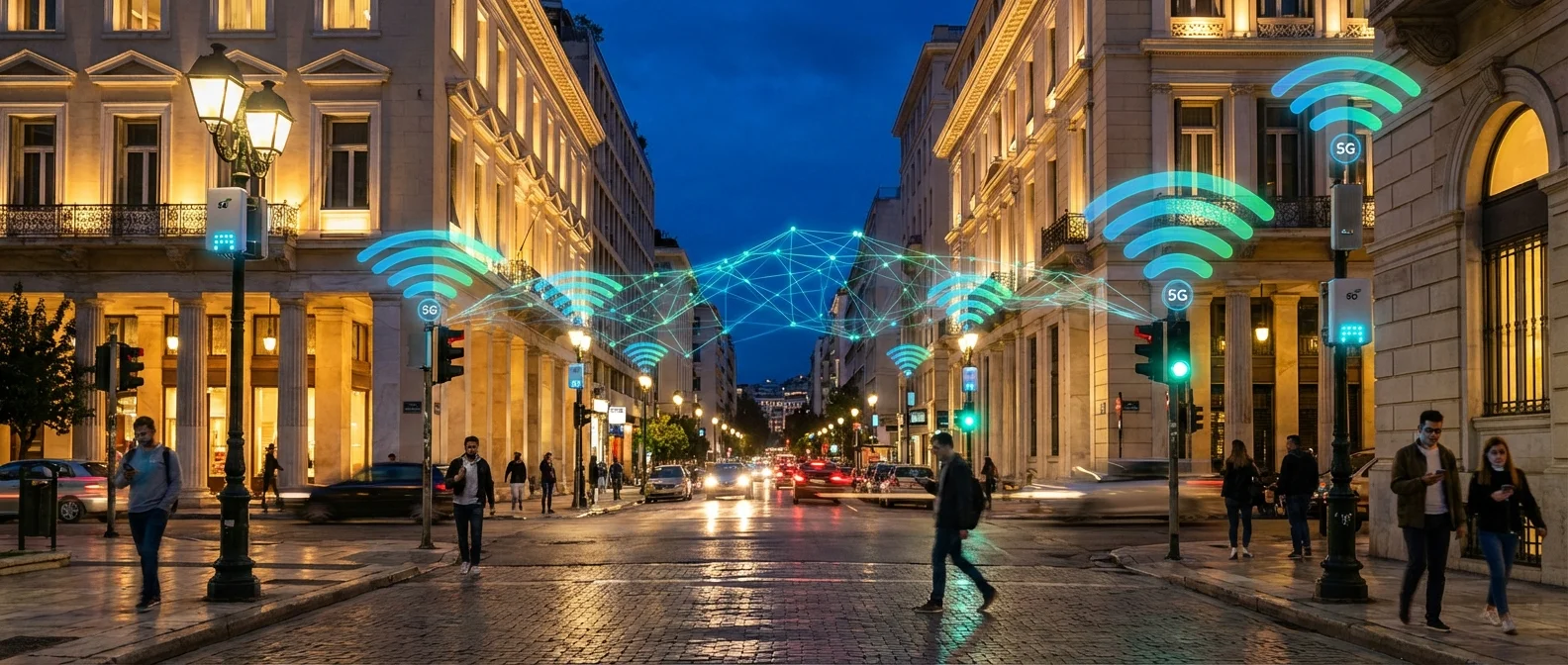
If you picture 5G as a massive antenna tower on a mountaintop, it's time to rethink. The real 5G revolution is happening inside small, nearly invisible boxes — mounted on lamp posts, bus shelters, and building facades. Small cells are the cornerstone of modern 5G networks, and without them, the promise of multi-gigabit speeds in cities would remain purely theoretical. Here's how they work, where they're installed, and how they're transforming urban connectivity.
What Are Small Cells?
Small cells are low-power radio nodes that extend network capacity in dense or indoor areas. Unlike traditional cell towers (macrocells) that cover kilometres, small cells operate over distances of a few dozen to a few hundred metres. This makes them ideal for maintaining mmWave signal coverage and relieving data congestion in crowded urban environments.
Think of them as local "boosters": where a large tower can't reach — narrow streets, indoor spaces, busy plazas — small cells step in to deliver high speeds and reliable connectivity.
Cell Types: From Your Home to the Tower
| Type | Use Case | Users | Power | Range |
|---|---|---|---|---|
| Femtocell | Homes / offices | 4-32 | 0.01-1W | Up to 50m |
| Picocell | Public venues | 64-128 | 0.1-5W | Up to 100m |
| Microcell | Urban areas | 128-256 | 5-10W | 200-500m |
| Macrocell | Wide-area coverage | 250+ | 10-20W | 300m-1km |
Why “Small”?
Small cells get their name from both their limited range and compact size — many are no larger than a home router. Installation doesn't require towers: a lamp post or building wall is all you need.
Why Do We Need Them?
Mobile data demand is growing exponentially. 4K video, cloud gaming, AR applications, IoT devices — all of these are pushing networks to their limits. Traditional cell towers (macrocells) can no longer handle the load in dense urban centres on their own.
"By 2028, mobile network data traffic is expected to triple compared to 2024. Without small cells, 5G networks simply can't sustain that load in cities."
There are three key reasons small cells are essential:
1. Capacity crisis: In city centres, thousands of users are packed into a few square metres — shopping streets, plazas, public transport. A single macrocell shares its bandwidth among everyone, causing speeds to plummet. Small cells break up this congestion into smaller, manageable zones.
2. mmWave support: mmWave frequencies (24-71 GHz) deliver impressive speeds but very limited range — 50 to 500 metres. Without dense small cell deployment, mmWave remains largely untapped.
3. Indoor coverage: 5G radio waves, especially at higher frequencies, struggle to penetrate buildings. Indoor small cells (e.g., femtocells, picocells) ensure coverage in shopping centres, offices, and airports.
Where Are They Installed?
Smart placement is key. Small cells are integrated into existing urban infrastructure so they function effectively without disrupting the environment. This “street furniture” integration is a core strategy for carriers worldwide.
Lamp Posts
The most popular mounting option. Street lights offer height, power supply, and dense spacing — ideal conditions for small cells.
Building Facades
Compact units are mounted on building walls along commercial streets, covering pedestrian zones and public squares.
Bus Shelters
Prime locations: high foot traffic, already electrified, and strategically positioned along major urban routes.
Utility & Telecom Poles
Existing infrastructure poles are leveraged for power access and backhaul connectivity.
Invisible Infrastructure
Modern manufacturers design small cells that resemble security cameras, LED lights, or even flower pots. The goal: full coverage with zero visual pollution.
Technologies Behind Small Cells
Small cells aren't just smaller antennas. They leverage advanced technologies that maximize their performance:
Beamforming: Instead of broadcasting signal in all directions (like a light bulb), small cells direct radio energy like a “flashlight” toward specific users. This dramatically boosts signal strength while reducing interference.
Massive MIMO: Large antenna arrays (e.g., 64 or 128 elements) are packed into a single unit. Each element can serve a different user simultaneously, multiplying capacity.
Backhaul & Fronthaul: Every small cell needs a connection back to the core network. This is achieved via fibre optics (ideal), microwave links, or even the 5G network itself (IAB — Integrated Access and Backhaul).
Backhaul Technologies
| Method | Speed | Cost | Best For |
|---|---|---|---|
| Fibre optic | 10+ Gbps | High | Permanent installations |
| Microwave link | 1-10 Gbps | Moderate | Urban sites |
| 5G IAB | 1-5 Gbps | Low | Rapid deployment |
Smart City Applications
Small cells don't just serve smartphones. They form the backbone of smart cities, supporting an entire IoT ecosystem that's transforming urban life.
Traffic Management
Real-time data from sensors and cameras enables dynamic traffic light adjustment, reducing congestion by 20-30%.
Environmental Monitoring
Air quality, noise level, and temperature sensors on every small cell. Real-time data for municipalities and citizens alike.
Public Safety
HD video surveillance, AI-powered incident detection, and instant alerts to emergency services — all via ultra-low latency 5G.
Smart Parking
Sensors in parking spots notify drivers in real time, cutting search time and emissions significantly.
"A small cell network in a city isn't just telecom infrastructure — it's the foundation on which the smart city of tomorrow is built."
Small Cells in Greece
Greece is in the early stages of small cell deployment, but the outlook is promising. Athens and Thessaloniki, with their densely populated centres, are the prime candidates for large-scale installation.
Cosmote has begun pilot small cell installations in central Athens, particularly in high-traffic commercial zones. Vodafone is following a similar strategy, focusing on metro stations and shopping centres.
EU Regulatory Framework
The EU is actively encouraging small cell deployment through the European Electronic Communications Code. Key initiatives include:
- Streamlined permitting for low-power small cells
- Open access to public infrastructure (street lights, bus stops)
- Incentives for shared infrastructure between carriers
- Target: 5G coverage across all urban areas by 2030
On the ground in Greece, the biggest obstacles remain bureaucratic permitting delays, access to electrical power at installation sites, and coordination between municipalities and carriers. EETT (Greece's National Telecommunications Commission) is working on a simplified framework to accelerate the process.
Challenges & the Road Ahead
Mass small cell deployment faces real-world challenges that must be addressed:
Permitting & zoning: Every small cell installation requires a permit — and in many countries, the process is painfully slow. Municipalities need to create fast-track procedures.
Aesthetics: Residents often oppose new installations in their neighbourhood. The solution lies in stealth design: small cells that look like ordinary pieces of street furniture.
Power supply: Every small cell needs electricity. Many locations lack easy access to the power grid, requiring new infrastructure or solar panels.
Backhaul connectivity: Fibre doesn't reach everywhere. Solutions like 5G IAB (Integrated Access and Backhaul) and microwave links are bridging that gap.
What's Coming Next
- AI-driven small cells: Automatic power and beam adjustment based on real-time demand
- Open RAN: Open architectures that lower equipment costs
- Energy harvesting: Small cells that draw power from solar panels or vibrations
- Ultra-dense deployment: In mature networks, one small cell every 50-100 metres in urban centres
Small cells aren't future technology — they're already being installed in cities around the world. Greece needs to pick up the pace by cutting red tape and creating incentives for carriers. The result? Faster, more reliable 5G on every city block — the foundation for the smart cities of tomorrow.